When you apply for a mortgage, car loan, personal loan, or credit card, lenders run one calculation before almost anything else: your Debt-to-Income (DTI) ratio. This single percentage determines whether you get approved, how much you can borrow, and what interest rate you will pay. Yet most borrowers have never calculated their own DTI before sitting down with a lender.
What Is DTI and How Is It Calculated?
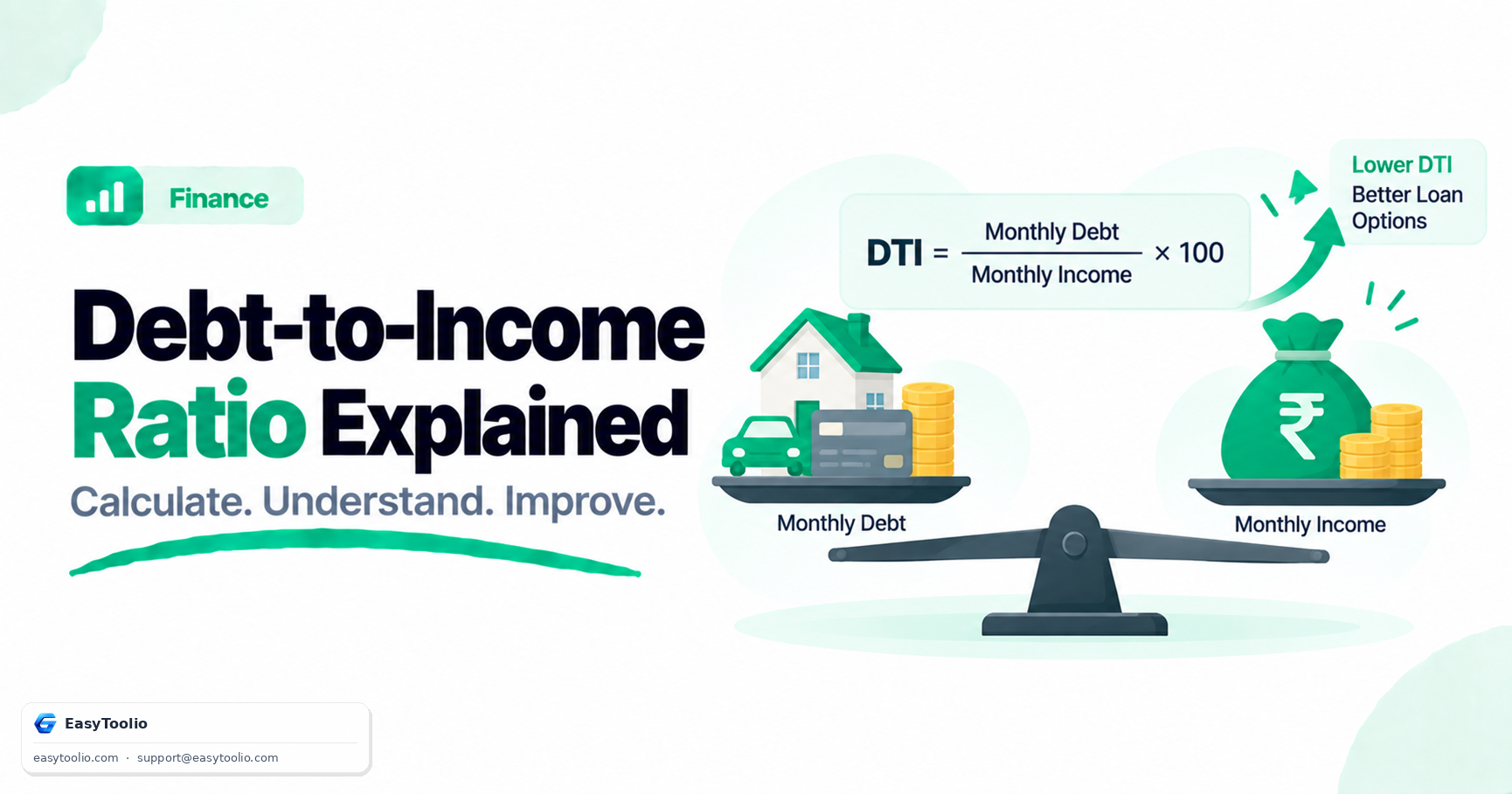
Your DTI ratio measures how much of your gross monthly income (before tax) is consumed by recurring debt payments.
DTI Formula: DTI (%) = (Total Monthly Debt Payments ÷ Gross Monthly Income) × 100
Monthly debt payments that count:
- Minimum credit card payments
- Student loan payments
- Car loan payments
- Personal loan payments
- Mortgage or rent payments (the proposed housing payment for a new application)
- Any other instalment loan payments
What does NOT count: Utilities, phone bills, groceries, subscriptions, insurance premiums, or any expense that is not a loan or credit payment.
Worked Example
A person earns $6,500 gross per month. Their monthly debts:
- Car loan: $380
- Student loan: $210
- Credit card minimums: $85
- Proposed mortgage: $1,450
Total monthly debt = $380 + $210 + $85 + $1,450 = $2,125
DTI = ($2,125 ÷ $6,500) × 100 = 32.7%
What Is a Good DTI Ratio?
Lenders and loan types have different thresholds, but here is the general guide:
| DTI Range | Lender Interpretation | Your Position |
|---|---|---|
| Below 28% | Excellent | Strong approval odds, best rates |
| 28% – 35% | Good | Approved in most cases |
| 36% – 43% | Acceptable | Marginal — lenders scrutinise other factors |
| 44% – 50% | High Risk | Limited options, higher rates |
| Above 50% | Danger Zone | Most lenders will decline |
The 28/36 Rule
For mortgage lending, many lenders use the classic 28/36 rule:
- Front-end ratio: No more than 28% of gross income goes to housing (PITI: Principal, Interest, Tax, Insurance)
- Back-end ratio: No more than 36% of gross income goes to all debt combined
This rule originated with conventional US mortgage guidelines. Today, FHA loans allow back-end DTI up to 43%, and in some cases up to 57% with compensating factors (like a large down payment or significant savings).
Two Types of DTI
Front-End DTI (Housing Ratio)
Only housing costs ÷ gross income. Lenders want this below 28% for conventional mortgages.
Back-End DTI (Total Debt Ratio)
All recurring debts ÷ gross income. This is the number most lenders focus on. Keep it below 36–43% depending on the loan type.
Example using the same person ($6,500 income):
- Front-end DTI: $1,450 (mortgage only) ÷ $6,500 = 22.3% ✓ (under 28%)
- Back-end DTI: $2,125 (all debt) ÷ $6,500 = 32.7% ✓ (under 36%)
Both pass. This person is in a strong position for mortgage approval.
DTI vs Credit Score: Which Matters More?
Both matter, but they measure different things:
- Credit score measures how reliably you repay debt historically
- DTI measures your current capacity to take on new debt payments
You can have an excellent 780 credit score and still be declined because your DTI is 52%. Similarly, a person with a 650 credit score but DTI of 22% may be approved, depending on the lender.
6 Proven Strategies to Lower Your DTI
1. Pay Down Revolving Debt First
Credit card balances have minimum payments that count against your DTI even if the balance is relatively small. A $3,000 card balance with a $75 minimum payment is worth eliminating because it permanently removes $75 from your monthly debt column.
2. Avoid Opening New Credit Accounts
Every new loan or credit card creates a new monthly minimum payment and immediately raises your DTI.
3. Increase Your Income
DTI is a ratio — the denominator matters as much as the numerator. A part-time income, freelance work, or salary negotiation that raises gross income by $500/month reduces DTI even if your debts stay the same.
Example: If gross income rises from $6,500 to $7,200: DTI = $2,125 ÷ $7,200 = 29.5% (down from 32.7%)
4. Pay Off Small Loans Entirely
If you have a car loan with only 6 months remaining, paying it off before a mortgage application eliminates that payment entirely — a much bigger DTI improvement than reducing a large balance.
5. Do Not Apply for New Loans Before a Major Application
Auto dealers, furniture stores, and "buy now pay later" services create new debt obligations. Any credit inquiry and new monthly commitment in the 3–6 months before a mortgage application harms your DTI profile.
6. Consolidate High-Minimum Debt
Consolidating multiple high-minimum credit cards into a single personal loan with a fixed payment can reduce your total monthly minimums — lowering DTI — while also reducing the interest rate.
What Lenders Really Look At
DTI is not reviewed in isolation. Lenders also consider:
- Loan-to-Value (LTV): A larger down payment compensates for a higher DTI
- Cash reserves: 3–6 months of mortgage payments in savings signals financial stability
- Credit score: Higher scores partially offset marginal DTI
- Employment history: 2+ years in the same field is a positive signal
Calculate Your DTI Before You Apply
Use our Loan Calculator to estimate the monthly payment on any loan you are considering, then factor it into your DTI calculation. For mortgage planning specifically, the Mortgage Calculator shows full PITI payment breakdowns so you can calculate both your front-end and back-end DTI accurately before meeting with a lender.
Frequently Asked Questions
Q: What is the formula for calculating my DTI ratio? A: DTI (%) = (Total Monthly Debt Payments ÷ Gross Monthly Income) × 100. Only recurring debt payments count — mortgage or rent, car loans, student loans, personal loans, and minimum credit card payments — not utilities or groceries.
Q: What DTI ratio do mortgage lenders consider good? A: Most conventional lenders use the 28/36 rule: no more than 28% of gross income toward housing costs and no more than 36% toward total debt. A DTI below 28% is considered excellent, while anything above 50% puts you in the danger zone for most lenders.
Q: What is the fastest way to lower a high DTI ratio? A: Pay down revolving debt like credit cards first, since even a small balance's minimum payment counts against your ratio, and avoid opening new credit accounts before a major loan application. Paying off a small loan entirely or consolidating high-minimum debts can also produce a quick improvement.