
How the Battery Status API Works
The W3C Battery Status API allows web applications to inspect navigator.getBattery(), receiving live updates on charging status, discharge rate, and remaining runtime.
Check your laptop, tablet or Android battery status online. Monitor battery level, charging state, discharge rate and estimated runtime where supported by your browser.
Live battery level, charging state, and browser runtime estimates.
Track battery percentage changes over time to compute observed rate deltas.
Monitor level changes while on battery or charger.
| Time | Battery % | State | Observed Rate |
|---|---|---|---|
| No monitoring history recorded yet. Click "Start Monitor" to record samples. | |||
Your browser does not expose physical battery design capacity, full charge capacity, or charge cycle counts. As a result, actual physical battery health (e.g., "85% capacity") cannot be calculated inside any web browser. Be cautious of websites claiming to calculate exact physical battery health from browser levels alone.
To get true battery capacity, chemical wear, and cycle count reports, run native operating system commands as detailed below.
Run in Command Prompt (Admin):
powercfg /batteryreport
Open the generated HTML report to check Design Capacity vs Full Charge Capacity.
System Settings → Battery → Battery Health info, or hold Option and click Apple Menu → System Information → Power for cycle counts.
Settings → Battery → Battery Usage / Diagnostics, or dial *#*#4636#*#* on supported devices.
A Battery Health Test is an online diagnostic tool designed to monitor battery level, charging status, discharge rates, and estimated runtime for laptops, tablets, and mobile devices directly in your web browser. By leveraging the W3C Battery Status API, it provides real-time telemetry without software installations.
Checking laptop battery health involves evaluating both short-term runtime performance and long-term chemical battery capacity. Use our online Battery Health Test to monitor live percentage drain rates (% per hour) while on battery power, and combine it with your operating system's native battery report (powercfg /batteryreport on Windows) to verify physical full-charge capacity against design capacity.
When you connect your AC charger, the status dashboard updates to indicate charging state and measures observed charging rates (% / hour). Observing charging rate helps verify whether your power adapter and charging cable are delivering adequate power to charge the battery efficiently.
Battery drain monitoring measures how rapidly your battery depletes under active usage. By tracking percentage drop across timed samples, you can identify resource-intensive web apps or background processes that cause unexpected battery drain.
Browser-estimated runtime queries battery.dischargingTime. This metric dynamically adjusts based on system power draw. Combining browser estimates with your trial-observed drain rate provides an accurate projection of how long your laptop will last before requiring a recharge.
Web browsers operate within isolated sandbox environments. W3C privacy specifications restrict web pages from accessing low-level hardware controllers to read physical battery design capacity (milliamp-hours), cell voltage, or internal temperature. EasyToolio provides transparent telemetry instead of generating misleading fake health percentages.
On Windows 10 and Windows 11, open Command Prompt or PowerShell as administrator and type powercfg /batteryreport. Windows generates an HTML report showing detailed design capacity, full charge capacity history, and battery life estimates.
On MacBook laptops running macOS, navigate to Apple Menu → System Settings → Battery to check condition status (Normal or Service Recommended). For exact cycle counts, hold Option, click Apple Menu, select System Information, and click Power.
On Android smartphones and tablets, open Settings → Battery → Battery Usage. Select Android devices (such as Samsung Galaxy or Google Pixel) include dedicated battery diagnostics under Settings → Device Care.
The Battery Status API is supported in Chromium-based desktop and Android browsers (Chrome, Edge, Opera). However, Apple Safari and Mozilla Firefox have disabled the Battery API due to anti-fingerprinting privacy concerns. If your browser does not support the API, refer to our native OS battery report commands.
The W3C Battery Status API allows web applications to inspect navigator.getBattery(), receiving live updates on charging status, discharge rate, and remaining runtime.
Rechargeable batteries lose charge capacity over charge cycles. Full 0% to 100% discharges create higher chemical stress than shallower partial cycles.
High temperatures accelerate internal resistance growth and electrolyte degradation. Keeping laptops cool preserves battery health for longer.
Due to privacy concerns regarding tracking battery discharge levels across sites, modern browsers restrict sub-second precision on battery metrics.
Quick answers about how this tool works.
Google Chrome, Microsoft Edge, Opera, and Android Chromium browsers support the Battery Status API over HTTPS. Firefox and Safari disabled it for privacy reasons.
Apple Safari disables the Battery Status API to prevent cross-site user tracking and fingerprinting across web sessions.
No. Browsers can only access real-time charge state, charging time, and discharge time. Physical milliamp-hour (mAh) capacity requires OS system diagnostics.
Open Command Prompt or PowerShell as administrator and run powercfg /batteryreport. This creates an HTML file with full battery cycle history and design capacity.
Go to System Settings → Battery → Battery Health (click the "i" icon) to view maximum capacity percentage and condition status (Normal or Service Recommended).
Go to Settings → Battery → Battery Usage, or dial *#*#4636#*#* on supported phones. Third-party apps like AccuBattery also track wear over time.
Lithium-ion batteries degrade due to high operating temperatures, high voltage retention at 100% charge, rapid fast-charging cycles, and natural chemical aging.
Enable battery saver modes, keep battery levels between 20% and 80%, avoid direct heat exposure, and use OEM power adapters.
No. Battery diagnostics run 100% locally in your browser memory and are never saved to any server.
Plain-language explainers that sit next to this tool.
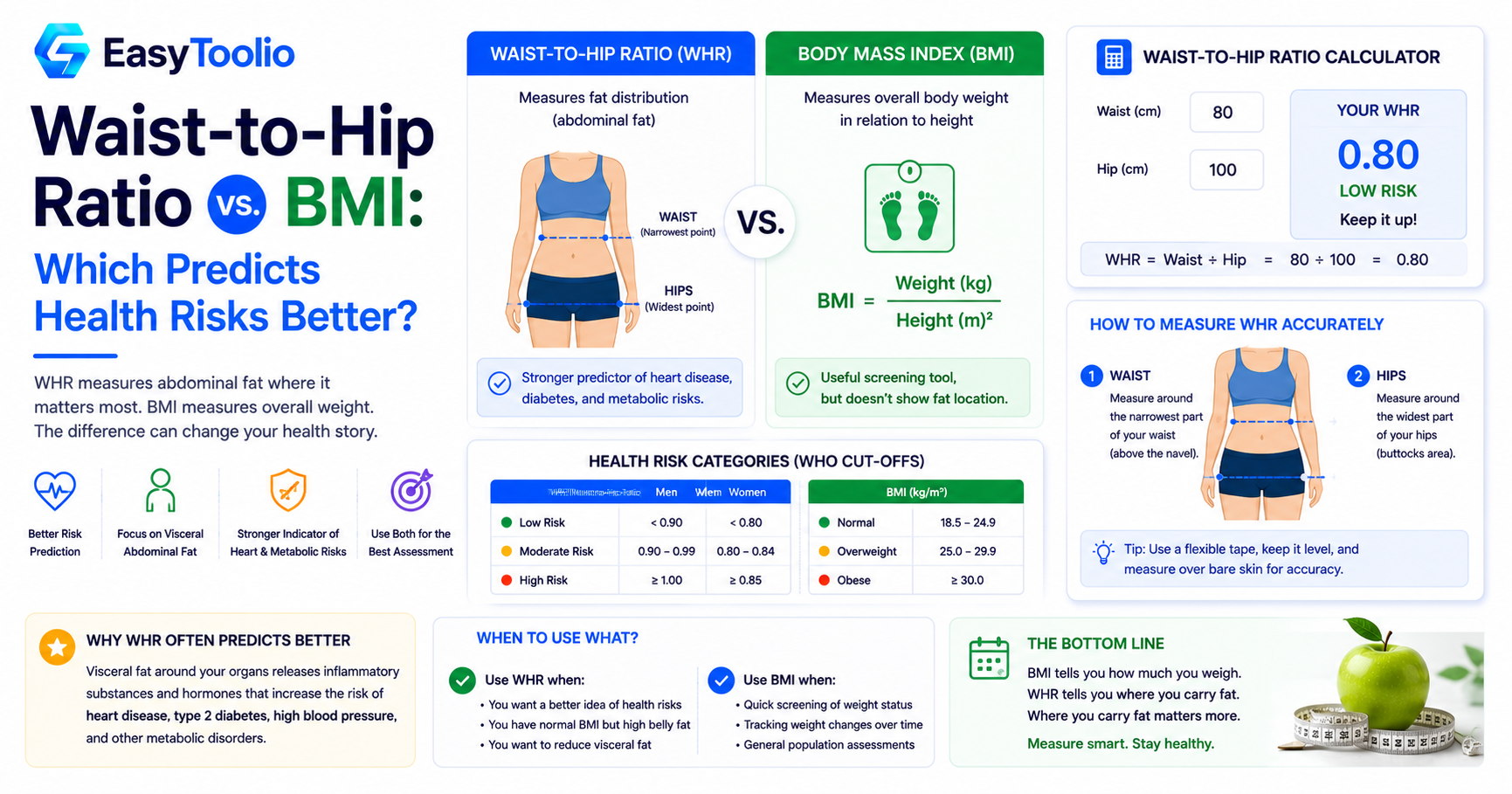
Two people can share the exact same BMI and have very different heart disease risk. Waist-to-hip ratio explains why — and when you should trust it over BMI.
This is a draft post that should not appear on the public pages but must be visible in the admin section.
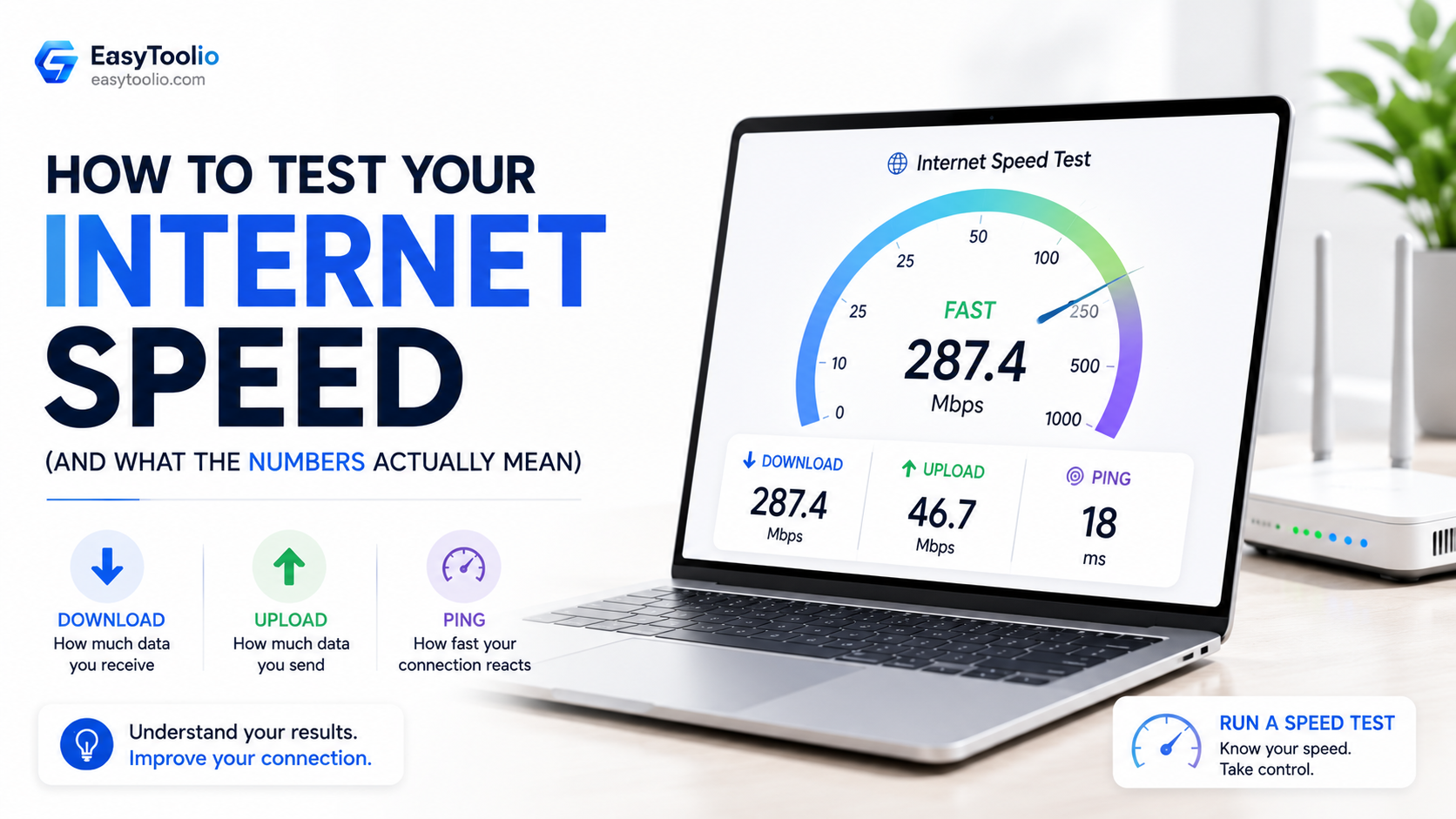
A speed test reports three numbers — download, upload, and ping — but most people only look at one. Here is how to read a speed test result and what to do if the numbers are disappointing.
Body fat percentage is a more accurate measure of health than BMI. But how is it calculated, what is a healthy range for men and women, and which measurement method is most accessible? This guide covers everything.
Search 205+ free tools by name, or pick a category below. Every one runs instantly in your browser — no signup, nothing to install.
Tap a star to rate us instantly.