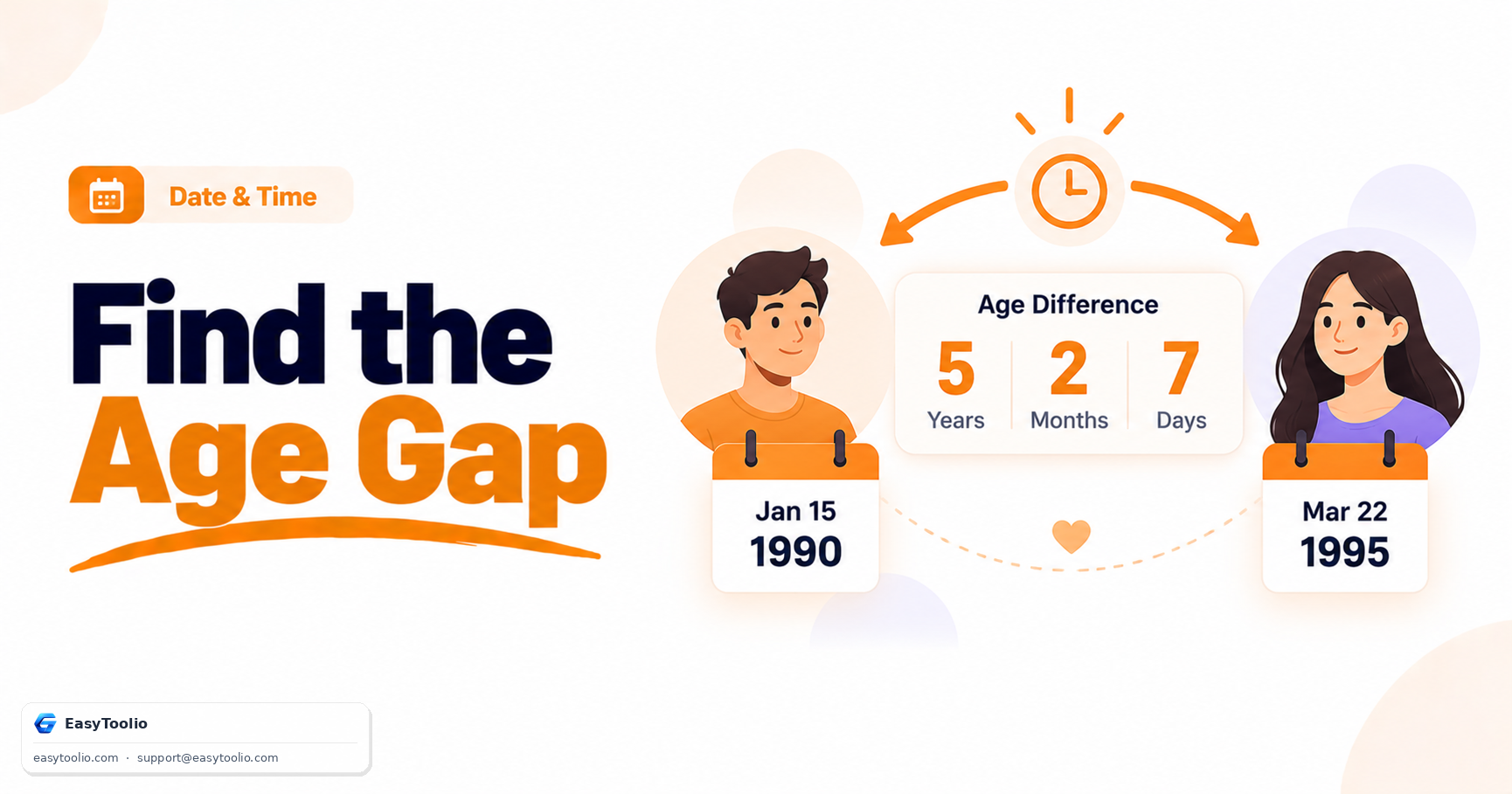
Trying to figure out exactly how much older or younger one person is compared to another sounds simple until you actually try to do it by hand. Subtracting birth years alone gives you a rough number, but it ignores months and days, which can throw the answer off by up to a full year depending on where the birthdays fall in the calendar.
Why Simple Subtraction Doesn't Work
If someone was born on March 10, 1990 and another person was born on November 22, 1995, a naive subtraction of 1995 − 1990 gives you 5 years. But that's not actually correct — since November comes after March, the second person hasn't yet had their "birthday equivalent" relative to the first person's birth date in that comparison window, so the real age gap is 5 years, 8 months, and 12 days, not a flat 5 years. Getting this right requires comparing year, month, and day components together, borrowing from the next unit when needed — the same logic used in general date subtraction.
The Correct Calculation Method
To calculate the precise age difference between two birth dates:
- Subtract the day components. If the second date's day is smaller, borrow days from the previous month.
- Subtract the month components. If the second date's month is smaller, borrow 12 months (1 year).
- Subtract the year components after any borrowing.
- The result is the exact difference expressed as years, months, and days.
This "borrowing" logic is exactly why manual subtraction on paper is error-prone — you're effectively doing calendar arithmetic across variable month lengths (28, 29, 30, or 31 days), which a plain subtraction can't account for. An Age Difference Calculator handles this borrowing logic automatically and returns a precise breakdown in seconds.
Worked Example
Let's find the exact age gap between two siblings: one born April 5, 2012, and the other born January 18, 2015.
- Days: 18 − 5 = 13 (no borrowing needed)
- Months: January (1) − April (4) = −3, so borrow 12 months → 1 + 12 − 4 = 9 months, and reduce the year subtraction by 1
- Years: 2015 − 2012 = 3, minus 1 borrowed = 2 years
Final result: 2 years, 9 months, and 13 days apart. Notice how different this is from the naive "2015 − 2012 = 3 years" guess — the actual gap is nearly a full year less once months and days are properly accounted for.
Practical Use Cases
- Comparing sibling age gaps for family planning or parenting research
- Verifying age eligibility requirements that depend on exact date differences
- Genealogy research to compare ages between relatives across generations
- Relationship or compatibility discussions based on precise age gaps
- HR or legal contexts requiring an exact age difference on record
Frequently Asked Questions
Q: Why is my manual age difference calculation off by a year? A: This usually happens because you subtracted only the years without checking whether the second person's birth month and day come before or after the first person's. If they come earlier in the calendar year, you need to borrow a year, which reduces the result by one.
Q: Does the age difference stay the same every year? A: Yes. The gap between two birth dates in years, months, and days is fixed for life — only your current age changes each year, not the difference between two people's ages.
Q: Can this method handle leap years correctly? A: Yes, proper date-difference calculations account for the actual number of days in each month, including February 29 in leap years, which is another reason an automated calculator is more reliable than manual subtraction.