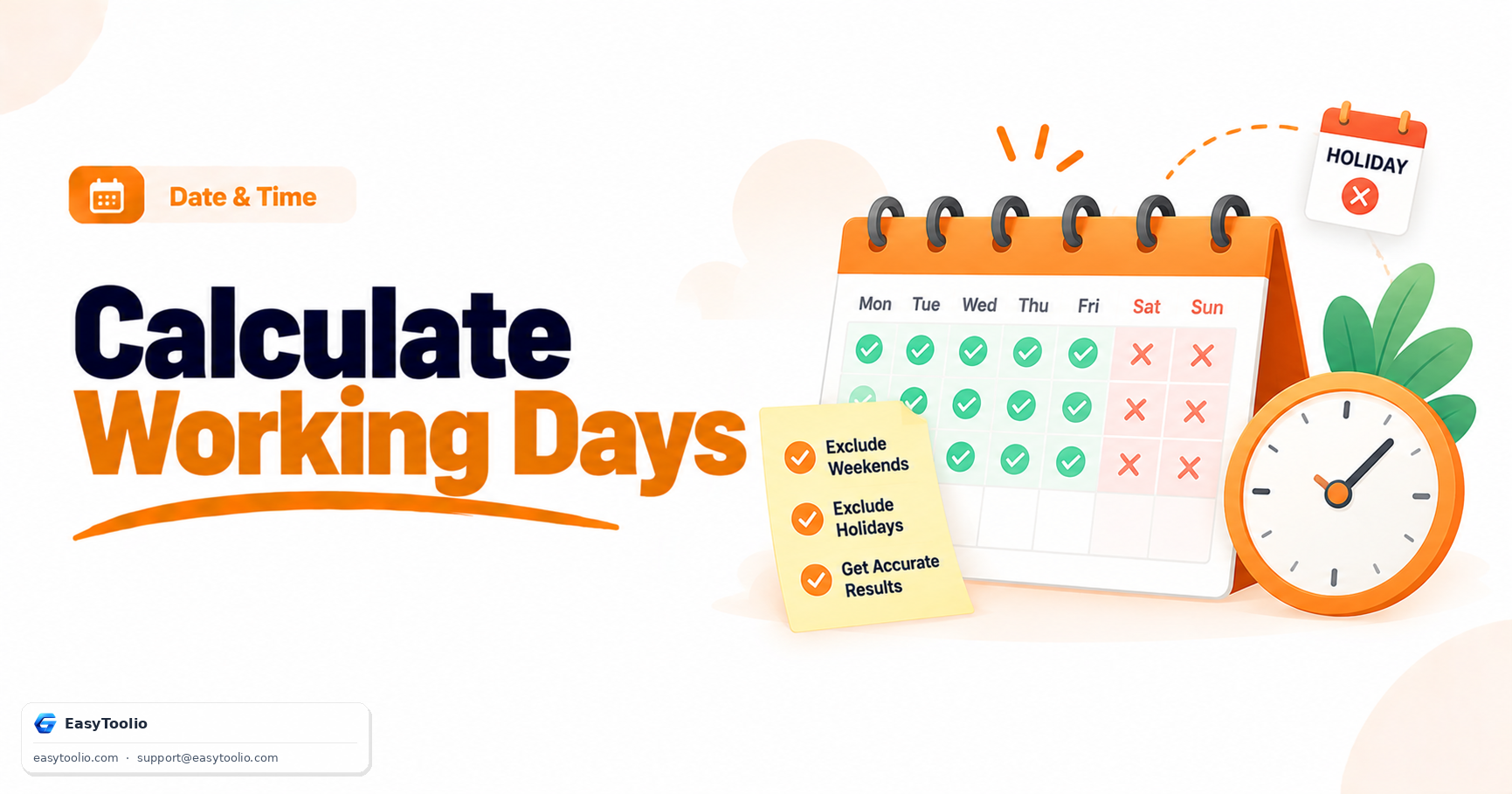
Whether you're estimating a project deadline, calculating employee leave, or figuring out a delivery window, the total number of calendar days between two dates rarely tells the full story. What actually matters for business purposes is the number of working days — the days people are actually available to work, after weekends and public holidays are removed from the count.
Calendar Days vs. Working Days
A calendar day count simply subtracts one date from another. If a project runs from June 1 to June 30, that's 29 calendar days. But if you need people to actually be at their desks working, you need to strip out Saturdays, Sundays, and any recognized holidays that fall within that range. The general formula looks like this:
Working Days = Total Calendar Days − Weekend Days − Holiday Days (that fall on weekdays)
It's important to only subtract holidays that land on what would otherwise be a working weekday — a holiday that falls on a Saturday shouldn't be double-counted since it was already excluded as a weekend.
Step-by-Step Manual Calculation
- Count the total number of calendar days between the start and end dates (inclusive or exclusive, depending on your convention).
- Divide the total by 7 to find the number of complete weeks, then multiply by 2 to estimate weekend days (Saturday + Sunday per week).
- Add any leftover partial-week weekend days based on which days of the week the start and end dates fall on.
- Subtract the number of recognized public holidays that fall on a weekday within the range.
- The remaining number is your working day count.
This manual process is doable for short ranges but becomes error-prone over multi-month spans or when holidays vary by country and region — which is exactly why a dedicated Working Days Calculator is worth using for anything beyond a quick estimate. It automatically accounts for weekends and lets you factor in specific holiday dates so you get an accurate figure instantly.
Worked Example
Let's calculate the working days from Monday, June 1, 2026 to Friday, June 26, 2026.
- Total calendar days: 26 days (June 1 through June 26, inclusive)
- Full weeks: 3 weeks and 5 extra days (June 1–21 is 3 full weeks, June 22–26 is the remainder)
- Weekend days in 3 full weeks: 3 × 2 = 6 days
- Extra days (June 22 Mon – June 26 Fri): all weekdays, so 0 additional weekend days
- Subtotal working days: 26 − 6 = 20 working days
- If there's one public holiday in that range (say June 15, a Monday), subtract 1 more: 19 working days
So a range that looks like "26 days" on a calendar is actually only 19 usable working days once weekends and a holiday are excluded — a meaningful difference for deadline planning.
Practical Use Cases
- Estimating realistic project timelines and sprint durations
- Calculating employee notice periods, probation periods, or paid leave accrual
- Determining shipping and delivery estimates that exclude non-working days
- Calculating contractor or freelancer billable day counts
- HR and payroll calculations involving business-day deadlines
Frequently Asked Questions
Q: Do working days include Saturdays in some countries? A: It depends on the region and industry. Many countries treat Saturday and Sunday as the weekend, but some businesses in certain countries operate a Sunday-to-Thursday or Friday-to-Saturday week. Always confirm the local work week before calculating.
Q: Should the start date and end date both be counted? A: This depends on convention — some calculations are inclusive of both dates, others exclude the start date. Being explicit about which convention you're using avoids off-by-one errors.
Q: Why use a calculator instead of counting manually? A: Manually excluding weekends and holidays across long date ranges is tedious and error-prone, especially when holidays shift year to year. A working days calculator automates the exclusion logic and gives you an instant, accurate result.