You check a countdown to your birthday at 11:50 PM and it says "2 days left." You check again ten minutes later, right after midnight, and it still says "2 days left" when it should have ticked over to "1 day left" — or worse, two different devices in two different regions show you two different counts for the exact same target date. Neither one is broken in an obvious way. The disagreement is coming from a design decision buried in how the tool measures "now" and how it counts days across a calendar, and both are easy to get subtly wrong.
Direct Answer: A countdown calculator has to answer two questions that are more mechanically involved than they look: "what does 'now' mean," and "how many calendar days sit between now and the target date." On the first question, if the tool anchors its "now" to UTC (or to the server's time zone) rather than to the viewer's actual local time zone, the calculated day-count can disagree with what a person in a different time zone would count by hand, especially in the hours near midnight when one location has already crossed into the next calendar day while another hasn't. On the second question, a naive implementation that estimates elapsed days by dividing total days by 365, or that fails to explicitly check the calendar for February 29th within the counted range, will drift by roughly a day for every leap year the range crosses, because a correct count must recognize that years divisible by 4 (except century years not divisible by 400) contain an extra calendar day. Correct implementations anchor explicitly to a specific time zone and walk actual calendar dates — including leap days — rather than approximating with a fixed average year length.
The Time Zone Problem: "Today" Isn't the Same Moment Everywhere
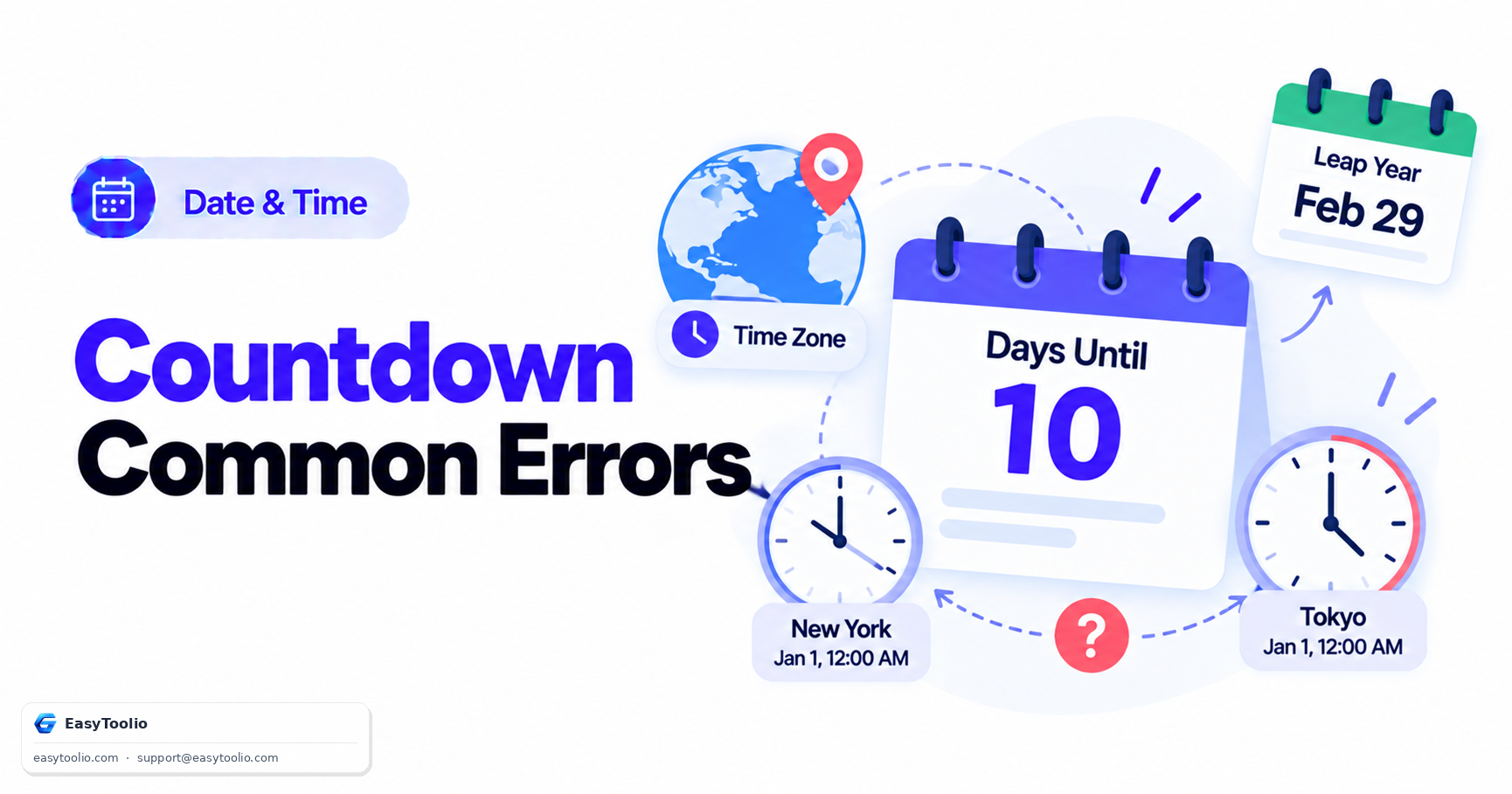
A date like "March 1" doesn't begin and end at the same real-world instant globally — it begins at midnight in each time zone, which means at any given moment, some parts of the world are already on March 1 while others are still on February 28. A countdown tool has to pick one reference frame to measure against: it can anchor to UTC, to a server's local time zone, or to the actual device/browser time zone of the person viewing the countdown.
If the tool anchors to UTC but the viewer is several hours ahead or behind, there's a window — right around the viewer's local midnight — where the UTC-based calculation and the viewer's own intuitive sense of "what day it is" disagree. A Birthday Countdown Calculator that anchors correctly to the viewer's local time zone will flip from "1 day left" to "0 days left" exactly at the viewer's own local midnight, matching intuition. One anchored to UTC or a fixed server time zone instead flips at a moment that may be several hours off from the viewer's actual midnight, producing a count that looks wrong even though the arithmetic itself is internally consistent.
| Anchoring Approach | Flips to "0 days left" at | Matches viewer's intuition? |
|---|---|---|
| Viewer's local time zone | Viewer's own local midnight | Yes |
| Fixed UTC | UTC midnight (may be mid-afternoon locally) | Only if viewer happens to be in UTC |
| Server's time zone | Server's local midnight | Only if viewer shares the server's zone |
The Leap Year Problem: Why /365 Silently Drifts
A calendar year isn't a fixed 365 days — it's 365 days in ordinary years and 366 days in leap years, where an extra day (February 29) is inserted to keep the calendar aligned with Earth's actual orbital period. The leap year rule itself has three layers: a year divisible by 4 is a leap year, except a century year (divisible by 100) is not a leap year, except that a year divisible by 400 is a leap year after all. This is why 2000 was a leap year but 1900 was not, and it's a rule that's easy to implement incompletely if someone only codes the first layer.
A naive "days until" calculation that simply divides the number of days between two dates by 365 to estimate elapsed years, or that estimates a date offset using a flat 365-day year, will be off by one day for every leap year contained within the span being measured. A correct implementation instead walks the actual calendar — counting real days between two specific dates, inclusive of any February 29th that falls within that range — using proper calendar arithmetic rather than an averaged year length.
Worked Example: Counting Days Across a Leap Year
Suppose you want the exact number of days between January 1, 2024 and January 1, 2025.
| Method | Calculation | Result |
|---|---|---|
| Naive fixed-365 assumption | 365 days flat | 365 days |
| Correct calendar-aware count | Actual days elapsed, including Feb 29, 2024 (a leap year) | 366 days |
| Drift introduced by the naive method | — | 1 day short |
That single day of drift seems small in isolation, but if a tool is calculating a countdown to a recurring annual event (a birthday, an anniversary, a deadline) across multiple years using an averaged year length rather than actual calendar dates, the error compounds — a countdown calculated this way can end up a full day or more off after just a few leap years pass through the range, without ever throwing an obvious error. A properly built Date Calculator avoids this entirely by working directly with actual calendar dates and checking each year in the range against the real leap-year rule, rather than treating a year as a fixed-length unit.
Frequently Asked Questions (FAQs)
Why do two countdown apps sometimes show a different number of days for the same target date?
Almost always because they're anchoring their "now" to different time zones, or because one of the two is using a naive day-count approximation while the other does full calendar-aware arithmetic. Neither tool is necessarily broken — they can both be internally consistent and still disagree, because "how many days until X" isn't a single unambiguous number until you've fixed both the reference time zone and the calendar method being used.
Is February 29th itself ever miscounted, separate from the leap-year-total issue?
Yes — a related but distinct bug shows up in tools that calculate recurring annual dates (like "next birthday") when the anniversary date itself is February 29th. In non-leap years, that literal calendar date doesn't exist, so a naive tool has to decide whether to treat the observed date as February 28th or March 1st in those years, and inconsistent handling of that choice across different years produces countdowns that don't align with how the person actually celebrates the date.
Does this kind of error only affect long-range countdowns, or can it affect a countdown to something just a few days away?
The leap-year drift accumulates over longer ranges and is negligible for a countdown of just a few days, since a short range is unlikely to cross February 29 at all. The time zone anchoring issue, however, is exactly the opposite — it's most visible for short countdowns and especially for countdowns measured in hours or that are about to flip from one day-count to the next, since that's precisely when the choice of reference time zone determines whether the flip has already happened or not.
For reference on the Gregorian calendar's leap year rule and international time zone standards, see the documentation maintained by the International Earth Rotation and Reference Systems Service (IERS) and the IANA Time Zone Database.