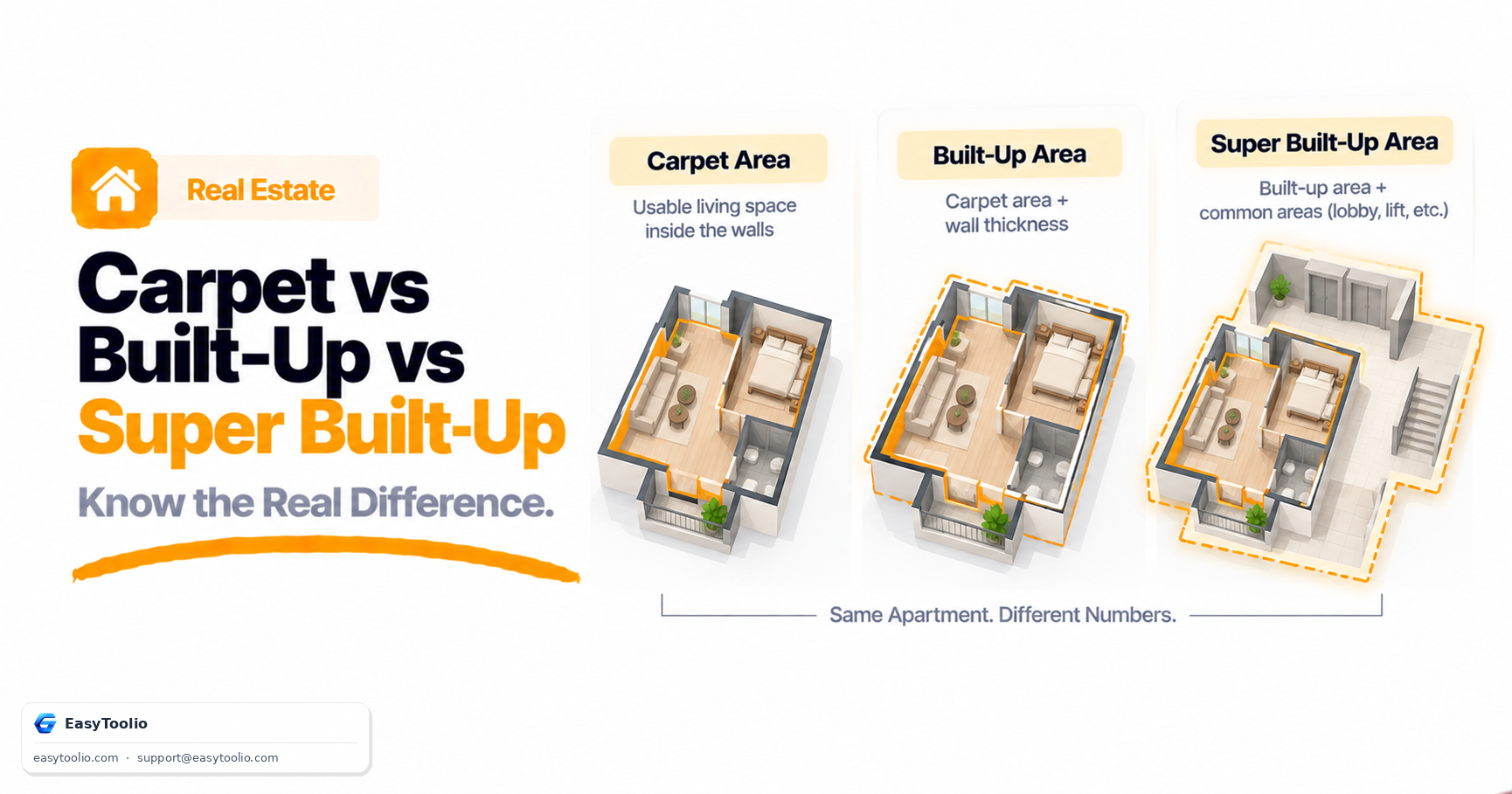
Two apartments can be advertised at the exact same "1,200 sq. ft." and still hand you completely different amounts of usable living space. The reason is that "area" in a property listing rarely means the same thing twice — a builder's brochure, a resale agreement, and a bank valuation report can each quote a different number for the same flat, and none of them are lying. They are simply measuring three different things: carpet area, built-up area, and super built-up area.
Confusing these three terms is one of the most common — and most expensive — mistakes a home buyer makes. It changes what you think you're paying per square foot, and it changes how one project compares against another.
Direct Answer: Carpet area is the actual usable floor space within the four walls of your unit, excluding wall thickness. Built-up area is the carpet area plus the thickness of the walls and any balcony or utility area attached to the unit. Super built-up area (also called "saleable area") is the built-up area plus a proportional share of common areas in the building — lobbies, staircases, lifts, and corridors. Super built-up area is always the largest number, carpet area is always the smallest, and the gap between them — the loading factor — is what determines how much common-area cost you are silently paying for.
1. The Three Area Definitions, Side by Side
| Area Type | What It Includes | What It Excludes | Who Uses It |
|---|---|---|---|
| Carpet Area | Usable floor space inside the four internal walls of the unit | Wall thickness, balconies (usually), common areas | RERA-mandated disclosure; what you actually walk on |
| Built-Up Area | Carpet area + wall thickness + balcony/utility area attached to the unit | Shared building common areas | Builder floor plans, property tax assessments |
| Super Built-Up Area | Built-up area + a proportional share of lobbies, stairs, lifts, corridors, clubhouse | — (this is the largest figure) | Builder sale agreements, price-per-sq.-ft. marketing |
A simple way to picture the progression:
Carpet Area ──► + Wall Thickness + Balcony ──► Built-Up Area ──► + Share of Common Areas ──► Super Built-Up Area
(Smallest, what you actually use)                                                     (Largest, what you're often billed against)
2. The Loading Factor: Why the Same Flat Has Multiple "Sizes"
The percentage difference between super built-up area and carpet area is commonly called the loading factor. In many urban apartment projects, super built-up area tends to run roughly 25% to 35% more than the carpet area of the same unit — but this is a general market pattern, not a fixed rule. The actual loading factor for any specific project depends on the number of floors, the amenities included (clubhouse, gym, extra lift lobbies), and how the builder chooses to allocate common space. Two towers built by the same developer in the same city can carry noticeably different loading factors.
This matters because loading factor is not disclosed with equal consistency across markets, so it should always be verified against the specific project's sale agreement or RERA filing rather than assumed from a rule of thumb.
Loading Factor (%) = (Super Built-Up Area - Carpet Area) ÷ Carpet Area × 100
Worked example: If a unit has a carpet area of 800 sq. ft. and a super built-up area of 1,040 sq. ft., the loading factor is:
(1,040 - 800) ÷ 800 × 100 = 30%
That means 240 sq. ft. — nearly a full extra room's worth of space — is being counted in the sale price even though it isn't floor space inside your unit.
3. Why Price-Per-Square-Foot Is Meaningless Without Knowing the Area Type
A quoted price of "₹8,000 per sq. ft." tells you almost nothing on its own, because the answer to "per square foot of what?" changes the real cost dramatically.
Consider two listings for the same 800 sq. ft. carpet area unit:
| Quoted Rate | Basis | Total Price | Effective Rate per Carpet Sq. Ft. |
|---|---|---|---|
| ₹8,000/sq. ft. | Super built-up area (1,040 sq. ft.) | ₹83,20,000 | ₹10,400 |
| ₹10,000/sq. ft. | Carpet area (800 sq. ft.) | ₹80,00,000 | ₹10,000 |
The listing that looks "more expensive per square foot" on paper is actually the cheaper one once both are converted to the same basis. This is why comparing two projects purely on their advertised rate — without first checking which area type that rate is quoted against — routinely leads buyers to the wrong conclusion.
4. Practical Checklist Before You Sign
- Ask for the carpet area figure explicitly. Under India's RERA regulations, developers are required to disclose carpet area in the sale agreement — use this as your anchor number.
- Request the loading factor in writing, or calculate it yourself once you have both the carpet and super built-up figures.
- Convert every competing listing to the same area basis before comparing price per square foot.
- Remember built-up area sits in between — it's useful for understanding how much of the "extra" area is your own balcony/walls versus shared building space.
Calculate your own numbers instantly with our carpet-area-calculator, convert between the three using the built-up-area-calculator and super-built-up-area-calculator, and work out your all-in purchase cost with the property-cost-calculator.
5. Frequently Asked Questions (FAQs)
Is carpet area the same as the area I can actually furnish?
Almost. Carpet area is the usable floor space within the walls, but it typically still includes space taken up by internal columns or shafts that may restrict furniture placement in specific spots. It remains the closest legal measure to "space you can walk and live in."
Why do builders prefer quoting super built-up area?
Super built-up area is the largest of the three figures for any given unit, so a price-per-square-foot rate applied against it produces a lower-looking per-square-foot number for the same total price — which can make a listing appear more competitively priced at first glance.
Does RERA require builders to disclose carpet area in India?
Yes. RERA mandates that sale agreements state the carpet area of a unit, which is intended to give buyers a consistent, comparable figure across projects rather than relying solely on built-up or super built-up marketing numbers.
References: Real Estate (Regulation and Development) Act, 2016 (RERA) — carpet area disclosure requirements.