
Ask a contractor for "M20 concrete" and they'll know exactly what mix to prepare — but the letter-and-number combination that looks like a product code is actually a strength specification with a standardized mix ratio behind it. Understanding what these grades mean, and how to convert a design volume into an actual materials order, is essential before pouring anything structural.
Direct Answer: The "M" in a concrete grade like M15, M20, or M25 stands for "Mix," and the number represents the characteristic compressive strength of that concrete in megapascals (MPa), equivalent to newtons per square millimeter (N/mm²), measured on a standard test cube after 28 days of curing. Each grade has a corresponding nominal mix ratio of cement, sand, and coarse aggregate by volume — and general practice associates specific grades with specific structural elements, though local building codes and structural engineering requirements ultimately govern what's actually used on any given project.
1. What the Grade Number Actually Means
A concrete grade of M20 means the concrete is designed to achieve a characteristic compressive strength of 20 MPa (20 N/mm²) when tested on a standard cube 28 days after casting. Higher numbers mean higher strength:
| Grade | Characteristic Strength | Typical General Use (Practice Varies by Region/Code) |
|---|---|---|
| M15 | 15 MPa (15 N/mm²) | Driveways, pathways, non-structural flooring, leveling courses |
| M20 | 20 MPa (20 N/mm²) | Residential slabs, beams, general structural work |
| M25 | 25 MPa (25 N/mm²) | Columns, foundations, load-bearing structural elements |
This table reflects common construction practice, not a universal building code mandate — actual grade selection for any structural element should always be confirmed against the applicable local building code and a structural engineer's design, since seismic zone, load requirements, and regional standards can all shift which grade is appropriate.
2. Standard Nominal Mix Ratios
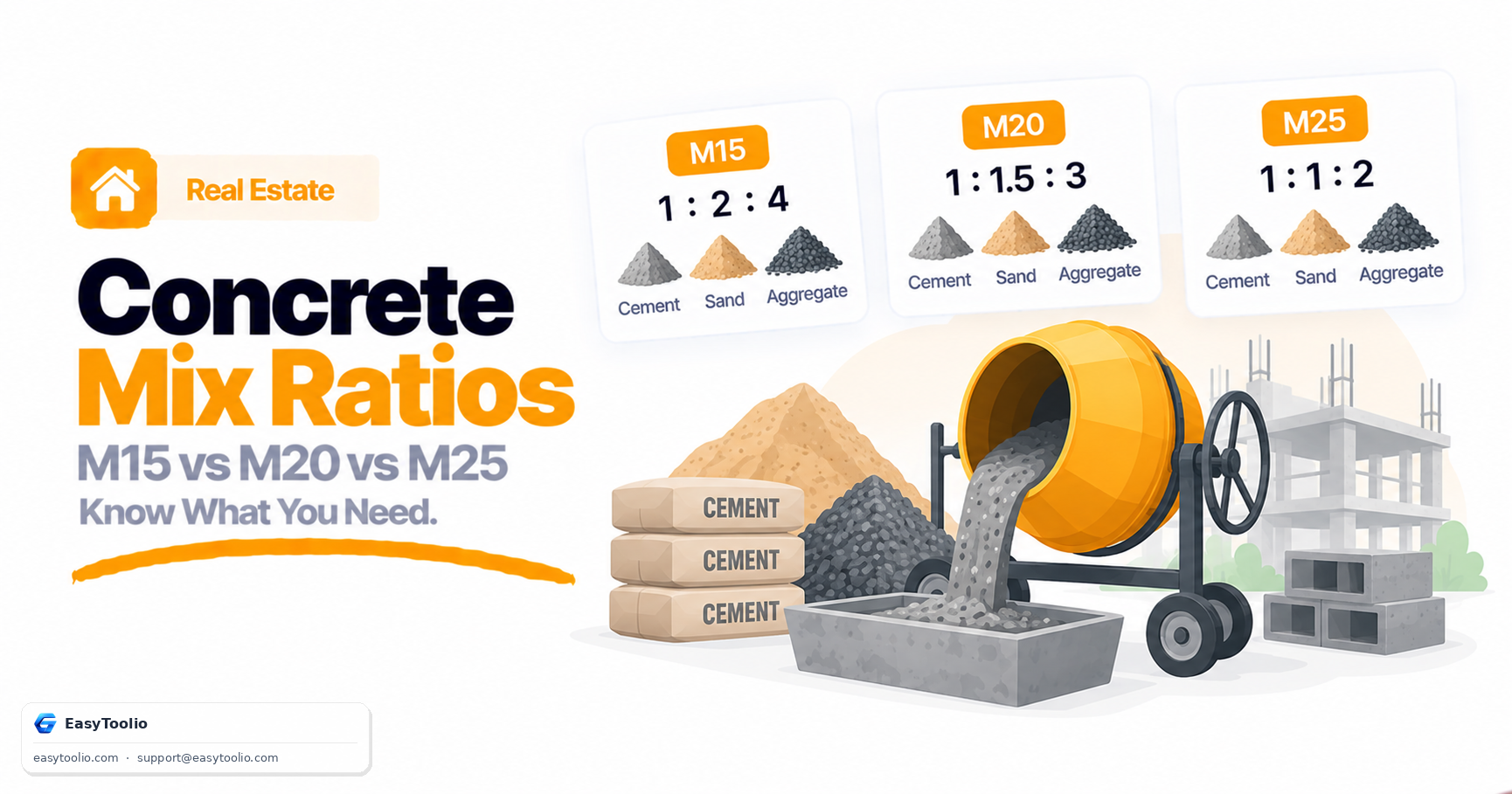
For the lower grades (up to M25), concrete is commonly specified using a nominal mix ratio — a fixed proportion of cement : sand : coarse aggregate by volume, without a full lab-designed mix:
| Grade | Cement : Sand : Aggregate (Nominal Mix) |
|---|---|
| M15 | 1 : 2 : 4 |
| M20 | 1 : 1.5 : 3 |
| M25 | 1 : 1 : 2 |
As the grade number increases, the proportion of cement relative to sand and aggregate increases — more cement per unit volume produces higher compressive strength. Above M25, mixes are typically design mixes calculated in a lab for the specific project rather than fixed nominal ratios.
3. The Wet-to-Dry Volume Conversion Factor
Here is where many manual concrete estimates go wrong: the volume of wet, mixed concrete you pour is not the same as the volume of dry materials (cement + sand + aggregate) you need to buy and mix together.
When dry ingredients are mixed with water, air voids between the dry particles collapse and the mixture compacts — meaning the dry volume required is larger than the final wet concrete volume. Standard construction practice applies a dry volume conversion factor of approximately 1.54 to account for this:
Dry Volume of Materials = Wet Concrete Volume × 1.54
4. Worked Example: From Volume to Cement Bags
Suppose you need to cast an M20 concrete slab with a wet volume of 5 cubic meters.
Step 1 — Convert to dry volume:
5 × 1.54 = 7.7 cubic meters (dry volume of materials)
Step 2 — Split by the M20 ratio (1 : 1.5 : 3, total parts = 5.5):
Cement Volume = 7.7 × 1 ÷ 5.5 = 1.4 m³
Sand Volume = 7.7 × 1.5 ÷ 5.5 = 2.1 m³
Aggregate Volume = 7.7 × 3 ÷ 5.5 = 4.2 m³
Step 3 — Convert cement volume into bags:
A standard cement bag weighs 50 kg, and cement has a bulk density of approximately 1,440 kg/m³, giving a standard bag volume of about 0.035 m³.
Number of Cement Bags = 1.4 ÷ 0.035 ≈ 40 bags
So a 5 m³ M20 slab requires roughly 40 bags of cement, 2.1 m³ of sand, and 4.2 m³ of coarse aggregate — before accounting for on-site wastage, which contractors typically add as a separate buffer.
5. Common Grade Selection Mistakes to Avoid
- Assuming M15 is "good enough" for structural slabs. M15 is a lower-strength general-purpose mix; using it where a code requires M20 or higher for structural load-bearing elements risks non-compliance and structural underperformance.
- Skipping the 1.54 dry volume factor. Ordering exactly the wet-poured volume of dry materials will consistently leave you short.
- Treating nominal mixes as universal above M25. Design mixes calculated for specific project conditions (aggregate size, exposure condition, admixtures) replace fixed nominal ratios at higher grades.
Estimate exact material quantities for your pour with our concrete-calculator, work out your full project budget with the construction-cost-calculator, and plan flooring quantities with the tile-calculator.
6. Frequently Asked Questions (FAQs)
Is M20 concrete strong enough for a residential foundation?
General practice often reserves M25 or higher for foundations and columns due to the sustained structural load they carry, while M20 is more commonly used for slabs and beams — but the correct grade for any specific foundation depends on soil conditions, building height, and local code requirements, which only a structural engineer's design can confirm.
Why does more cement in the mix mean higher strength?
Cement is the binding agent that reacts with water to form the hardened matrix holding sand and aggregate together. A higher proportion of cement relative to sand and aggregate produces a denser, stronger matrix — which is why the nominal mix ratio shifts toward more cement as the grade number rises.
Can I mix concrete without knowing the exact grade needed?
It's not advisable for any structural element. Under-strength concrete in a load-bearing component is a safety risk, while over-specifying strength unnecessarily increases material cost. Always match the grade to the structural design requirement rather than guessing.
References: General nominal mix ratio conventions for concrete grades up to M25, as commonly referenced in construction practice guidance (e.g., IS 456 nominal mix provisions in Indian construction standards).