
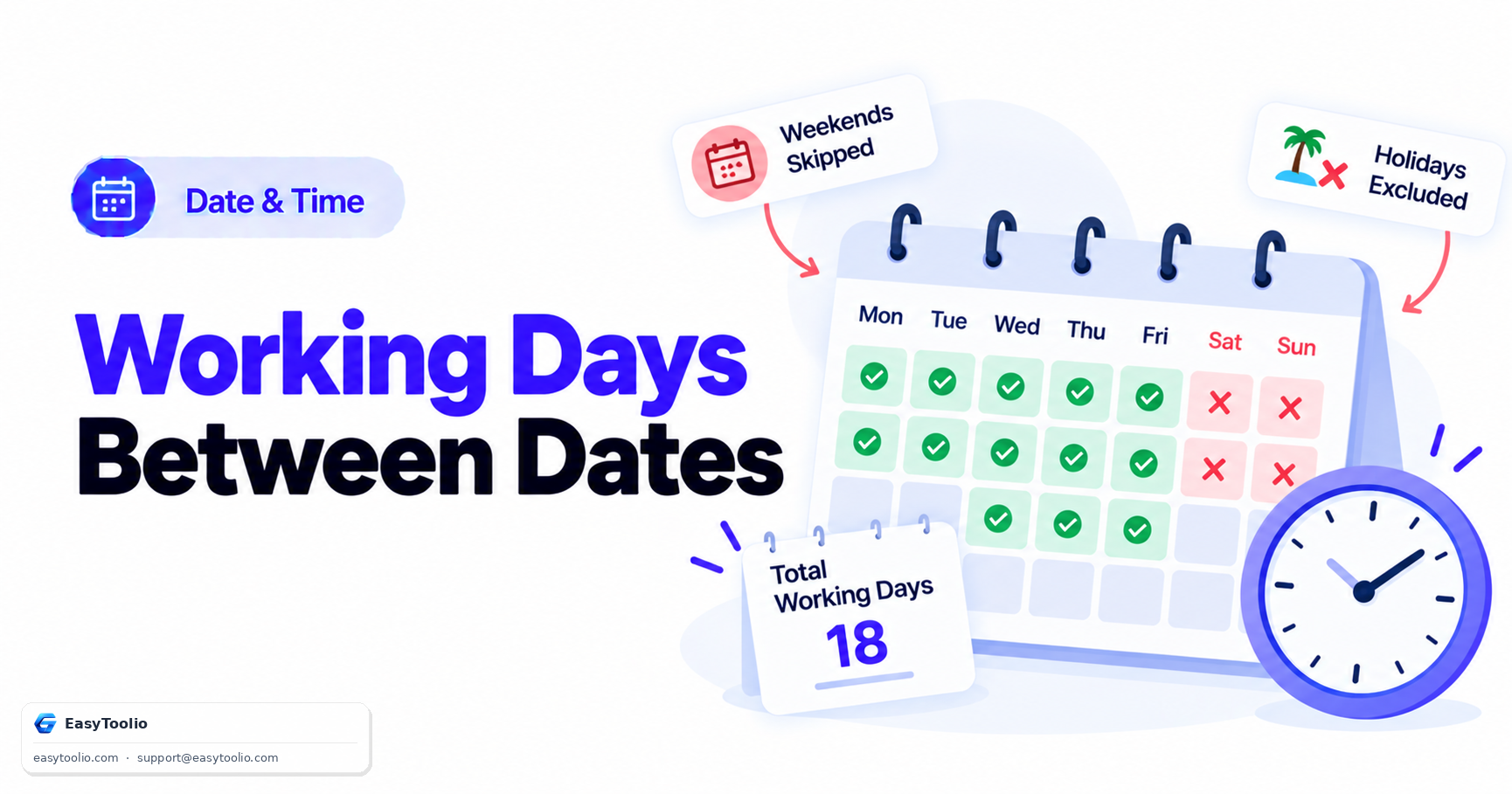
Payroll runs, SLA deadlines, project timelines, and delivery estimates all depend on a single deceptively simple question: how many working days fall between two dates? Counting total calendar days is trivial; correctly excluding weekends — and holidays, where applicable — is where most manual estimates go wrong.
Direct Answer: The number of working days between two dates is calculated as the total number of calendar days in the range, minus weekend days (typically Saturdays and Sundays), minus any recognized public holidays that fall within the range if holidays are being excluded for that use case. A common shortcut — dividing the total day count by 7 and multiplying by 5 — only approximates the true answer and produces incorrect results for short date ranges, because it does not account for exactly which days of the week the range starts and ends on.
1. The Correct Calculation Method
Step 1: Count total calendar days between the start and end date (inclusive or exclusive, per your convention)
Step 2: Iterate each date in the range and identify which fall on Saturday or Sunday
Step 3: Subtract the weekend day count from the total calendar day count
Step 4: If public holidays are relevant (e.g., payroll, government SLAs), subtract any holiday
        that falls on what would otherwise be a working day (a holiday landing on a weekend
        does not reduce the count further, since it was already excluded)
Working Days = Total Calendar Days - Weekend Days - Holidays Falling on Weekdays
The critical detail is that this must be done by walking the actual calendar, not by a flat ratio — because the position of the start and end date within the Monday–Sunday week determines exactly how many weekend days fall inside the range.
2. Why "Divide by 7, Multiply by 5" Fails on Short Ranges
The rough approximation many people use is:
Estimated Working Days ≈ Total Days ÷ 7 × 5
This is a reasonable estimate only when averaged over very long ranges (many months or years), because over a long enough span, weekdays and weekend days occur in their expected 5:2 ratio. Over short ranges, it breaks down badly:
| Range | Total Calendar Days | Approximation (÷7×5) | Actual Working Days | Error |
|---|---|---|---|---|
| Monday to Friday (same week) | 5 | 3.57 → ~4 | 5 | Undercounts by 1 |
| Saturday to Sunday | 2 | 1.43 → ~1 | 0 | Overcounts by 1 |
| Friday to Monday | 4 | 2.86 → ~3 | 2 | Overcounts by 1 |
Because the approximation has no awareness of which specific days of the week the range starts and ends on, it can be off by a full day or more on ranges of a week or less — exactly the ranges where a one-day error matters most for a deadline.
3. Worked Example
Suppose a task starts on Thursday and the deadline is the following Wednesday (9 calendar days later, inclusive of both endpoints spanning Thu–Wed across two weeks):
- Total calendar days in range: 9
- Weekend days falling in that range: 2 Saturdays... actually one Saturday and one Sunday from the first weekend, i.e., 2 weekend days
- Working days: 9 − 2 = 7 working days
The naive approximation (9 ÷ 7 × 5 ≈ 6.4, rounded to 6) would have undercounted by one full day — a meaningful error if that day determines whether an SLA was met.
4. Why This Matters for Payroll, SLAs, and Project Deadlines
- Payroll processing: Many payroll systems calculate pay periods, notice periods, or probation timelines in working days rather than calendar days, so an off-by-one error directly affects pay dates or legal notice compliance.
- SLA (Service Level Agreement) deadlines: Support and legal contracts frequently specify response times in "business days" (e.g., "5 business days to respond"), and miscounting weekends can cause a business to appear to breach an SLA it actually met, or vice versa.
- Project and delivery deadlines: Estimating a delivery date by adding calendar days instead of working days routinely produces deadlines that fall on a weekend or understate how much working time is actually available before a milestone.
Calculate the exact working day count between any two dates — with or without holidays — using working-days-calculator, find total elapsed calendar time with date-calculator, and convert working periods into exact hour counts with hours-calculator.
5. Frequently Asked Questions (FAQs)
Does "working days" always mean Monday through Friday?
In most Western business contexts, yes — Saturday and Sunday are treated as the standard weekend. However, some countries and industries use a different weekend (for example, Friday–Saturday in parts of the Middle East), so the correct weekend days to exclude depend on the region and organization in question.
Should public holidays always be subtracted from a working-days count?
Only when the specific use case calls for it. A generic "days between two dates excluding weekends" calculation does not require holiday data, but payroll, legal notice periods, and SLA calculations often explicitly require excluding recognized public holidays as well — always check what the underlying contract or policy actually specifies.
Is the start date or end date included in the count?
This depends on convention and must be stated explicitly — "5 working days from Monday" can mean the deadline lands on the following Friday or the following Monday depending on whether the starting day itself is counted as day one. Ambiguity here is a common source of missed-deadline disputes.
References: Standard business-day counting conventions used in payroll and SLA calculations; ISO 8601 (week and weekday definitions).