
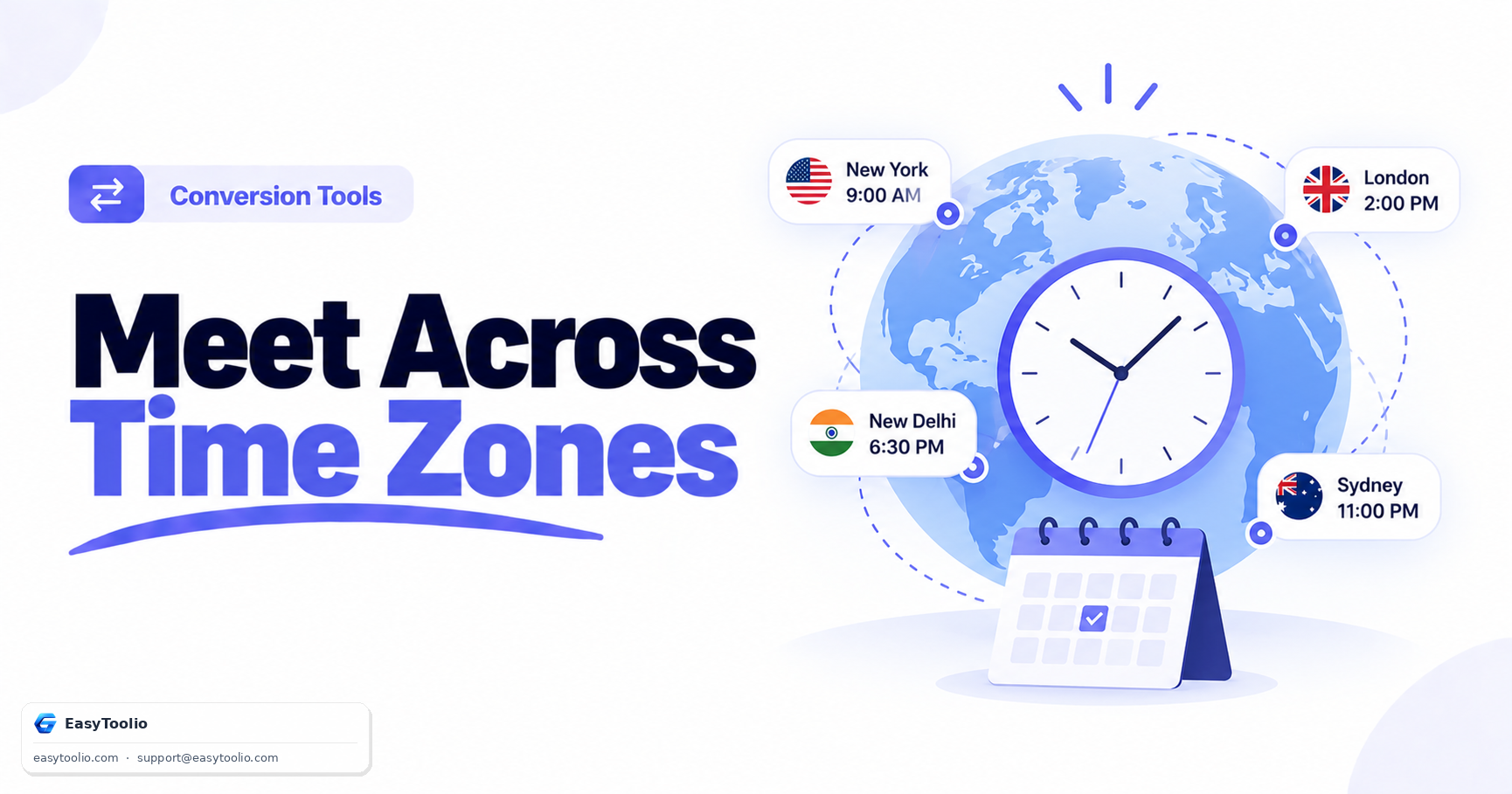
Scheduling a meeting across three time zones sounds simple until someone shows up an hour early, or worse, an hour late, because one country switched to daylight saving time and another did not. Time zone math is not just about adding or subtracting a fixed number of hours; it depends on daylight saving rules that vary by country, region, and even year. Getting it right consistently requires understanding a few core rules rather than memorizing offsets.
Why Time Zone Conversion Is More Complicated Than It Looks
A time zone offset (like UTC+5:30 for India or UTC-5 for New York) is not fixed year-round in most countries. Many regions observe daylight saving time (DST), shifting their clocks forward in spring and back in autumn to make better use of daylight. The catch is that:
- Not every country observes DST. India, Japan, and most of the countries near the equator do not change their clocks at all.
- DST start and end dates differ by country. The United States and Europe both use DST, but they switch on different dates, which means for a few weeks each year the offset between them shifts by an extra hour compared to the rest of the year.
- Some countries have changed their DST policy in recent years, and a handful of US states and territories are exempt even though the rest of the country observes it.
This is exactly why a meeting time that was correct in March can be wrong in November, even if nobody's clock setting changed on your end.
Practical Steps for Scheduling Across Time Zones
- Always convert using a specific date, not just a time. A tool like the Time Zone Converter accounts for whether DST is active on that particular date in each relevant location, which a simple fixed offset cannot do.
- Confirm the time zone abbreviation is unambiguous. "CST" alone could mean Central Standard Time (North America) or China Standard Time, and "IST" could mean India Standard Time or Irish Standard Time. Always use a full location name or UTC offset when confirming with participants.
- Send calendar invites with time zone data attached, not just a plain text time. Calendar software (Google Calendar, Outlook) automatically converts the invite to each recipient's local time zone if the event has proper time zone metadata.
- Double-check meetings scheduled near a DST transition date. The one to two weeks surrounding a DST switch (typically March and November in many regions) is when scheduling errors are most common.
- Rotate meeting times for global teams. If your team spans Asia, Europe, and the Americas, no single time is convenient for everyone; rotating the "inconvenient" slot is fairer than always burdening the same region.
Common Time Zone Scheduling Mistakes
| Mistake | Why It Causes Problems | Better Approach |
|---|---|---|
| Using a fixed UTC offset year-round | Ignores DST shifts, causing hour-long errors part of the year | Convert using the actual meeting date |
| Relying on time zone abbreviations alone | Abbreviations like CST or IST are ambiguous across countries | Use full city names or UTC offsets |
| Sending plain-text meeting times | Recipients must manually convert, increasing error risk | Use calendar invites with embedded time zone data |
| Assuming all countries observe DST | Some regions never change their clocks | Check each participant's location individually |
| Ignoring DST transition weeks | Offsets can shift unexpectedly around the switch date | Reconfirm meeting times close to DST changeovers |
Frequently Asked Questions
Q: Why does the time difference between two countries sometimes change during the year? A: This happens when one or both countries observe daylight saving time. Since DST start and end dates differ by country, the gap between two time zones can temporarily grow or shrink by an hour during transition periods.
Q: What is the safest way to communicate a meeting time internationally? A: Specify the date, time, and UTC offset (or a clearly named city, like "3 PM in London") rather than relying on an abbreviation, and use a calendar invite so each recipient's software converts it automatically to their local time.
Q: Do all countries change their clocks for daylight saving time? A: No. Most of Asia, Africa, and countries near the equator do not observe DST at all, while parts of North America, Europe, and Australia do, each with their own transition dates.