You're told a project deadline is "20 working days out," you count on a calendar by hand, land on a Saturday, and only then remember weekends don't count — so the actual date is further out than your first pass suggested. Manual date arithmetic looks trivial until a weekend, a leap year, or a month boundary quietly throws the count off by a day or more.
Date math shows up constantly in ordinary life and work, but it splits into a few genuinely distinct calculation types, each with its own way of going wrong by hand.
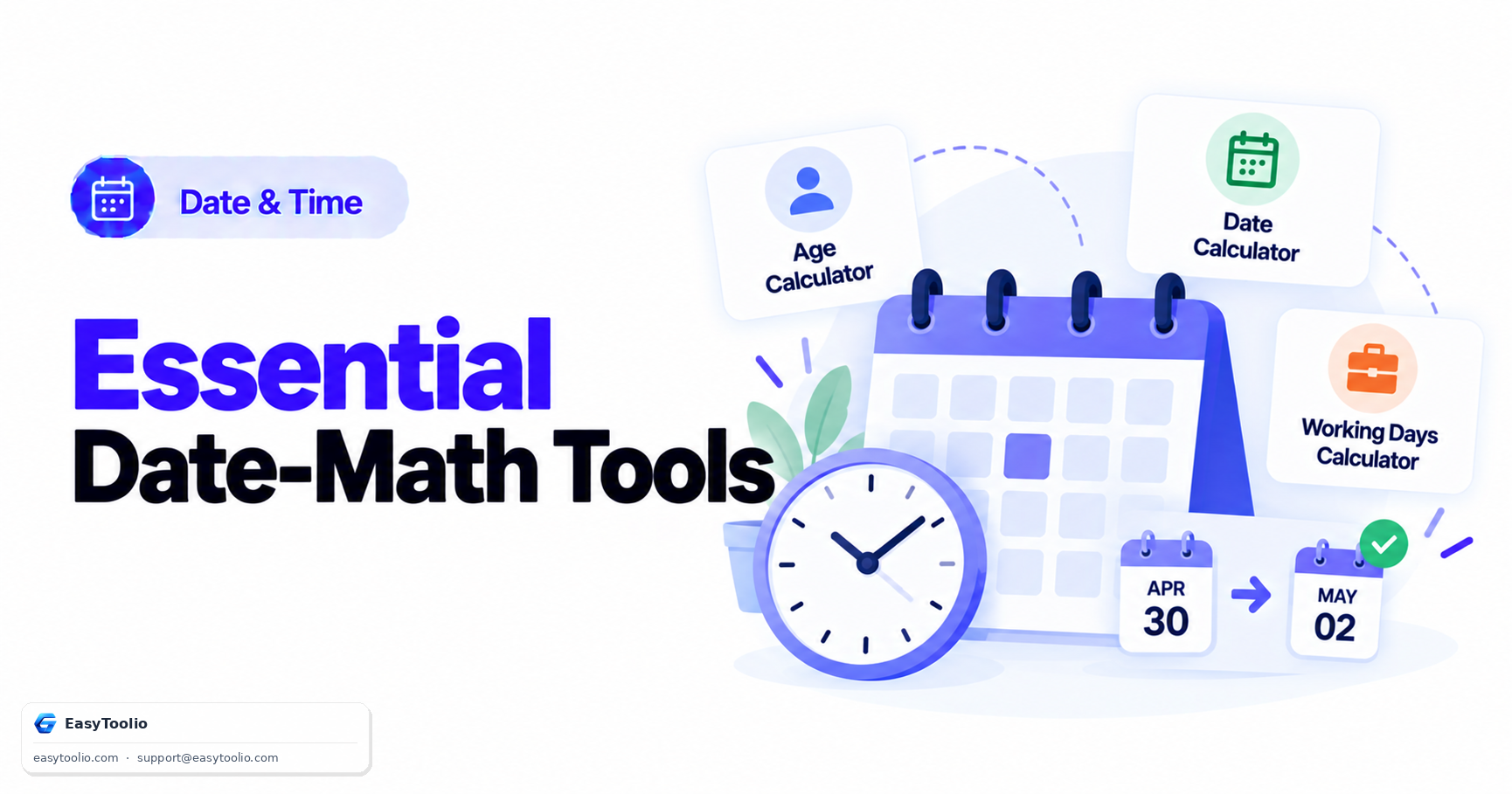
Direct Answer: Three separate but related date-math problems come up most often: counting working days (business days between two dates, excluding weekends and often public holidays — used for project deadlines and SLA calculations), calculating exact age (the precise number of years, months, and days between a birth date and today, or between any two dates — used for forms, eligibility checks, and legal requirements), and adding or subtracting a span of days from a date (finding what date falls a given number of days before or after a reference date — used for due dates, expiry calculations, and scheduling). Each requires correctly handling calendar irregularities — different month lengths, leap years, and weekend patterns — that manual counting reliably gets wrong past a certain span.
1. Working Days: Counting Business Days Correctly
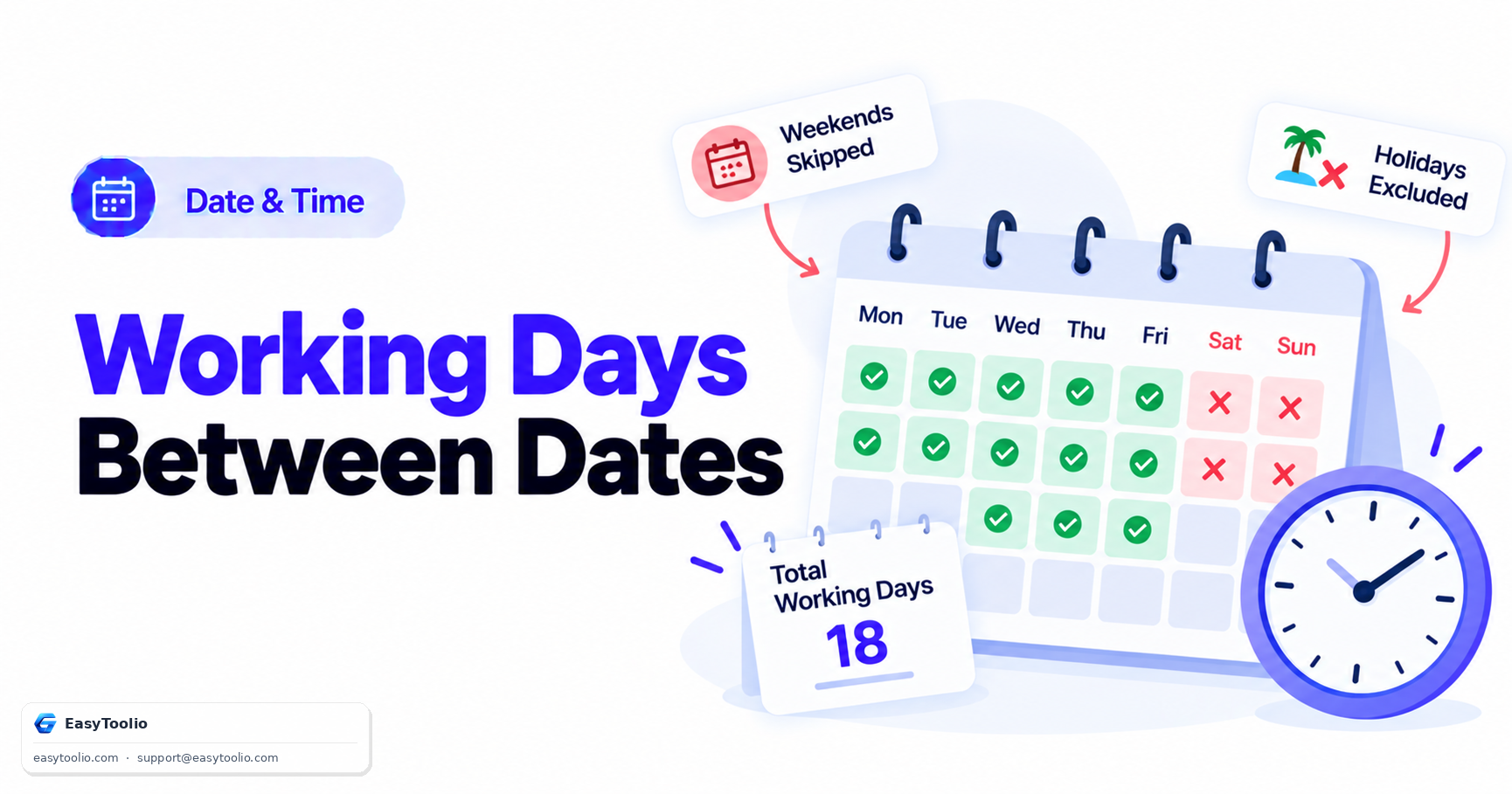
A working-days calculation counts only weekdays (typically Monday-Friday) between two dates, and often subtracts recognized public holidays on top of weekends. This matters for anything with a contractual or SLA-style deadline — "5 working days to respond," "20 business days for delivery" — because a plain calendar-day count between the same two dates will always overstate how many actual business days are available.
Example: From Thursday, June 5 to Thursday, June 26 is 21 calendar days, but excluding the three intervening weekends (6 weekend days: two Saturdays and two Sundays, plus a partial third weekend depending on exact boundary) brings the actual working-day count down meaningfully — the exact figure depends on precisely which weekend days fall inside the range, which is exactly the kind of boundary-counting error that trips people up doing this by hand. Our working days calculator counts business days between two dates automatically, with the option to exclude specific holidays on top of weekends.
2. Exact Age: Years, Months, and Days Between Two Dates
Calculating age sounds trivial — subtract the birth year from the current year — until the birth month and day haven't occurred yet this calendar year, at which point the naive subtraction overstates age by one year. A correct age calculation compares month and day as well as year, and many practical uses (school admission cutoffs, eligibility thresholds tied to exact age, legal age verification) require the precise years-months-days breakdown, not just a rounded year count.
Example: Someone born June 24, 1995, checked on March 10, 2026 has not yet had their 2026 birthday, so their exact age is 30 years, 8 months, and 14 days — not simply "2026 minus 1995 = 31." This one-year discrepancy around the birthday boundary is the most common manual age-calculation mistake. Our age calculator handles the month/day comparison correctly and returns the full years-months-days breakdown rather than a single rounded figure.
3. Date Addition/Subtraction: Finding a Date N Days Away
The third common problem is the reverse of counting between two known dates: given one reference date and a number of days, what date results after adding or subtracting that span? This is the calculation behind due dates ("invoice due 30 days from issue"), expiry dates ("valid for 90 days from purchase"), and simple scheduling ("what date is 45 days from today").
Example: Adding 40 days to January 25 requires correctly rolling over January's 31 days, then counting the remaining days into February and (in a leap year) accounting for February having 29 rather than 28 days — a small but real source of off-by-one errors when done manually across a leap year boundary, since the extra day shifts every subsequent date calculation by one if it's missed or double-counted. Our date calculator adds or subtracts a specified number of days, weeks, or months from any starting date, correctly handling month-length and leap-year variation automatically.
4. Why Manual Date Math Fails More Often Than People Expect
| Failure Point | Why It Trips People Up |
|---|---|
| Variable month lengths | 28, 29, 30, or 31 days depending on the month — easy to miscount across a boundary |
| Leap years | An extra day in February every 4 years (with century-based exceptions) shifts every date past it by one if missed |
| Weekend exclusion | Manually tracking which calendar days fall on a weekend across a multi-week span is error-prone past roughly 2-3 weeks |
| Birthday-not-yet-occurred | A same-year subtraction for age overstates by one year until the birth month/day has passed in the current year |
Each of these is a small, individually forgivable mistake — but they compound, and the further out the date range or the more boundaries (weekends, month-ends, leap years) a calculation crosses, the more likely a manual count is off by at least a day.
Frequently Asked Questions
Do working-day calculators account for public holidays automatically?
Most allow you to specify holidays to exclude in addition to weekends, since public holiday calendars vary by country, region, and even specific organization, so this typically isn't fully automatic without input.
Why does my manually calculated age come out one year higher than expected?
This usually happens when the birth month and day for the current year haven't occurred yet — a naive year-only subtraction doesn't account for that, while a correct age calculation compares the full month and day as well.
How does a leap year affect date addition calculations?
Adding a span of days that crosses February 29 in a leap year needs to count that extra day; missing it (or double-counting it) shifts every date calculated after that point by one day.
Can I calculate age between two dates other than a birth date and today?
Yes — the same year-month-day comparison logic used for birth-date-to-today age calculations applies to the interval between any two arbitrary dates.
What counts as a "working day" — does it ever include Saturdays?
It depends on the context and region — most calculations default to a Monday-Friday work week, but some industries or countries treat Saturday as a working day, so it's worth confirming which convention applies before relying on a business-day count for a deadline.
Is there a difference between "30 days from now" and "one month from now"?
Yes — 30 days is a fixed span regardless of the calendar, while "one month" shifts depending on the specific month's length (28-31 days), so the two calculations can land on different dates depending on which months are crossed.
References: ISO 8601 date representation standard; standard Gregorian calendar leap-year rules (divisible by 4, except century years not divisible by 400).