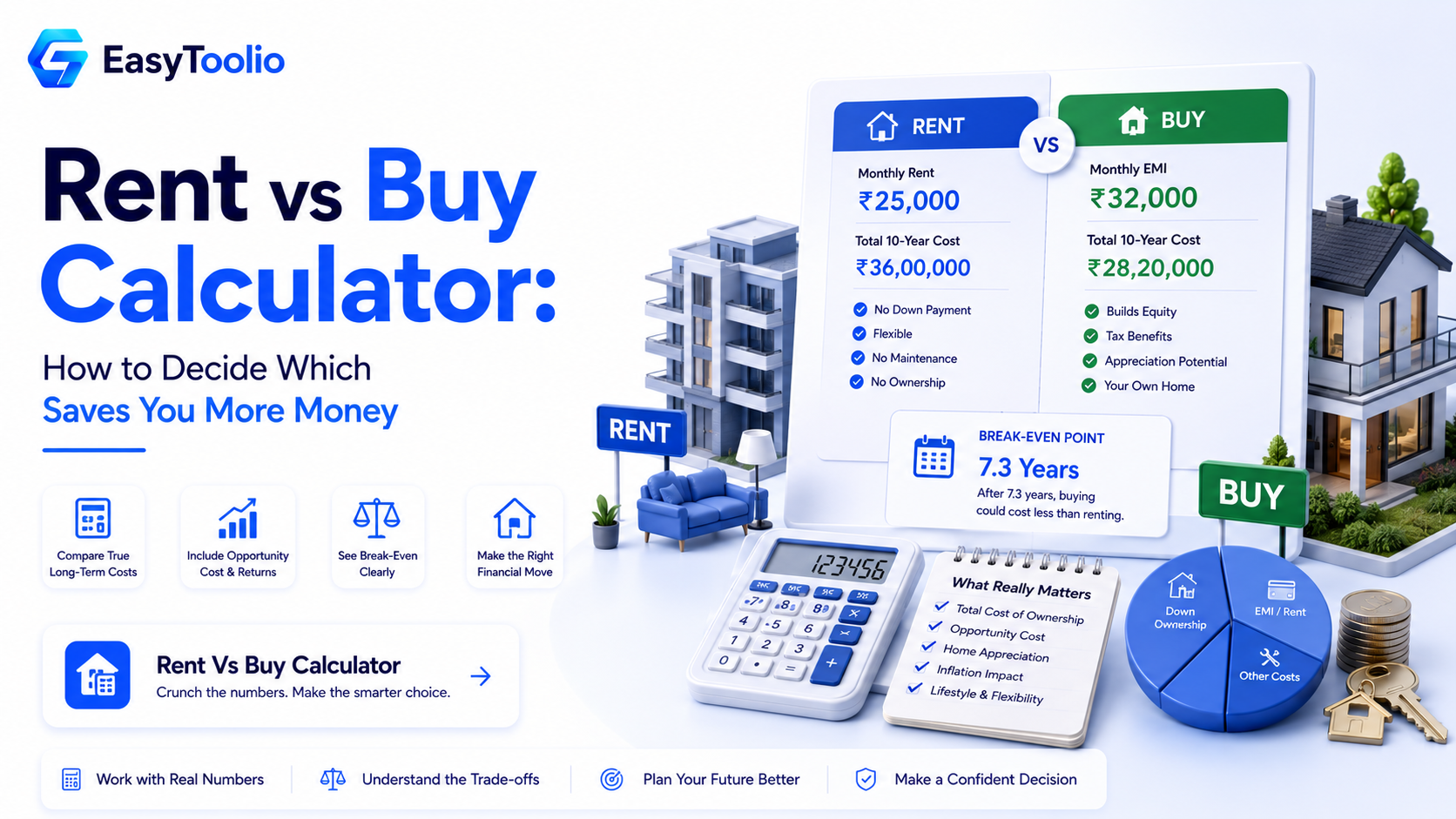
"Rent is money down the drain, buying builds equity" is the most repeated — and most oversimplified — line in personal finance. In reality, whether renting or buying saves you more money depends on interest rates, how long you plan to stay, what your down payment could otherwise earn, and maintenance costs that buyers often forget to count. Here is the actual math.
What Renting Really Costs vs What Buying Really Costs
Renting's cost is straightforward: monthly rent plus an annual rent increase (typically 5-10% in Indian cities), plus a refundable security deposit that ties up some cash.
Buying's cost is more than the EMI. It includes:
- Down payment (usually 20% of property value, since banks fund up to 80% via loan-to-value norms)
- EMI on the home loan (principal + interest)
- Property tax, society maintenance, and repairs (typically 1-2% of property value annually)
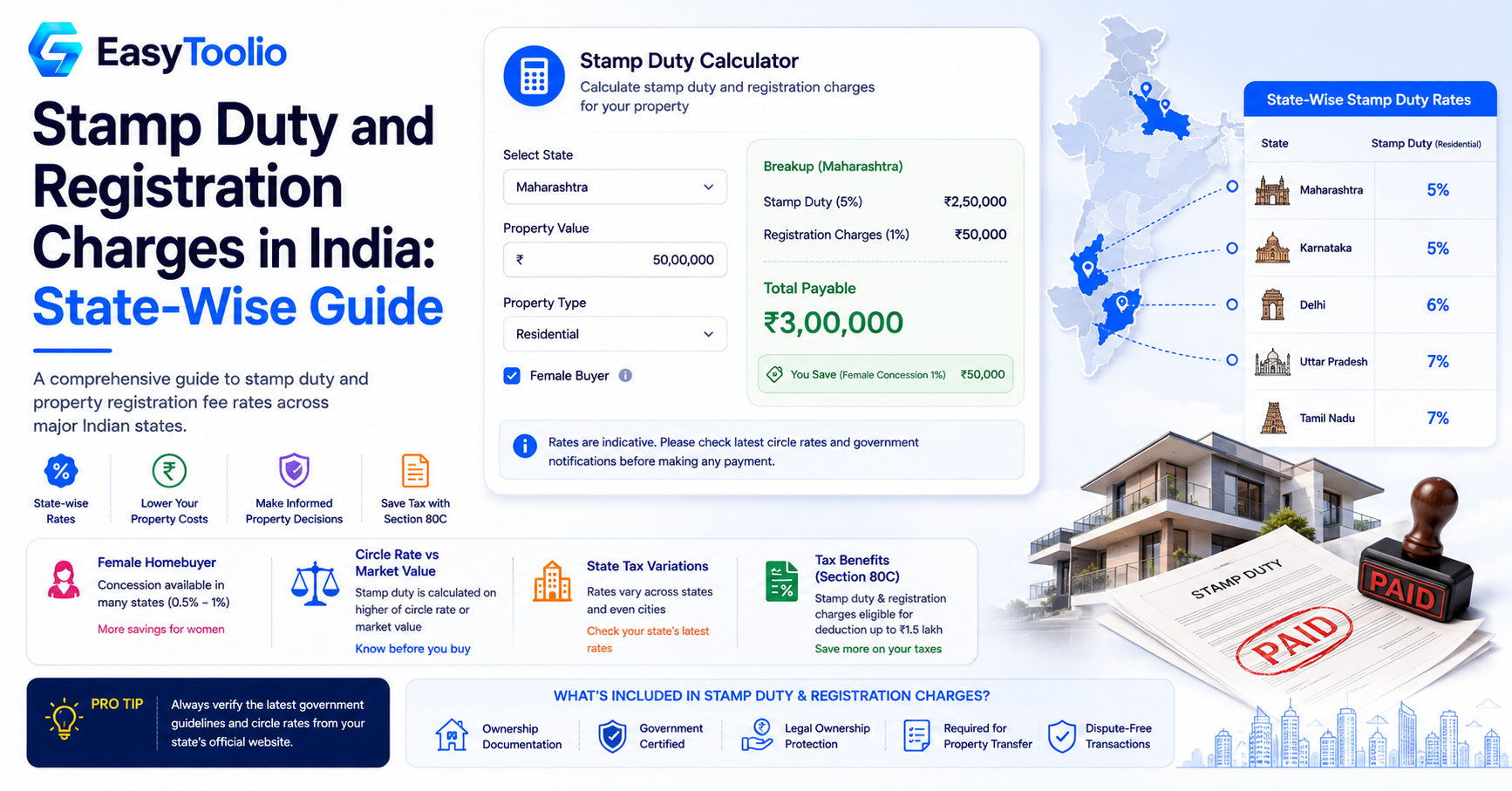
- Stamp duty and registration (5-8% of property value, one-time)
- The opportunity cost of the down payment — what that lump sum would have earned if invested instead (e.g., in equity mutual funds or FDs)
Most rent-vs-buy comparisons fail because they ignore that last point: money used for a down payment stops earning market returns.
The Core Formula
A fair comparison looks at the net cost after N years for both paths:
Net Cost of Renting = Total Rent Paid (with annual escalation) − Returns on Invested Deposit Difference
Net Cost of Buying = Total EMI Paid + Taxes + Maintenance + Stamp Duty − Home's Appreciated Value − Equity Built
Whichever number is lower over your expected holding period is the financially better option.
Worked Example
Consider a ₹80,00,000 flat versus renting an equivalent flat at ₹25,000/month, over a 10-year horizon.
Buying:
- Down payment: ₹16,00,000 (20%)
- Loan: ₹64,00,000 at 8.5% for 20 years → EMI ≈ ₹55,500/month
- Over 10 years, total EMI paid ≈ ₹66,60,000, of which roughly ₹47,00,000 is interest and ₹19,60,000 reduces principal
- Maintenance + tax (1.5%/year) ≈ ₹12,00,000 over 10 years
- Stamp duty (6%): ₹4,80,000 one-time
- If the property appreciates at 6% annually, its value after 10 years ≈ ₹1,43,00,000
Renting:
- Rent at ₹25,000/month rising 7% annually totals roughly ₹41,00,000 over 10 years
- The ₹16,00,000 down payment plus the monthly EMI-vs-rent difference (~₹30,500/month initially), if invested in an index fund averaging 11% annually, could grow to well over ₹1,10,00,000
In this scenario, buying still wins over a full 10-year horizon because of home appreciation and equity built, but the gap is much narrower than the "rent is wasted money" narrative suggests — and if you plan to stay less than 5-6 years, renting usually comes out ahead once stamp duty and interest-heavy early EMIs are factored in.
Rent vs Buy Comparison Table
| Factor | Renting | Buying |
|---|---|---|
| Upfront cost | 1-2 months deposit | Down payment + stamp duty (25-28% of value) |
| Monthly outgo | Rent (rises with market) | EMI (mostly fixed, front-loaded interest) |
| Flexibility to relocate | High | Low |
| Wealth building | None directly, but frees capital to invest | Equity + property appreciation |
| Maintenance responsibility | Landlord's (mostly) | Yours |
| Break-even holding period | N/A | Typically 5-7 years in most Indian cities |
When Renting Wins and When Buying Wins
Buying tends to win when you plan to stay 7+ years, property appreciation in your city is healthy, and interest rates are moderate. Renting tends to win when you move frequently for work, interest rates are high, or you can invest the difference disciplined over time. Run your own numbers — city, rent, loan rate, and holding period — through our Rent vs Buy Calculator instead of relying on rules of thumb.
Frequently Asked Questions
Q: Is there a simple rule of thumb for rent vs buy? A: A commonly used shortcut is the price-to-rent ratio: divide the property price by annual rent. A ratio below 15 generally favors buying, while above 20 tends to favor renting, though this ignores appreciation and opportunity cost, so treat it only as a first filter.
Q: Does buying always build more wealth than renting? A: No. If the invested difference between renting and the higher costs of buying (down payment plus extra monthly outgo) compounds at a strong rate over the same period, renting-and-investing can outperform buying, especially over shorter holding periods of under 5 years.
Q: What is the biggest hidden cost buyers forget? A: The opportunity cost of the down payment and the front-loaded interest in early EMI years, where a large share of each payment goes toward interest rather than reducing principal.