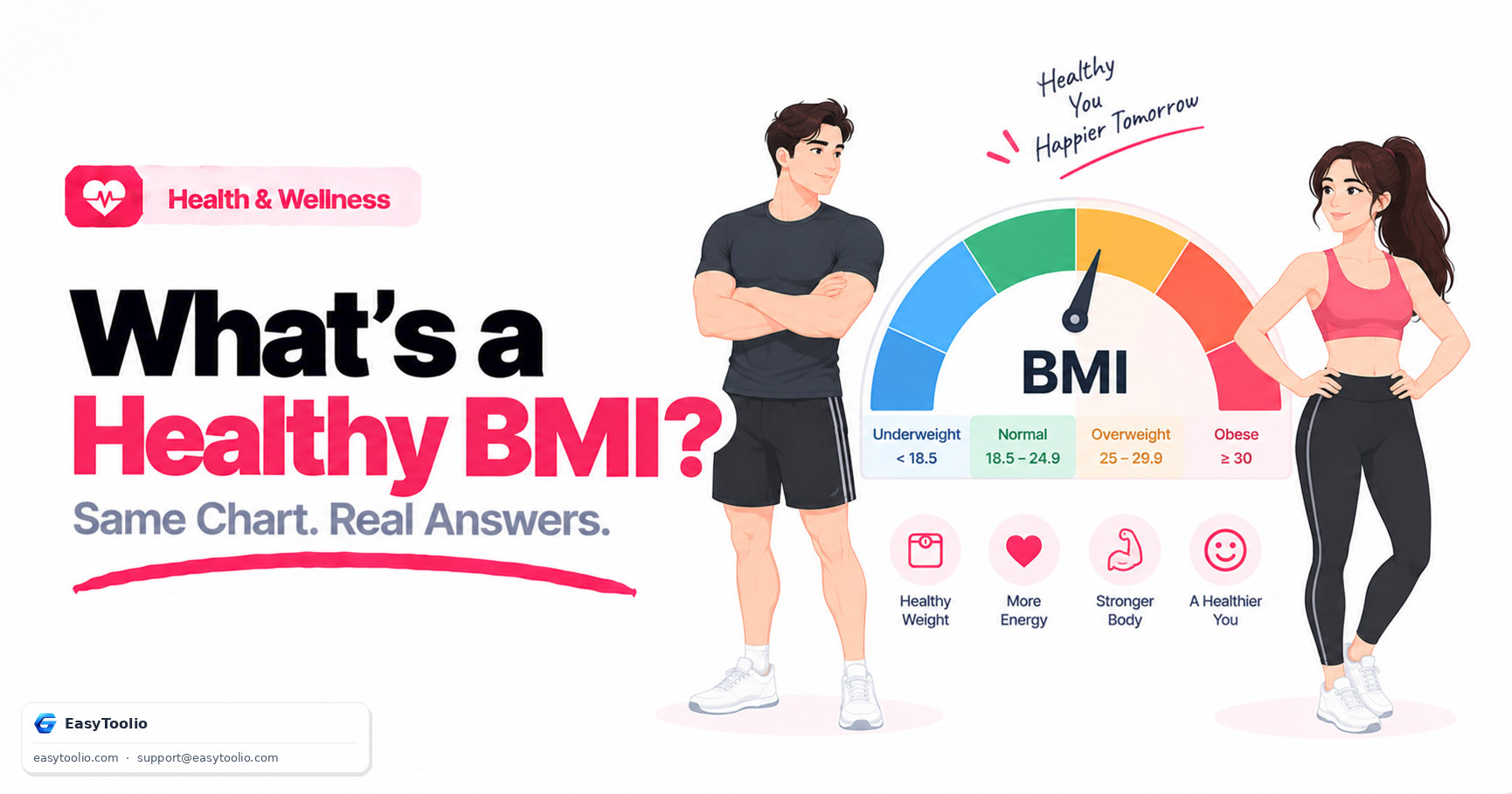
Body Mass Index (BMI) is the most widely used screening tool for weight categories worldwide. It is fast, free, and requires no equipment. Understanding what your BMI means — and what it cannot tell you — is a foundational health literacy skill.
The BMI Formula
BMI = Weight (kg) ÷ Height (m)²
Or in imperial units: BMI = (Weight in lbs × 703) ÷ Height (inches)²
Example: A person who weighs 70 kg and is 1.75 m tall: BMI = 70 ÷ (1.75)² = 70 ÷ 3.0625 = 22.9 (Normal weight)
The WHO BMI Classification Chart
| BMI Range | Category | Health Risk |
|---|---|---|
| Below 18.5 | Underweight | Nutritional deficiency, bone loss risk |
| 18.5 – 24.9 | Normal weight | Lowest risk range |
| 25.0 – 29.9 | Overweight | Moderately elevated metabolic risk |
| 30.0 – 34.9 | Obese Class I | High risk — diabetes, hypertension |
| 35.0 – 39.9 | Obese Class II | Very high risk |
| 40.0 and above | Obese Class III | Extremely high risk |
This classification is used by the WHO, CDC, and most national health bodies as the standard global reference.
BMI Reference Table for Adults
Here is a quick-reference table showing the weight ranges for a normal BMI (18.5–24.9) by height:
| Height | Minimum Normal Weight | Maximum Normal Weight |
|---|---|---|
| 155 cm (5'1") | 44 kg (97 lbs) | 60 kg (132 lbs) |
| 163 cm (5'4") | 49 kg (108 lbs) | 66 kg (146 lbs) |
| 170 cm (5'7") | 53 kg (117 lbs) | 72 kg (159 lbs) |
| 178 cm (5'10") | 59 kg (130 lbs) | 79 kg (174 lbs) |
| 185 cm (6'1") | 63 kg (139 lbs) | 85 kg (188 lbs) |
| 193 cm (6'4") | 69 kg (152 lbs) | 92 kg (203 lbs) |
BMI for Children and Teens
Adult BMI cut-offs do not apply to children or teenagers. For those aged 2–19, BMI is interpreted using age- and sex-specific growth charts as a BMI-for-age percentile:
| Percentile | Category |
|---|---|
| Below 5th | Underweight |
| 5th to 84th | Healthy weight |
| 85th to 94th | Overweight |
| 95th and above | Obese |
The Well-Known Limitations of BMI
BMI is a population-level screening tool, not a diagnostic measurement. Its key limitations:
1. It cannot distinguish muscle from fat. A 90 kg bodybuilder and a 90 kg sedentary adult at the same height will have the same BMI — but very different health profiles.
2. Fat distribution matters. Two people at BMI 27 can have very different risks depending on whether their fat is stored abdominally (higher risk) or peripherally (lower risk). Waist circumference is a better predictor of metabolic disease than BMI.
3. Different ethnic groups have different risk thresholds. Research shows that people of South Asian, East Asian, and some other ethnic backgrounds carry higher metabolic risk at lower BMI values than people of European descent.
A More Complete Picture
BMI is a useful starting point, but pair it with:
- Waist circumference: Men above 102 cm / Women above 88 cm = elevated risk
- Waist-to-height ratio: Below 0.5 is generally healthy for all adults
- Body fat percentage: More accurate measure of body composition
Use our BMI Calculator to find your BMI instantly, and our Ideal Weight Calculator to see the healthy weight range for your height using multiple established formulas.
Frequently Asked Questions
Q: What BMI range counts as a healthy weight? A: According to the WHO classification, a BMI between 18.5 and 24.9 is considered normal weight and carries the lowest health risk, while below 18.5 is underweight and 25.0 and above is overweight or obese.
Q: Does the healthy BMI range apply to children the same way as adults? A: No. For ages 2–19, BMI is interpreted using age- and sex-specific growth charts as a BMI-for-age percentile, where the 5th to 84th percentile is considered a healthy weight rather than fixed numeric cut-offs.
Q: Why can two people with the same BMI have very different health risks? A: BMI cannot distinguish muscle from fat, so a 90 kg bodybuilder and a 90 kg sedentary adult of the same height share an identical BMI despite very different health profiles; fat distribution and ethnicity-specific risk thresholds also affect how BMI should be interpreted.