
Notification
Go to Home All Tools Compare Glossary Blog Contact

Waist-to-Height Ratio Calculator

Calculate your waist-to-height ratio to assess body fat distribution and health risk, often considered more reliable than BMI alone.

cm
Measure just above belly button
cm

Waiting for details

Enter your height and waist circumference to calculate your health risk ratio.

Formula Reference

Waist-to-Height Ratio Formula

Waist-to-Height Ratio is a simple screening tool for central obesity, based on the guideline of keeping your waist circumference below half your height. Unlike BMI or Waist-to-Hip...

$$WHtR = \frac{\text{Waist Circumference}}{\text{Height}}$$
View Full Formula, Step-by-Step Guide & Worked Examples

WHtR vs BMI

Understanding why body fat distribution is critical.

The Muscle Problem

BMI often classifies athletes and muscular individuals as "overweight" because muscle is dense. WHtR ignores total weight and focuses entirely on the abdominal region, giving a clearer picture of fat storage.

Apple vs. Pear Shape

"Apple-shaped" bodies store fat centrally and have higher WHtRs and health risks. "Pear-shaped" bodies store fat in the hips and thighs, which is metabolically safer.

A Universal Rule

Unlike BMI thresholds which should ideally be adjusted by ethnicity and age, the "keep your waist to less than half your height" rule applies effectively across almost all demographics and ages.

Wellness & Health Coach

AI Advisor Health Advisor

Ask AI
Education

How Waist-to-Height Ratio Assesses Risk

01

The Ratio Formula

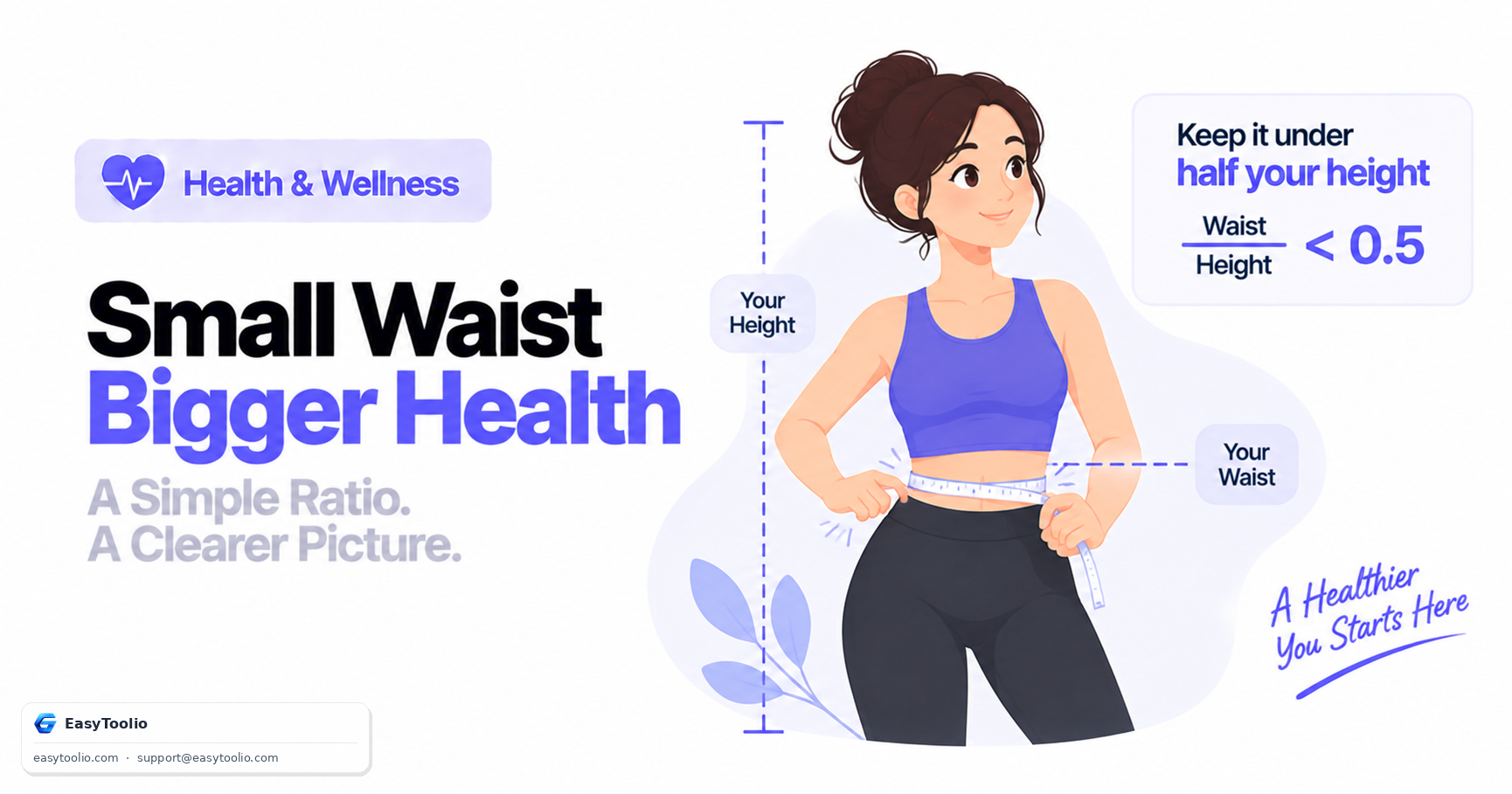
Waist-to-Height Ratio (WHtR) is calculated simply as waist circumference divided by height, using the same unit for both measurements. Unlike BMI, which only reflects total body mass, this ratio isolates abdominal fat specifically, since visceral fat around the midsection carries a stronger link to cardiovascular and metabolic risk than fat stored elsewhere.

02

Risk Bands

The calculator classifies your ratio into four bands: below 0.43 is flagged as an "Underweight Risk" range, 0.43 to 0.52 is the Healthy Range, 0.52 to 0.57 is Increased Risk, and above 0.57 is High Risk. The commonly cited "keep your waist under half your height" guideline corresponds to a ratio of 0.50, which falls within the healthy band.

03

Worked Example

For a waist circumference of 84 cm and a height of 175 cm, the ratio is 84 ÷ 175 = 0.48, landing in the Healthy Range. The calculator would also report an ideal maximum waist size of about 87.5 cm for that height, calculated as height × 0.5.

04

Where This Fits With Other Metrics

Because WHtR does not account for muscle mass, a very muscular person could show a slightly elevated ratio without having excess abdominal fat, so it works best alongside other measurements. Compare your results with the BMI Calculator or the Healthy Weight Range Calculator for a broader picture of body composition.

Good to know

Questions, answered

Quick answers about how this tool works.

Do not measure at your pants belt line. Find the midpoint between the bottom of your ribs and the top of your hip bones (usually just above the belly button). Breathe out naturally and measure without pulling the tape too tight.

A ratio between 0.43 and 0.52 is generally considered healthy for both men and women. A simple rule of thumb to remember is that your waist circumference should be less than half of your height (a ratio of 0.50).

A WHtR of less than 0.5 is generally considered healthy. A ratio above 0.5 indicates increased cardiovascular health risks.

WHtR measures central abdominal obesity, which is a stronger predictor of visceral fat deposits and metabolic diseases than BMI.

The same formula applies to children. Keeping their waist-to-height ratio below 0.5 is a strong indicator of healthy growth and development.

Popular Tools on EasyToolio

Swipe

What do you need to work out next?

Search 190+ free tools by name, or pick a category below. Every one runs instantly in your browser — no signup, nothing to install.