
Notification
Go to Home All Tools Compare Glossary Blog Contact

Healthy Weight Range Calculator

Find your healthy weight range based on height, age, gender, and body frame size, not just a single BMI number.

Enter Your Details

cm
kg

Examples

Ready to Calculate

Enter your details to generate your personalized healthy weight range and visual scale.

The Science of Weight Ranges

Understand the limitations of standard BMI and how body composition affects healthy targets.

Body Frame Variability

The standard BMI model assumes an average bone structure. By adjusting the healthy weight range ±10% for large or small frames, we account for the natural density of your skeletal system, preventing misclassification.

Muscle Mass Exceptions

Athletes and weightlifters carry significant lean muscle mass, which weighs more per volume than fat. If you are highly muscular, this calculator may categorize you as "Overweight" despite having a healthy, low body-fat percentage.

Why Stay in the Range?

Maintaining a weight within your calculated healthy range is statistically linked to lower risks of cardiovascular disease, hypertension, type 2 diabetes, and severe joint strain over your lifetime.

Formula Reference

BMI Formula

Body Mass Index (BMI) is a simple, widely used metric to estimate whether a person has a healthy body weight relative to their height. BMI categorizes individuals into underweight...

$$BMI = \frac{weight\ (kg)}{height^2\ (m^2)}$$
View Full Formula, Step-by-Step Guide & Worked Examples
Wellness & Health Coach

AI Advisor Health Advisor

Ask AI
Education

How Your Healthy Weight Range Is Calculated

01

The Global BMI Range Formula

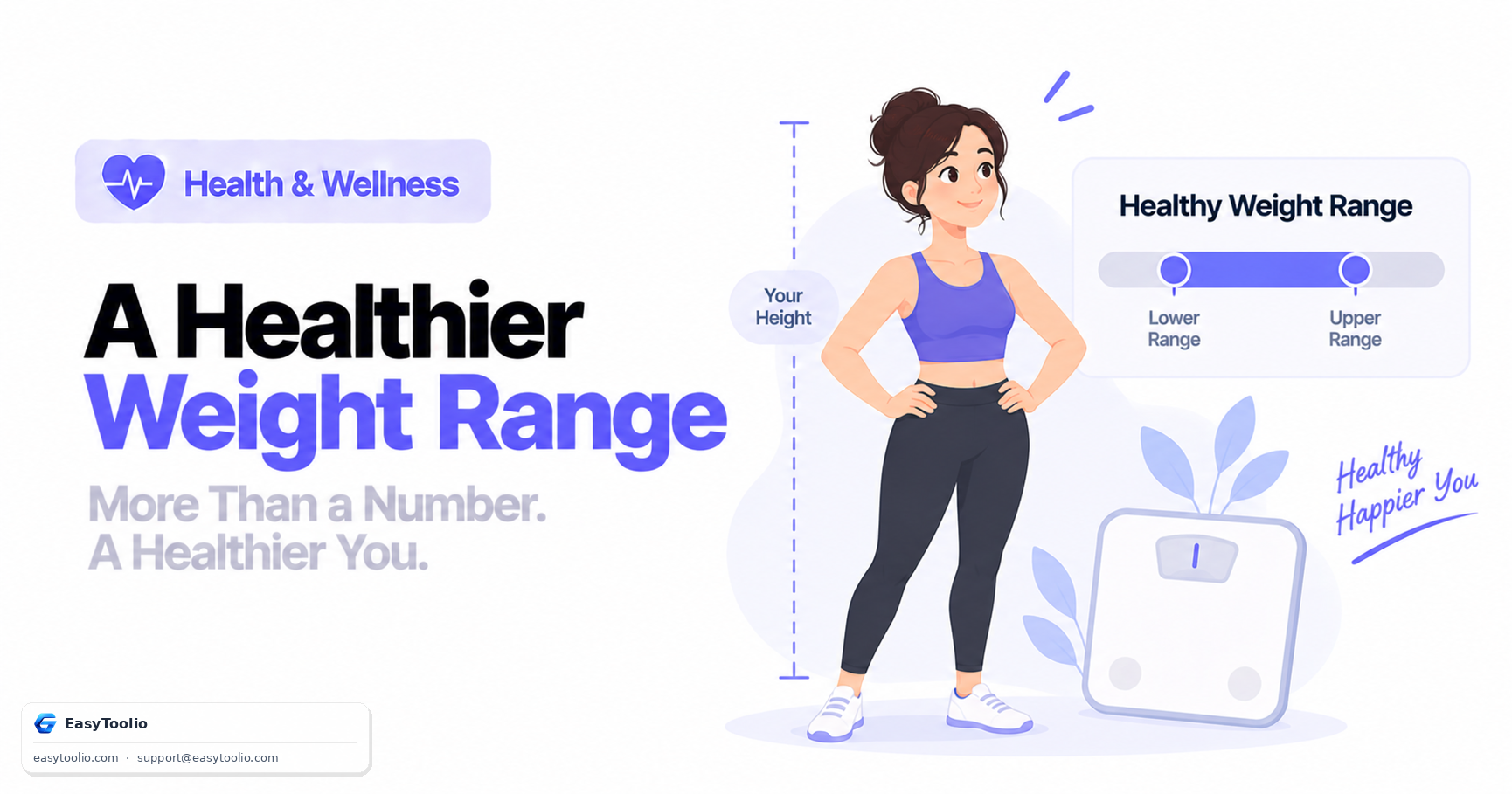
This calculator defines a healthy weight range as any weight producing a BMI between 18.5 and 24.9, calculated as minimum weight (kg) = 18.5 x height (m)² and maximum weight (kg) = 24.9 x height (m)². These are the standard global WHO cutoffs rather than the stricter Asian-Pacific thresholds used on some other BMI-based tools.
02

Body Frame Size Adjustment

The base range is then adjusted by a frame-size multiplier: a small frame reduces both bounds by 10% (multiplier 0.90), a large frame increases both bounds by 10% (multiplier 1.10), and a medium frame leaves the range unchanged. This accounts for the fact that a broader bone structure carries more lean mass at a given height.

03

Worked Example

For someone 165 cm (1.65 m) tall with a medium frame, the healthy range is 18.5 x 1.65² = 50.4 kg to 24.9 x 1.65² = 67.8 kg. For the same height with a large frame, both bounds shift upward by 10% to approximately 55.4 kg to 74.6 kg.

04

Compare With Related Tools

For a single clinically-targeted number rather than a range, try the Ideal Weight Calculator, or use the BMI Calculator to see how your current weight is classified using different regional standards.

Good to know

Questions, answered

Quick answers about how this tool works.

People with a large bone structure and wider shoulders (large frame) naturally carry more lean mass, so their healthy weight range is adjusted upwards by about 10%. Conversely, those with a smaller frame have their range adjusted downwards by 10%. This prevents the standard BMI scale from misclassifying healthy, broad-framed individuals as overweight.

The Ideal Weight Calculator uses specific clinical formulas (like Devine or Robinson) to pinpoint a single "ideal" target. This Healthy Weight Range Calculator uses the recognized healthy BMI bracket (18.5 - 24.9) to give you a broader, more flexible range of what is considered medically healthy for your height and frame.

Being below the range (underweight) can lead to weakened immunity and osteoporosis, while being above (overweight/obese) increases the risk of heart disease and type 2 diabetes. The calculator will show you exactly how many pounds or kilograms you need to gain or lose to reach the safe boundary.

A healthy BMI range is between 18.5 and 24.9. BMIs below 18.5 are underweight; BMIs of 25 and above are overweight.

BMI does not differentiate between fat and muscle mass. Athletes with high muscle mass may be classified as overweight despite having low body fat.

Popular Tools on EasyToolio

Swipe

What do you need to work out next?

Search 190+ free tools by name, or pick a category below. Every one runs instantly in your browser — no signup, nothing to install.