Notification
Go to Home All Tools Compare Glossary Blog Contact

TDEE Calculator

Calculate your Total Daily Energy Expenditure, the total calories you burn each day, based on your activity level and BMR.

Secure Daily Expenditure Estimates
Notice
Calculations run locally in client-side Javascript. No physiological metrics are shared or uploaded to the servers.

Energy Inputs

cm
kg
Biological Gender

Example Presets

Load representative profiles to check metrics:

TDEE Assessment

Awaiting Parameters

Fill in your physical attributes to predict resting energy expenditure and TDEE baselines.

Formula Reference

TDEE Formula

The Mifflin-St Jeor Equation calculates Basal Metabolic Rate (BMR) — the calories your body burns at complete rest — from weight, height, age, and gender. Multiplying BMR by an act...

$$\begin{aligned} BMR &= 10W + 6.25H - 5A + s \\ TDEE &= BMR \times \text{Activity Multiplier} \end{aligned}$$
View Full Formula, Step-by-Step Guide & Worked Examples

TDEE, Metabolism & Fitness Planning Guide

Understanding BMR, TEA, and TEF components of metabolism to structure calorie goals.

What is TDEE?

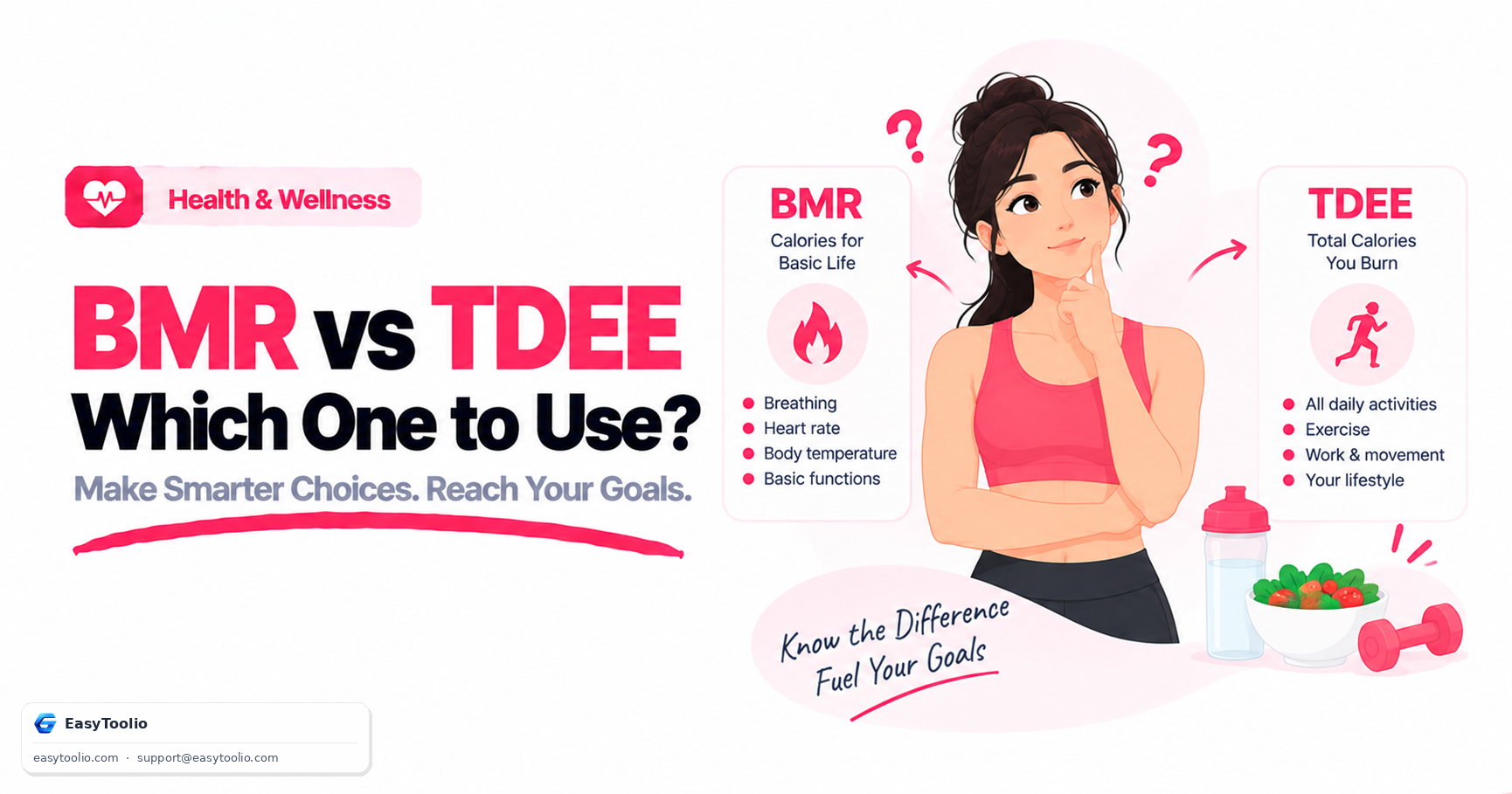
Total Daily Energy Expenditure represents the sum of calories burned in a 24-hour cycle. It is calculated by adding resting metabolism (BMR) with the energy burned during active movement and digestion.

Metabolic Components

  • BMR (~70%): Basal metabolic rate, energy required for resting biological processes.
  • TEA (~20%): Thermic effect of activity, calories burned during workouts, standing, and NEAT.
  • TEF (~10%): Thermic effect of food, calories burned processing and digesting meals.

Fitness Planning Adjustments

To construct a fitness regimen, adjust daily targets relative to TDEE:

  • • Deficit (Fat Loss): TDEE - 500 kcal
  • • Maintain (Stasis): TDEE baseline
  • • Lean Bulk (Muscle): TDEE + 300 kcal
  • • Surplus (Mass Gain): TDEE + 500 kcal
Wellness & Health Coach

AI Advisor Health Advisor

Ask AI
Education

How TDEE Is Calculated From BMR and Activity

01

Mifflin-St Jeor BMR to TDEE

The calculator first finds your Basal Metabolic Rate using the Mifflin-St Jeor equation (10 × weight in kg + 6.25 × height in cm − 5 × age, then +5 for men or −161 for women), then multiplies that BMR by an activity factor ranging from about 1.2 for sedentary lifestyles to nearly 1.9 for extremely active ones to get your TDEE.


02

Breaking TDEE Into Components

TDEE is split into three parts for the results breakdown: BMR (resting energy, the largest share), the Thermic Effect of Food fixed at 10% of TDEE, and the Thermic Effect of Activity, which is whatever calories remain after subtracting BMR and TEF from the total.

03

Worked Example

A 30-year-old, 80 kg, 178 cm male with moderately active habits (activity factor 1.55) has a BMR of about 1,768 calories, giving a TDEE near 2,740 calories. Of that total, roughly 274 calories represent food digestion (TEF) and about 698 calories represent daily movement and exercise (TEA).

04

Using TDEE for Goals

A fat-loss target is generally set at TDEE minus 500 calories and a muscle-building target at TDEE plus 300 calories, with a safety floor of 1,500 calories for men and 1,200 for women so recommendations never drop below what most adults need for basic function. Combine this baseline with the Macro Calculator to translate your calorie target into grams of protein, carbs, and fat, or the Water Intake Calculator for hydration needs.

Good to know

Questions, answered

Quick answers about how this tool works.

TDEE is composed of three main factors: Basal Metabolic Rate (BMR, resting calories, ~70%), Thermic Effect of Activity (TEA, energy burned during movement and exercise, ~20%), and Thermic Effect of Food (TEF, energy required to digest and process nutrition, ~10%).

To lose body fat, you must consume less than your TDEE (creating a calorie deficit, usually -500 calories/day). To build significant muscle tissue, consuming slightly above your TDEE (creating a calorie surplus of +300 to +500 calories/day) provides the body with the energy and raw building blocks required to synthesis new muscle fibers.

Total Daily Energy Expenditure (TDEE) is the total calories you burn in a day. It is BMR multiplied by your physical activity factor.

To lose weight, consume a caloric deficit (typically 300 to 500 calories below your calculated TDEE).

TDEE typically decreases as you age due to a gradual loss of muscle mass and changes in metabolic rates, making periodic recalculation helpful.

Popular Tools on EasyToolio

Swipe

What do you need to work out next?

Search 190+ free tools by name, or pick a category below. Every one runs instantly in your browser — no signup, nothing to install.