
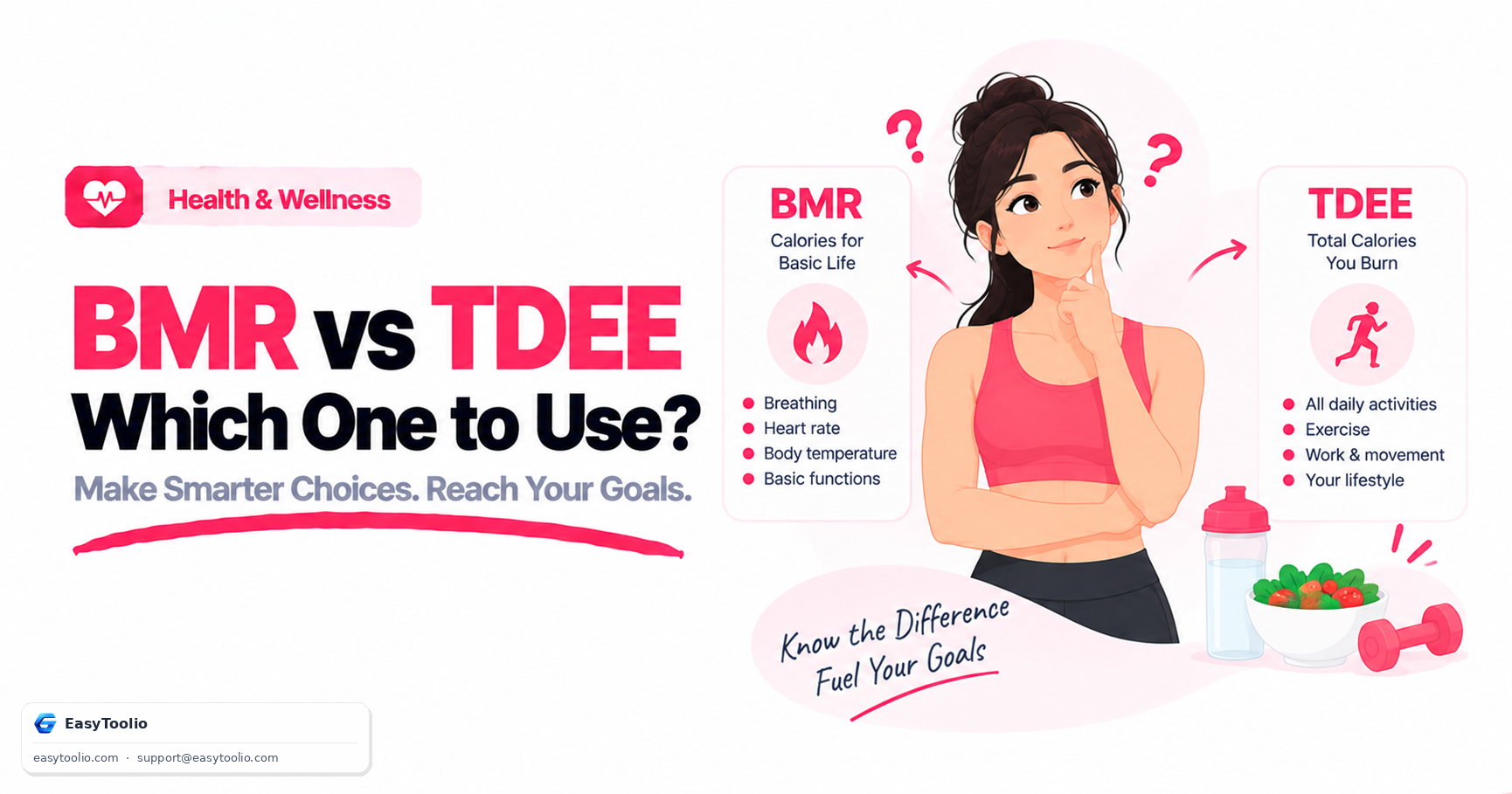
When people start tracking calories, a common mistake is eating at their BMR when they should be eating at their TDEE. The result is an unexpectedly severe calorie deficit that leads to fatigue, muscle loss, and an unsustainable diet. Understanding the difference between these two numbers is essential.
BMR: What Your Body Burns at Rest
Basal Metabolic Rate (BMR) is the number of calories your body needs simply to survive — breathing, circulation, cell repair, temperature regulation — assuming you lie completely still for 24 hours and do not eat.
BMR is calculated using the Mifflin-St Jeor equation:
- Men: (10 × kg) + (6.25 × cm) − (5 × age) + 5
- Women: (10 × kg) + (6.25 × cm) − (5 × age) − 161
For a typical 30-year-old woman (60 kg, 163 cm), BMR ≈ 1,352 calories.
TDEE: What You Actually Burn Each Day
Total Daily Energy Expenditure (TDEE) is your BMR multiplied by an activity factor that accounts for everything you do:
TDEE = BMR × Activity Multiplier (1.2 – 1.9)
For the same woman with a moderately active lifestyle: 1,352 × 1.55 = 2,095 calories/day.
Why the Difference Matters
| Scenario | Calories | What Happens |
|---|---|---|
| BMR only | 1,352 | Extreme deficit (−743 kcal) — fatigue, hair loss, muscle wasting |
| TDEE − 500 | 1,595 | Healthy deficit of ~500 kcal — ~0.5 kg loss per week |
| TDEE | 2,095 | Maintenance — no weight change |
| TDEE + 300 | 2,395 | Lean bulk — slow muscle gain |
Eating at your BMR when you are moderately active creates a 743-calorie daily deficit — equivalent to more than 1 kg of weight loss per week. This is too aggressive for most people and causes metabolic adaptation, where your body reduces its own BMR to compensate.
The Right Calorie Target for Weight Loss
The evidence-based approach is to eat at TDEE minus 20% for sustainable fat loss:
| TDEE | 20% Deficit Target | Expected Loss |
|---|---|---|
| 1,800 kcal | 1,440 kcal | ~0.35 kg/week |
| 2,200 kcal | 1,760 kcal | ~0.45 kg/week |
| 2,600 kcal | 2,080 kcal | ~0.52 kg/week |
| 3,000 kcal | 2,400 kcal | ~0.60 kg/week |
A 20% deficit is large enough to produce steady progress but small enough to preserve muscle mass, maintain energy levels, and be followed consistently.
Which Number Should You Use?
Use TDEE for every dietary calculation — not BMR. BMR is a component of TDEE, not a dietary target. Think of BMR as your baseline and TDEE as your actual calorie budget.
The only time you might reference BMR directly is if you are temporarily bed-ridden (post-surgery, illness) and need to estimate minimal calorie needs for recovery.
Calculate Both Numbers Instantly
Our BMR Calculator gives you your resting metabolic rate, and our TDEE Calculator converts it into a practical daily calorie target based on your activity level. Use both to build an accurate, personalised nutrition baseline.
Frequently Asked Questions
Q: What happens if I eat at my BMR instead of my TDEE? A: For a moderately active woman with a BMR of 1,352 and TDEE of 2,095, eating at BMR creates a 743-calorie daily deficit — more than 1 kg of weight loss per week — which is too aggressive and triggers metabolic adaptation.
Q: What is the recommended calorie deficit for sustainable weight loss? A: Eating at TDEE minus 20% is the evidence-based target; for example, a 2,200 kcal TDEE becomes a 1,760 kcal target, producing about 0.45 kg of loss per week.
Q: Should I ever use BMR instead of TDEE as my calorie target? A: Only in rare cases like being temporarily bed-ridden after surgery or illness — for everyone else, TDEE (not BMR) should be used as the actual dietary calorie budget.