
Notification
Go to Home All Tools Compare Glossary Blog Contact

Lean Body Mass Calculator

Calculate your lean body mass and fat-free mass using the Boer, James, or Hume formulas, or your known body fat percentage.

Secure Physical Composition Estimates
Notice
Calculations run locally in client-side Javascript. No weight, height, or fat measurements are uploaded to servers.

Body Parameters

kg
cm
Biological Gender
Range: 1 - 80%
%

Example Presets

Select a profile to load its composition values instantly:

Body Composition Summary

Awaiting Parameters

Fill in your physical weight, height, gender, and fat parameters to calculate your lean body mass breakdown.

Formula Reference

Lean Body Mass Formula

Lean Body Mass represents everything in the body except fat. The Boer formula estimates it directly from weight and height using gender-specific regression coefficients, without re...

$$\begin{aligned} \text{Boer (Male):} \quad &LBM = 0.407W + 0.267H - 19.2 \\ \text{Boer (Female):} \quad &LBM = 0.252W + 0.473H - 48.3 \end{aligned}$$
View Full Formula, Step-by-Step Guide & Worked Examples

Healthy Lean Body Mass Standards

Typical healthy lean mass and body fat percentage thresholds classified by biological gender.

🙋‍♀️

Women's Composition Standards

Women require higher essential body fat levels (10-13%) compared to men to support reproductive health, hormonal balance, and endocrine functions. Consequently, the healthy lean mass baseline percentage range is slightly lower.

LBM Percentage Body Fat Equivalent Category Description
87.0% - 90.0% 10.0% - 13.0% Essential Fat Only (Stage lean)
80.0% - 86.0% 14.0% - 20.0% Athletes / High Muscle Outline
76.0% - 79.0% 21.0% - 24.0% Fitness / Fit Athletic Range
69.0% - 75.0% 25.0% - 31.0% Average / Normal Store
< 68.0% ≥ 32.0% Over-fat / Obese Class Range
🏋️‍♂️

Men's Composition Standards

Men naturally have a larger skeletal mass and lower physiological fat demands (2-5% essential fat). The healthy lean mass percentage baseline is consequently higher. Ratios below 75% lean mass indicate potential fitness adjustments.

LBM Percentage Body Fat Equivalent Category Description
95.0% - 98.0% 2.0% - 5.0% Essential Fat Only (Stage lean)
87.0% - 94.0% 6.0% - 13.0% Athletes / High Muscle Outline
83.0% - 86.0% 14.0% - 17.0% Fitness / Fit Athletic Range
76.0% - 82.0% 18.0% - 24.0% Average / Normal Store
< 75.0% ≥ 25.0% Over-fat / Obese Class Range

Deep Dive: Body Composition & Muscle Development

Understanding fat-free mass index, muscle hypertrophy dynamics, and accurate body composition tracking.

What constitutes Lean Body Mass?

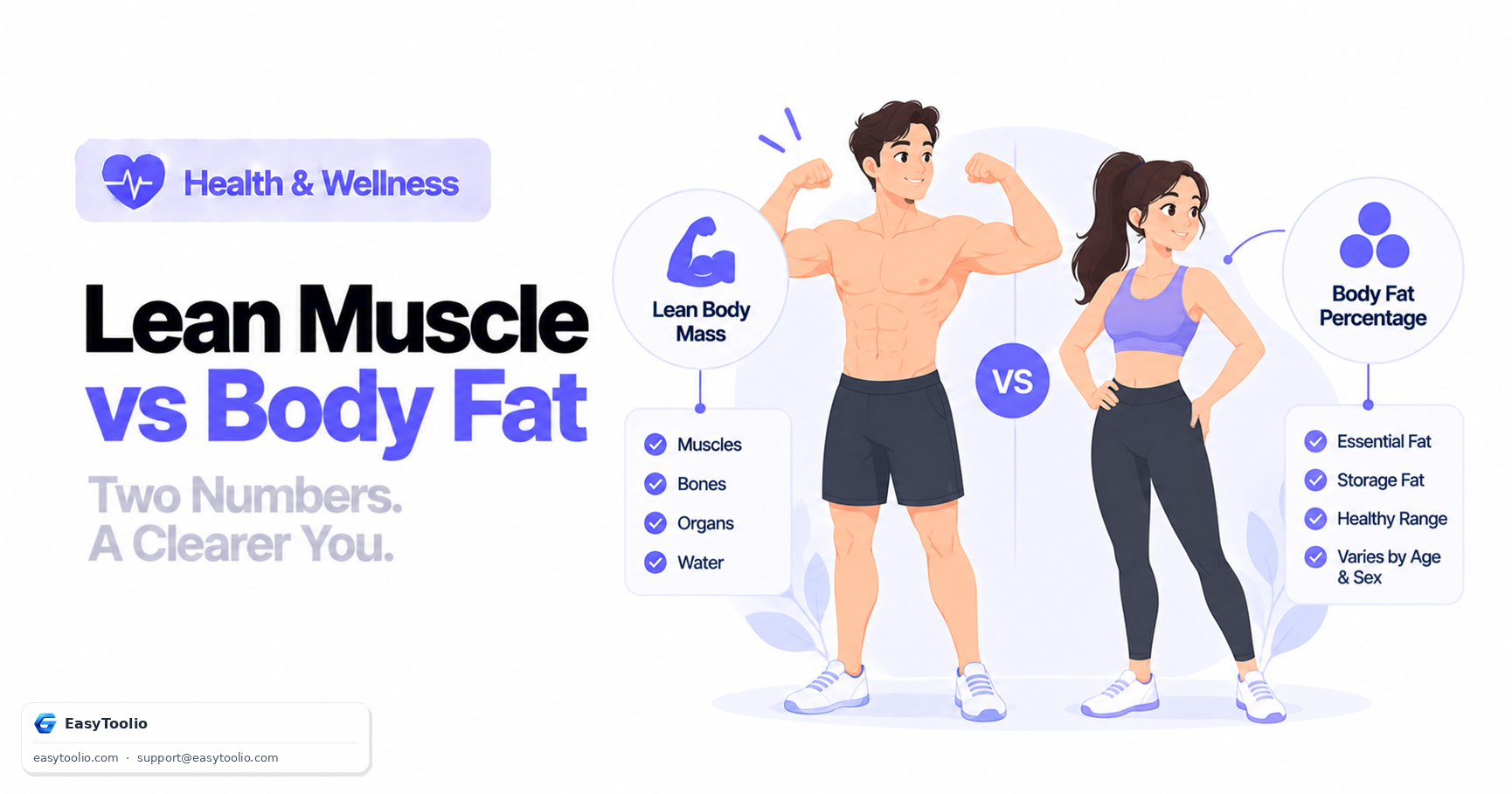
**Lean Body Mass (LBM)** is the weight of everything in the body except for adipose (fat) tissue. It is divided into:

  • Skeletal Muscle: The contractile tissue trained during lifting.
  • Essential Water: Intra- and extracellular fluids making up 60-70% of muscles.
  • Bone & Connective: The skeletal framework and joints.
  • Organs: The liver, heart, kidneys, and internal systems.

Muscle Development & Protein

To stimulate muscle growth (hypertrophy) and protect LBM during caloric restriction, you must create a stimulus via progressive overload strength training, and feed amino acids via dietary protein. Consuming **1.6 to 2.2 grams of protein per kilogram** of body weight triggers muscle protein synthesis (MPS) and helps block muscle tissue oxidation.

Fat-Free Mass Index (FFMI)

While BMI measures weight vs height without noting fat, **FFMI** isolates your relative muscle mass. Natural bodybuilders typically hit an upper ceiling around an FFMI of 25. Anything between 22 and 24 indicates superior natural muscle density, whereas values below 18 for men suggest potential benefits from additional resistance training.

Fat Loss vs. Weight Loss

Shedding pounds blindly on a scale can result in losing skeletal muscle instead of fat. Severe caloric deficits combined with poor protein intake force the body to strip amino acids from muscle fibers for fuel. Focus on a **moderate caloric deficit** (300-500 calories) to ensure your weight loss is fat loss while your Lean Body Mass stays protected.

How to Track Body Composition

Relying only on the scale can hide progress since you might gain muscle and lose fat simultaneously (body recomposition), leaving scale weight unchanged. Optimize your tracking by:

  • • Measuring waist/hip circumferences monthly.
  • • Taking consistent photos under identical lighting.
  • • Monitoring strength improvements in key lifts.
  • • Tracking metrics in this local history console.

Boer, James & Hume Formulas

When body fat is unknown, the calculator uses clinical equations. The **Boer** and **Hume** formulas are linear systems widely validated in drug dosage calibrations, whereas the **James** formula uses non-linear height-to-weight ratios. The calculator averages all three to counter any individual bias at extreme heights or weights.

Wellness & Health Coach

AI Advisor Health Advisor

Ask AI
Education

How Lean Body Mass Is Estimated

01

The Boer, James, and Hume Equations

When body fat percentage is not already known, this calculator averages three clinical equations. For men: Boer LBM = 0.407 x weight (kg) + 0.267 x height (cm) - 19.2; James LBM = 1.1 x weight (kg) - 128 x (weight / height)²; Hume LBM = 0.3281 x weight (kg) + 0.33929 x height (cm) - 29.5336. Each equation uses slightly different coefficients for women to reflect typical differences in muscle and bone mass.
02

The Direct Body Fat Method

If you already know your body fat percentage, for example from the Body Fat Calculator or a DEXA scan, Lean Body Mass is calculated directly and more simply as Weight x (1 - Body Fat% / 100), skipping the population-based equations entirely.

03

Worked Example

For a man weighing 80 kg who is 180 cm tall, the three equations give approximately 61.4 kg (Boer), 62.7 kg (James), and 57.8 kg (Hume), which average to about 60.6 kg of lean mass, implying a body fat percentage of roughly (80 - 60.6) / 80, or about 24%.

04

Use With Related Tools

Tracking lean mass over time alongside the Body Fat Calculator and BMI Calculator gives a clearer picture of whether weight changes come from muscle or fat, which is especially useful during structured training or dieting phases.

Good to know

Questions, answered

Quick answers about how this tool works.

Lean Body Mass is the total weight of your body minus your fat mass. It includes skeletal muscle, bones, organs, blood, connective tissue, and water content. LBM is the metabolically active tissue that burns calories even at rest.

If you know your body fat percentage, LBM is calculated directly as: Weight * (1 - Body Fat% / 100). If you do not know it, the calculator uses the Boer (1984), James (1976), and Hume (1966) equations, which estimate LBM based on your height, weight, and biological gender.

FFMI is a metric that evaluates your muscle mass relative to your height, similar to how BMI evaluates total weight. It is calculated as LBM (kg) / Height (m)². A normalized FFMI adjusts for heights different from 1.8 meters, allowing comparison of muscularity across individuals.

Ideal LBM depends on gender, age, and fitness goals. Typically, a healthy LBM range is 76% to 92% of total weight for men (corresponding to 8% to 24% body fat) and 69% to 80% of total weight for women (corresponding to 20% to 31% body fat).

You can increase your LBM by engaging in regular progressive resistance training (weightlifting), consuming adequate dietary protein (typically 1.6 to 2.2g per kg of body weight), ensuring proper recovery/sleep, and maintaining a slight caloric surplus or a minor deficit (during body recomposition).

Popular Tools on EasyToolio

Swipe

What do you need to work out next?

Search 190+ free tools by name, or pick a category below. Every one runs instantly in your browser — no signup, nothing to install.