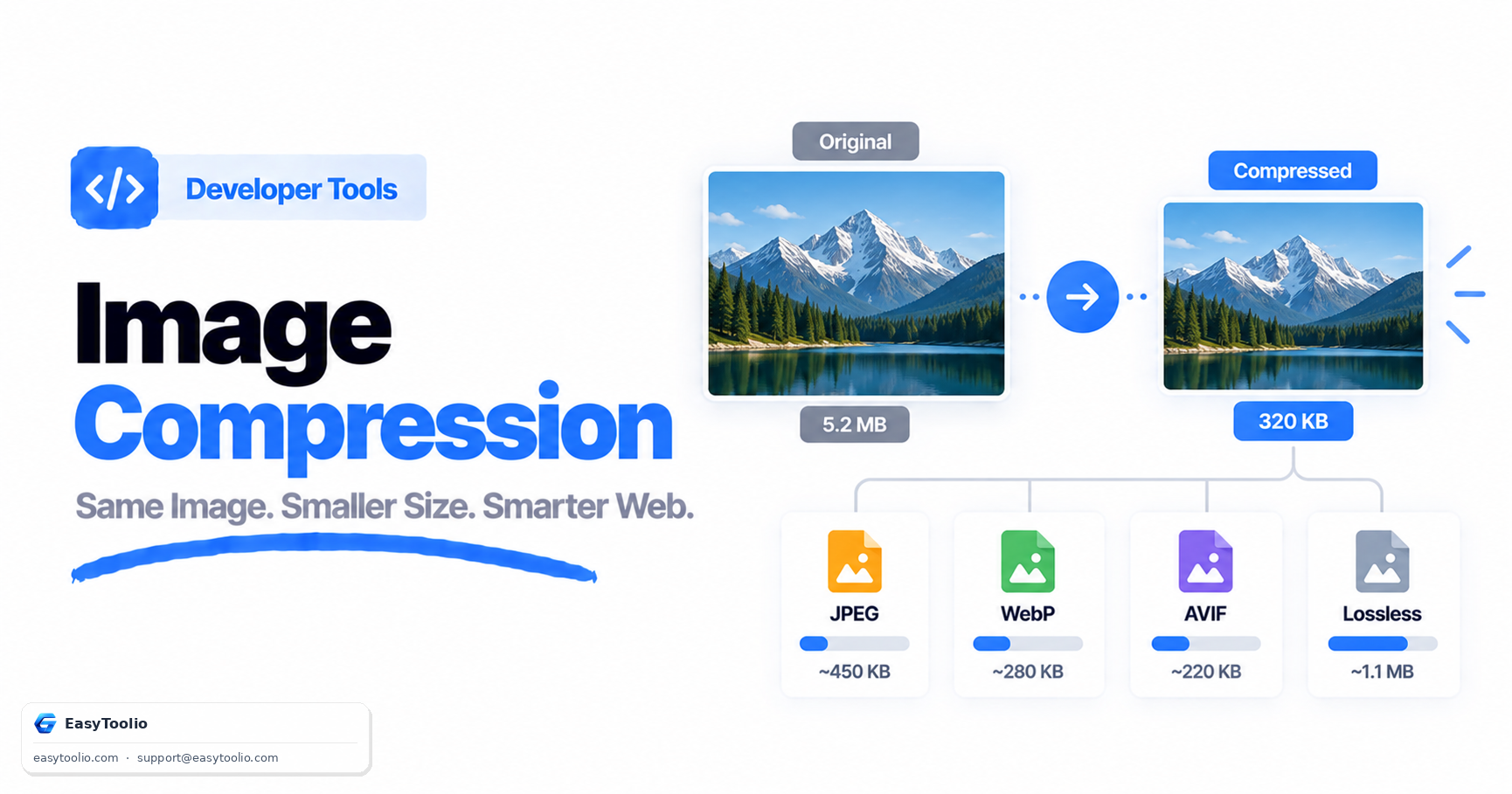
Optimizing web media requires balancing visual fidelity against file payload size. Every image displayed in a browser undergoes mathematical compression to reduce byte transfer size. Choosing the right format—whether legacy JPEG, modern WebP, or next-generation AVIF—requires understanding the core mathematical principles of Lossy and Lossless compression.
Direct Answer: Lossless compression reduces file size without discarding any pixel data; when uncompressed, the output image matches the original byte-for-byte (using algorithms like LZ77, Huffman coding, or DEFLATE). Lossy compression achieves dramatically smaller file sizes (50%–90% reduction) by discarding high-frequency spatial color information that the human eye cannot perceive (using Discrete Cosine Transform (DCT), Chroma Subsampling, and Quantization matrices). Use AVIF for maximum compression efficiency on modern web browsers, WebP for broad legacy fallback support, and PNG only for sharp vector graphics requiring pixel-perfect lossless transparency.
1. Mathematical Mechanics: Lossy vs Lossless Pipelines
The internal processing stages of image encoding differ fundamentally:
The Lossy Pipeline (JPEG / WebP Lossy / AVIF):
- Color Space Transformation: Converts RGB (Red, Green, Blue) to YCbCr (Luminance $Y$, Blue-Difference $Cb$, Red-Difference $Cr$).
- Chroma Subsampling: Because human vision is far more sensitive to brightness ($Y$) than color ($Cb/Cr$), color channels are downsampled (e.g.,
4:2:0subsampling drops 75% of color resolution without noticeable degradation). - Discrete Cosine Transform (DCT) / Frequency Transform: Converts 8 × 8 pixel blocks from spatial domain values to frequency domain coefficients.
- Quantization (The Lossy Step): High-frequency coefficients are divided by a quantization matrix and rounded to integers. High-frequency zeroes are created, permanently discarding unnoticeable visual details.
- Entropy Encoding: The resulting quantized matrix is compressed using lossless Huffman or Arithmetic coding.
RGB Image ──► YCbCr Conversion ──► Chroma Subsampling (4:2:0) ──► DCT Transform ──► Quantization Matrix (Lossy Step) ──► Entropy Coding ──► File Payload
To compress, convert, and resize images for your web applications, use the Image Compressor, Converter & Resizer.
2. Codecs vs Containers: WebP, AVIF & JPEG Breakdown
A common point of confusion is distinguishing the image container format from the underlying video/image codec:
- JPEG (JFIF): Introduced in 1992. Uses 8 × 8 DCT and Huffman encoding. Supports lossy compression only. No alpha channel transparency.
- WebP: Developed by Google based on the VP8 video intra-frame codec. Supports both lossy and lossless modes, 8-bit alpha transparency, and animations. Achieves ~25%–34% smaller payloads than JPEG at equivalent SSIM quality scores.
- AVIF (AV1 Image File Format): Based on the AV1 video codec (developed by the Alliance for Open Media). Employs directional intra-frame prediction, 4 × 4 to 64 × 64 variable transform blocks, and 10/12-bit wide color gamut support. Delivers ~50% payload savings compared to JPEG and ~20% compared to WebP.
3. Head-to-Head Format Comparison Matrix
| Feature / Metric | JPEG | PNG | WebP | AVIF |
|---|---|---|---|---|
| Compression Mode | Lossy | Lossless | Lossy & Lossless | Lossy & Lossless |
| Underlying Tech | 8 × 8 DCT | DEFLATE (LZ77 + Huffman) | VP8 Intra-frame | AV1 Intra-frame |
| Alpha Transparency | No | Yes (8-bit) | Yes (8-bit) | Yes (8-bit / 10-bit) |
| HDR / Color Depth | 8-bit | 8-bit / 16-bit | 8-bit | 8-bit, 10-bit, 12-bit HDR |
| Browser Support | 100% (Universal) | 100% (Universal) | >97% (All modern browsers) | >93% (Chrome, Firefox, Safari) |
| Encoding Speed | Instant | Fast | Fast | Slower (High CPU compression) |
4. Visual Quality Metrics: PSNR vs SSIM
Evaluating compression algorithms relies on objective mathematical benchmarks rather than subjective visual inspection:
- PSNR (Peak Signal-to-Noise Ratio): Measures logarithmic mean squared error (MSE) between original and compressed pixel values. Higher values (dB) indicate closer raw byte alignment.
- SSIM (Structural Similarity Index Measure): Models human visual perception by measuring structural luminance, contrast, and visual correlation across image patches. Scale ranges from -1 to 1 (1.0 = identical perceptual structure).
To test how optimized web images impact Core Web Vitals and Largest Contentful Paint (LCP), analyze pages with the Page Speed & Core Web Vitals Analyzer and encode asset data URLs with the Base64 Encoder Decoder.
5. Frequently Asked Questions (FAQs)
Does converting a JPEG to WebP or AVIF improve its quality?
No. Re-encoding a JPEG to another format cannot recover detail already discarded during the original lossy quantization step. Converting an already-compressed lossy JPEG only adds a second generation of quantization loss unless you re-encode from the original uncompressed source image.
Why does AVIF take longer to encode than WebP or JPEG?
AVIF's encoder evaluates many more prediction modes and variable transform block sizes (from 4x4 up to 64x64) inherited from the AV1 video codec, searching for the most efficient way to represent each region of the image. This exhaustive search yields better compression ratios but costs significantly more CPU time than JPEG's fixed 8x8 DCT or WebP's simpler VP8-based encoding.
Should PNG be used for all web images since it's lossless?
No. PNG's lossless guarantee makes its files much larger than lossy formats for photographic content, so it should be reserved for images that need pixel-perfect fidelity or alpha transparency, such as logos, icons, and screenshots with sharp edges, while photographs are far better served by WebP or AVIF.
References: ISO/IEC 10918 (Information Technology - Digital Compression and Coding of Continuous-Tone Still Images, JPEG); IETF RFC 1951 (DEFLATE Compressed Data Format Specification).