
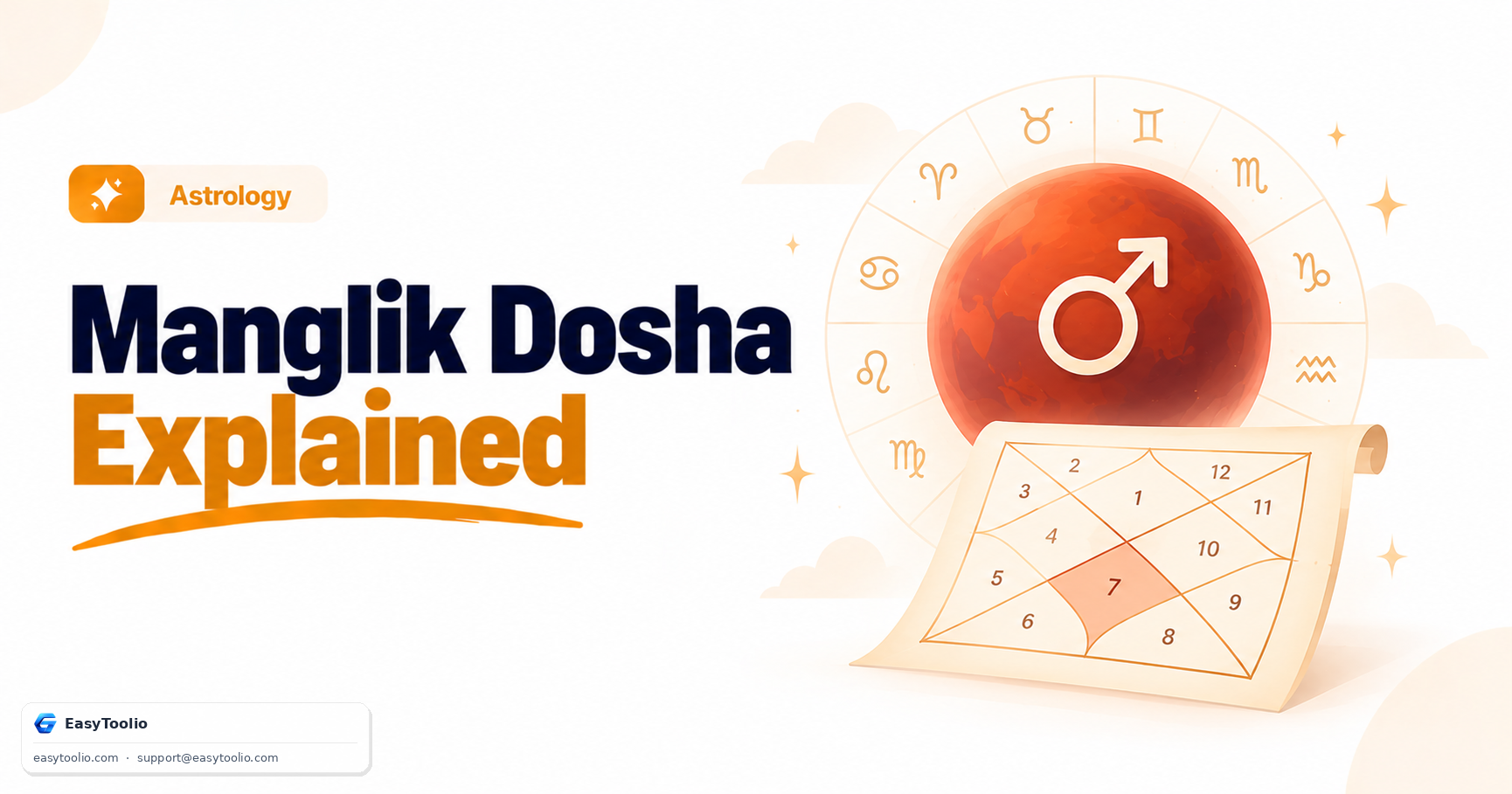
Few terms in Indian matchmaking generate as much anxiety as "Manglik." A single line in a birth chart report — "native is Manglik" — has ended promising matches, triggered urgent calls to family astrologers, and in some cases prompted entire ceremonies designed specifically to neutralise it. Understanding what Manglik Dosha actually measures, and how nuanced the traditional rules around it really are, replaces panic with perspective.
What Is Manglik Dosha?
Manglik Dosha (also called Kuja Dosha or Bhom Dosha) refers to a specific placement of Mars (Mangal) in a person's birth chart. In Vedic astrology, Mars is considered a fiery, aggressive planet, and its placement in certain houses is traditionally believed to introduce friction, impulsiveness, or conflict into married life.
A person is generally considered Manglik if Mars is placed in the 1st, 2nd, 4th, 7th, 8th, or 12th house counted from at least one of three reference points:
- The Lagna (Ascendant/rising sign)
- The Moon sign
- The Venus position (used by some traditions, particularly for assessing the spouse's temperament)
Different schools of astrology weight these three reference charts differently, which is one reason two astrologers can occasionally disagree on whether someone is "fully" Manglik.
Why It's Traditionally Linked to Marital Friction
Each of the six houses carries a specific traditional significance related to married life:
| House | Traditional Significance |
|---|---|
| 1st | Self, personality, physical vitality |
| 2nd | Family, speech, wealth |
| 4th | Domestic happiness, home environment |
| 7th | Marriage and spouse directly |
| 8th | Longevity, transformation, in-laws |
| 12th | Bed pleasures, losses, foreign settlement |
Mars occupying these positions is traditionally read as Mars's assertive, combative energy intruding on domains tied to domestic harmony — hence the association with disagreements, delayed marriage, or friction between spouses. It's important to frame this as traditional belief, not an empirically established outcome; it is one interpretive lens among many that Vedic astrology offers.
Degrees of Severity
Not all Manglik placements are treated as equally significant. Traditional classification generally recognises:
- Low Manglik (Anshik Manglik): Mars is Manglik from only one of the three reference points (e.g., only from Venus, not from Lagna or Moon), or is in a house considered mildly afflicting.
- Medium Manglik: Mars is Manglik from two of the three reference points.
- High Manglik: Mars is Manglik from all three reference points, or placed in the more heavily weighted 7th or 8th house.
A Manglik Dosha Calculator evaluates all three reference points automatically from your birth date, time, and place, giving you a clear severity classification rather than a simple yes/no.
Cancellation Rules (Dosha Nivarana)
Classical texts provide several conditions under which Manglik Dosha is considered cancelled or significantly weakened:
- Both partners are Manglik. This is the most commonly cited cancellation rule — if both partners in a proposed match are Manglik to a similar degree, the doshas are traditionally believed to neutralise each other, since both charts carry the same Martian influence.
- Mars is placed in its own sign or exaltation sign. If Mars sits in Aries, Scorpio (its own signs), or Capricorn (exaltation), some traditions hold that its affliction is reduced because it acts from strength rather than aggression.
- Specific age and gender exceptions. Some traditional texts hold that Manglik Dosha weakens naturally after a certain age (commonly cited as 28-30), since Mars's influence is considered to mellow with maturity.
- Aspect or conjunction with benefic planets. A strong aspect from Jupiter, or conjunction with certain benefics, is sometimes read as softening the affliction.
Because these cancellation rules vary by regional tradition and astrologer, it's common practice to run a joint Kundli comparison — using a Kundli Matching Calculator — rather than evaluating Manglik status for one person in isolation.
Common Remedies
For couples or families who want to address a Manglik placement according to tradition, commonly recommended remedies include:
- Kumbh Vivah: A symbolic ceremony where the Manglik individual is first "married" to a clay pot, banana tree, or Peepal tree, which is then ritually destroyed or discarded — the belief being that this absorbs the dosha before the real marriage.
- Mangal Shanti Puja: A dedicated worship ritual to Mars, typically performed at a temple, intended to pacify the planet's energy.
- Wearing red coral (Moonga): A gemstone traditionally associated with strengthening a well-placed Mars or appeasing a poorly placed one, usually recommended only after chart-specific consultation.
- Fasting on Tuesdays: Tuesday is considered Mars's day in Vedic tradition, and fasting is a common personal remedy.
- Reciting the Hanuman Chalisa or Mars mantras: Hanuman is associated with Mars energy in devotional practice and is a common devotional remedy.
A Balanced, Modern Perspective
It's worth being direct here: a growing number of contemporary astrologers and, more broadly, most urban Indian matchmaking conversations increasingly treat Manglik status as one data point among many — alongside compatibility of values, financial stability, family expectations, and personal chemistry — rather than an automatic dealbreaker. Severity, cancellation conditions, and the overall chart context matter far more than the single label "Manglik" or "non-Manglik." Many happy, long-lasting marriages include one or both Manglik partners.
Frequently Asked Questions
Q: What houses does Mars need to occupy for someone to be considered Manglik? A: Mars placed in the 1st, 2nd, 4th, 7th, 8th, or 12th house from the Lagna, Moon sign, or Venus is traditionally classified as Manglik, with the exact severity depending on how many of these three reference points show the affliction.
Q: Does Manglik Dosha automatically cancel if both partners are Manglik? A: This is the most widely cited cancellation rule in classical texts — both partners carrying a similar Mars affliction is traditionally believed to neutralise the dosha between them. However, many astrologers still check the specific houses and severity involved rather than treating this as an automatic pass.
Q: Is Manglik Dosha considered a serious problem by most astrologers today? A: Views vary, but many contemporary astrologers frame it as one traditional factor to consider alongside compatibility, family circumstances, and personal rapport, rather than a definitive predictor of marital difficulty. Severity level and applicable cancellation rules typically matter more than the binary Manglik/non-Manglik label.