If you've heard a relative say "Shani ki sade sati chal rahi hai" in a worried tone, you've encountered one of the most talked-about — and most misunderstood — concepts in Vedic astrology. Sade Sati literally means "seven and a half," referring to the roughly 7.5-year period during which Saturn transits three houses relative to your natal Moon sign. Here's what it actually involves, phase by phase.
What Is Sade Sati?
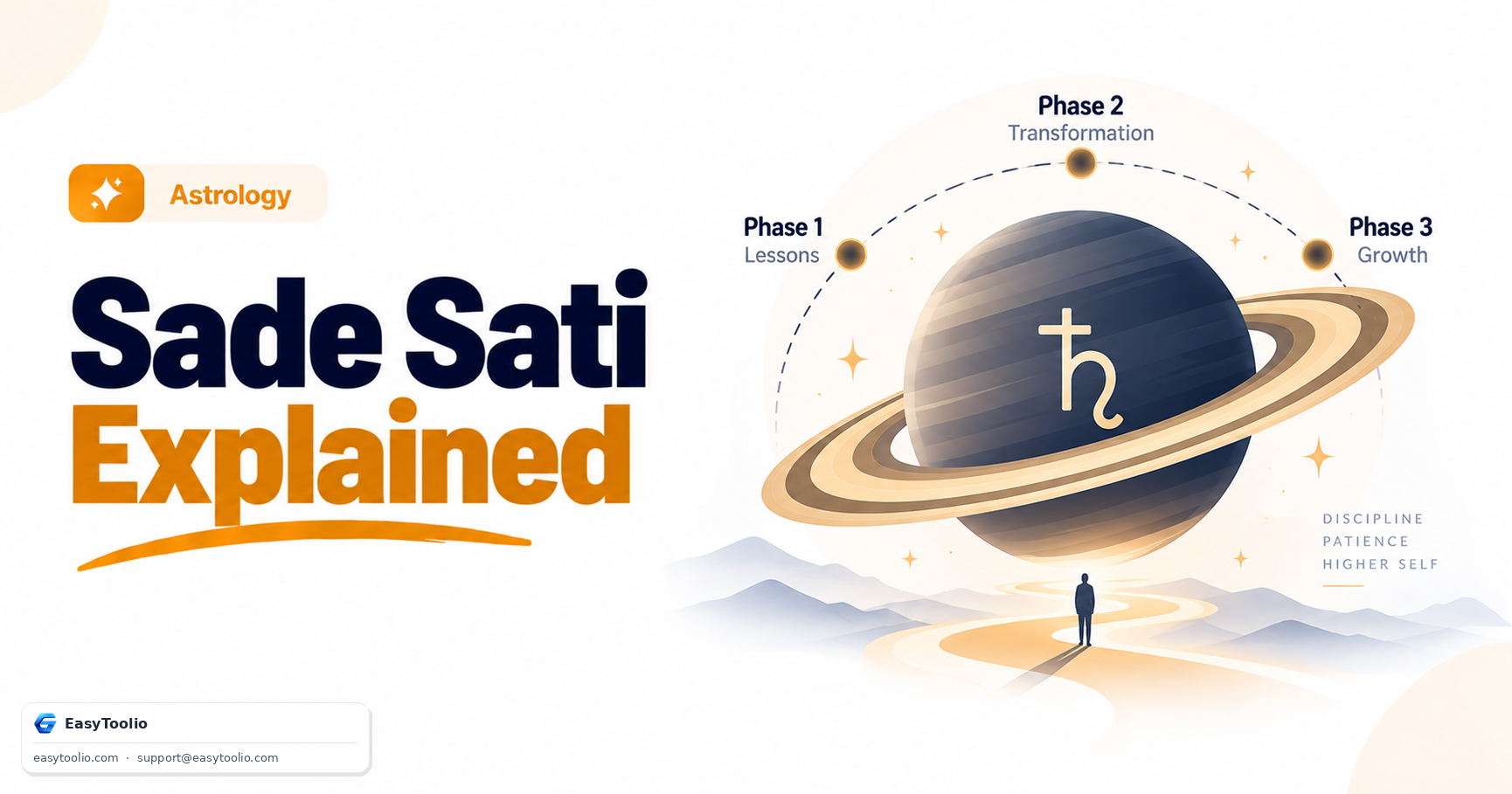
Saturn (Shani) takes approximately 29.5 years to complete one full orbit through the zodiac, spending roughly 2.5 years in each sign. Sade Sati refers to the period when Saturn transits through:
- The sign immediately before your natal Moon sign (12th from Moon)
- Your natal Moon sign itself (1st from Moon)
- The sign immediately after your natal Moon sign (2nd from Moon)
Since Saturn spends about 2.5 years in each of these three signs, the full cycle lasts approximately 7.5 years — hence "Sade Sati." Every person experiences this transit roughly twice, sometimes three times, over an average lifetime, since Saturn's full zodiac cycle repeats roughly every 29.5 years.
You can find your exact Sade Sati dates using a Sade Sati Calculator, which only needs your birth date, time, and place to determine your Moon sign and then map Saturn's current and upcoming transits against it.
The Three Phases
Traditional Vedic astrology treats the three legs of Sade Sati as distinct in intensity and theme, rather than one uniform 7.5-year block.
Phase 1: Rising Sade Sati (12th house from Moon)
Saturn transits the sign before your Moon sign. This phase is traditionally associated with:
- Increased expenses or financial restructuring
- Subtle anxiety or a sense of unease before visible changes appear
- Foundational shifts — career reconsideration, relocation discussions — that set up the more visible changes to come
Phase 2: Peak Sade Sati (Moon sign itself)
Saturn transits directly over your natal Moon sign. This is traditionally considered the most intense phase, since Saturn is directly conjunct the planet governing your mind and emotions. Commonly associated themes include:
- Heightened emotional pressure or mental fatigue
- Major life decisions coming to a head — job changes, relationship turning points
- A period requiring discipline, patience, and realistic expectations rather than impulsive decisions
Phase 3: Setting Sade Sati (2nd house from Moon)
Saturn transits the sign after your Moon sign. This phase traditionally relates to:
- Family responsibilities, speech, and financial consolidation
- The settling-in of changes made during the peak phase
- A gradual easing of pressure as Saturn moves toward exit
How to Calculate When Your Sade Sati Starts and Ends
The calculation requires two pieces of information: your natal Moon sign and Saturn's current sign position.
Step-by-Step Example
Suppose your Moon sign is Cancer.
- Rising phase begins when Saturn enters Gemini (the sign before Cancer)
- Peak phase begins when Saturn enters Cancer itself
- Setting phase begins when Saturn enters Leo (the sign after Cancer)
- Sade Sati fully ends when Saturn exits Leo and enters Virgo
Since Saturn moves through the zodiac at a known, published pace (roughly 2.5 years per sign, though it can vary somewhat due to retrograde motion), astrologers and calculators reference Saturn's actual ephemeris position to pin down real transit dates rather than a fixed formula — which is why using a calculator or verified panchang is more reliable than estimating by hand.
Traditional Remedies
For those who wish to observe traditional remedial practices during Sade Sati, commonly recommended options include:
- Shani Mantra recitation: Chanting "Om Sham Shanicharaya Namah" is a widely practiced devotional remedy.
- Saturday fasting: Saturn's day in the Vedic week is Saturday, and fasting on this day is a common personal discipline.
- Donating black items: Black sesame seeds, black cloth, iron, or mustard oil donated to the needy on Saturdays is a traditional charitable remedy associated with pacifying Saturn.
- Hanuman worship: Hanuman is traditionally regarded as offering protection from Saturn's harsher effects, making Hanuman Chalisa recitation a common devotional practice during this period.
- Wearing blue sapphire (Neelam): Recommended only after careful chart-specific consultation, as this is considered a powerful and sometimes unpredictable gemstone.
A Grounded Perspective on Sade Sati
It's worth stepping back from the fear-driven framing that sometimes surrounds this topic. Saturn, across Vedic astrology broadly, is associated with discipline, structure, responsibility, and long-term consequence — not simply "bad luck." Many astrologers describe Sade Sati less as a curse and more as a period of restructuring and forced maturity: a stretch of years when shortcuts stop working, effort gets tested, and the changes that stick are the ones built on real discipline rather than luck.
Framed this way, the traditional advice associated with Sade Sati — patience, financial prudence, avoiding major impulsive decisions, and doubling down on consistent effort — holds up as generally sound guidance regardless of how literally one interprets the astrological mechanism behind it.
Frequently Asked Questions
Q: How long does Sade Sati last in total? A: Sade Sati lasts approximately 7.5 years in total, split across three phases of roughly 2.5 years each, as Saturn transits the signs before, over, and after your natal Moon sign.
Q: Which phase of Sade Sati is considered the most intense? A: The second phase — when Saturn transits directly over your natal Moon sign — is traditionally considered the peak and most intense phase, since Saturn is conjunct the planet governing emotional and mental disposition.
Q: How many times does a person experience Sade Sati in their life? A: Since Saturn's full zodiac cycle takes about 29.5 years, most people experience Sade Sati two to three times across an average lifespan, roughly once every three decades.