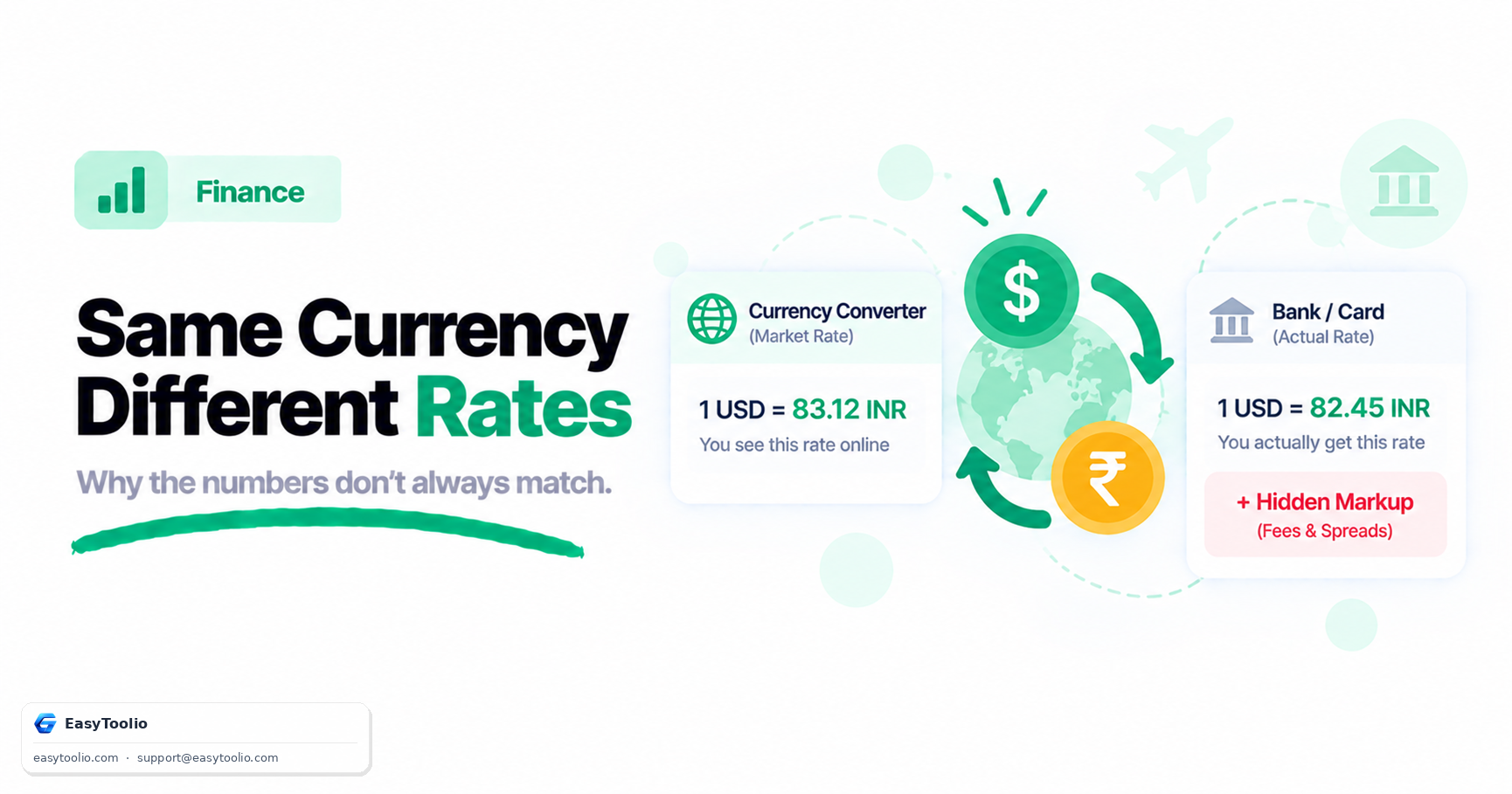
You punch 1,000 USD into a Currency Converter, it tells you that's worth roughly 83,000 INR at today's rate, so you walk into your bank or open your card statement expecting close to that number — and instead you get noticeably less. No error occurred. No fraud happened. The tool wasn't lying to you either. It's just answering a different question than the one you actually needed answered.
Direct Answer: The number a currency converter or a Google search shows you is the "mid-market rate" — the real, wholesale rate at which banks and large institutions trade currencies with each other on the interbank market, with no markup attached. No individual consumer transaction happens at that rate. When you actually convert money — through a bank, a credit card network, an airport kiosk, or a money-changer — the institution adds its own spread on top of the mid-market rate (effectively pricing the currency slightly worse for you than the real rate) and frequently tacks on a separate, explicitly stated conversion or transaction fee as well. To estimate the real effective rate you'll get, take the rate you were actually quoted (or the amount you were actually charged, divided back into the foreign currency amount) and compare it against the mid-market rate for that same day: the percentage difference between the two is your hidden markup, and it's often larger than people assume, especially at airport kiosks and on some default credit card settings. This is for educational/planning purposes and not personalized financial advice.
What "Mid-Market Rate" Actually Means
The mid-market rate is calculated as the midpoint between the global buy and sell prices for a currency pair at a given moment, aggregated from interbank trading. It's the rate that shows up on Google, on Reuters, on XE, and on most currency converter tools — because it's the only rate that's genuinely objective and doesn't depend on who's asking. It updates continuously as currencies trade, which is why the number on your screen shifts slightly every time you refresh.
The catch is that this rate is a benchmark, not an offer. No consumer-facing institution is obligated to give it to you, and in practice, none of them do, because they're running a business that needs to earn something on the conversion.
Where the Spread Comes From
Every institution that converts currency for you — a retail bank, a card network, a money-changer counter — builds in a spread: they buy currency from you (or sell it to you) at a rate shifted slightly away from the mid-market rate, in their favor. This is functionally identical to how a currency trading desk makes money on volume rather than fees: the spread itself is the revenue.
On top of the spread, many providers add a second, separate charge — a flat conversion fee, a percentage-based "foreign transaction fee" on card statements, or a service charge at a physical counter. These two costs are structurally different (one is baked into the rate, one is a line-item charge) but both reduce what you actually receive or increase what you actually pay, and converter tools show neither.
Worked Example: Converting 1,000 USD to INR
| Stage | Rate Used | INR Received/Charged |
|---|---|---|
| Mid-market rate (what the converter shows) | 1 USD = 83.00 INR | 83,000 |
| Bank's actual buy rate (spread applied) | 1 USD = 81.50 INR | 81,500 |
| Effective markup from spread alone | — | ~1.8% below mid-market |
| Plus flat conversion fee (example) | — | –500 INR |
| Final amount actually received | — | 81,000 |
In this illustrative example, the gap between the "rate you saw" and the "rate you got" works out to roughly 2.4% once both the spread and the flat fee are accounted for — money that simply never appears anywhere on the converter's screen because the converter isn't quoting a transactable price to begin with.
How to Estimate Your Real Effective Rate
Because the mid-market rate is publicly available and stable across sources for a given day, you can back into your actual markup with simple arithmetic: divide the amount of foreign currency you received by the amount of home currency you paid (or vice versa, depending on direction), and compare that implied rate against the mid-market rate quoted by a Currency Converter for that same date. The percentage gap between the two is the all-in cost of that transaction — spread and fees combined — expressed as a single comparable number, which is far more useful for evaluating whether a provider is expensive than looking at the fee disclosure alone, since a "zero fee" provider can still have a wide spread.
This comparison is also the only reliable way to shop between providers: a bank advertising "no conversion fee" might still be more expensive overall than a card with a small stated fee but a rate close to mid-market, and the only way to tell is by measuring the effective rate each one actually delivers.
Frequently Asked Questions (FAQs)
Why does the rate on a currency converter keep changing every few minutes?
Because the mid-market rate is derived from live interbank trading, which never stops during market hours across global time zones. The converter is reflecting genuine, continuous price movement in the currency markets — it isn't randomly fluctuating for display purposes. The rate a bank or card actually applies to your transaction, however, is usually locked in at the moment the transaction is processed, using whatever rate-plus-spread formula that institution applies at that instant, which is a separate update cycle from what the converter shows.
Is a "0% commission" currency exchange actually free?
Almost never in practice. "Commission-free" typically means there's no separate line-item fee charged on top of the conversion — but it says nothing about the spread baked into the rate itself. A provider can advertise zero commission while still applying a rate meaningfully worse than mid-market, which is functionally the same cost to you as a fee, just hidden inside the exchange rate rather than itemized. The only way to detect this is to compare the rate you were actually given against the mid-market rate for that day.
Do credit cards and debit cards get better rates than cash exchange counters?
Generally cards route currency conversion through the card network (which typically applies a smaller markup than physical exchange counters) but then many card issuers add their own foreign transaction fee on top, often as a percentage of the transaction. Physical exchange counters, especially in airports or tourist areas, tend to combine a wider spread with sometimes an additional service fee, making them one of the more expensive ways to convert cash, though this varies significantly by provider and location.
For reference on how mid-market exchange rates are calculated and published, see the methodology notes published by international rate-data providers such as Reuters and the European Central Bank's daily reference rate documentation.