High earners with large EPF contributions sometimes notice tax being deducted from their provident fund interest even though they haven't withdrawn a rupee. That's not a mistake — it's a specific rule, separate from the tax you'd owe for withdrawing early. This article covers only the excess-contribution interest rule; see our related article on premature-withdrawal taxation for that separate question.
The Rule
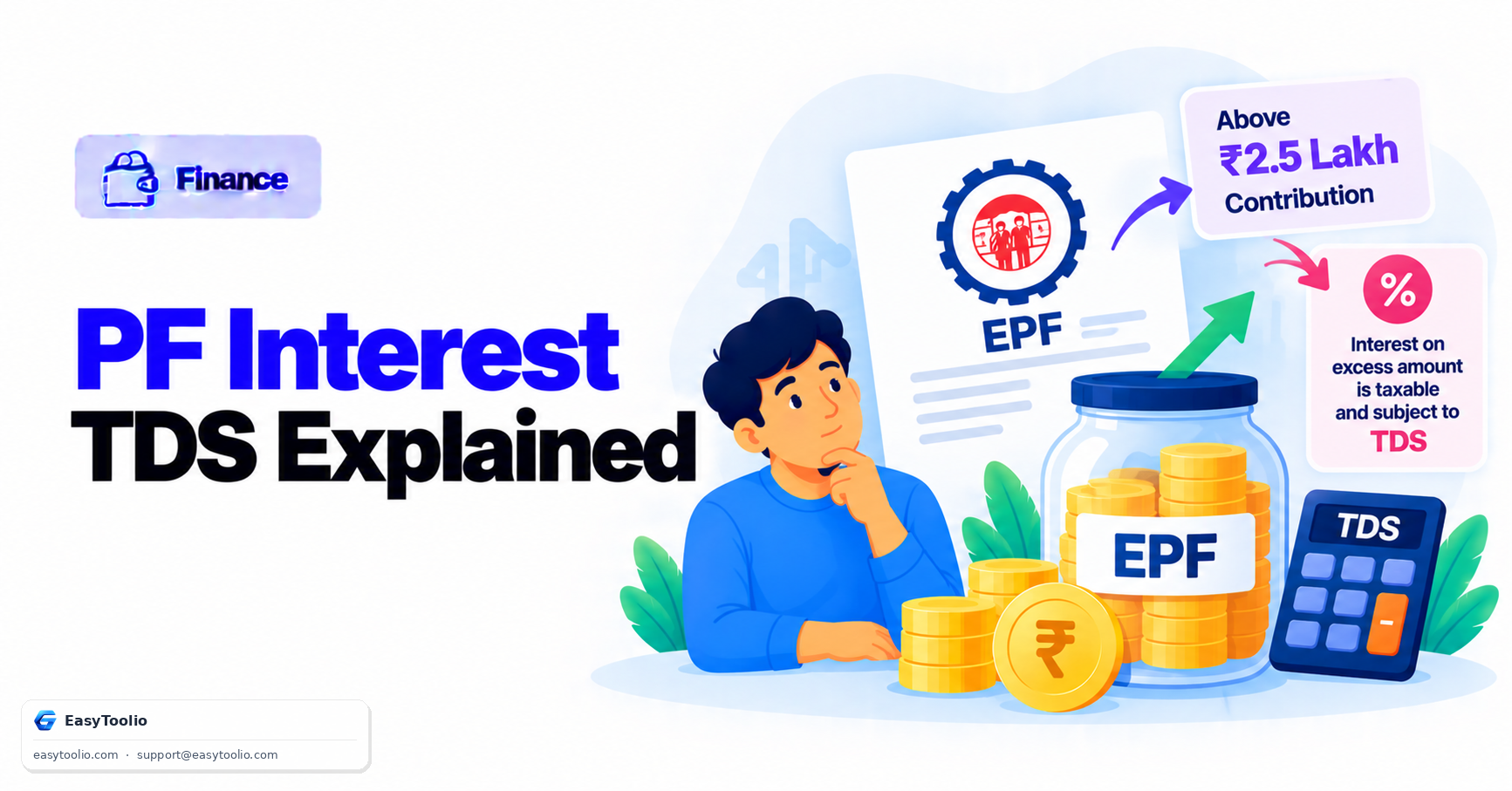
Since April 1, 2021 (contributions from FY2021-22 onward — not retroactive to older balances), interest earned on the portion of your own annual EPF contribution that exceeds a threshold becomes taxable:
| Situation | Annual contribution threshold |
|---|---|
| Standard (employer also contributes to EPF) | ₹2.5 lakh |
| No employer contribution (e.g., GPF for government employees) | ₹5 lakh |
The rule comes from CBDT Notification No. 95/2021, which inserted Rule 9D — requiring EPF accounts to be split into two sub-accounts, one for interest on contributions up to the threshold (tax-free, as EPF interest normally is) and one for interest on the excess (taxable as "Income from Other Sources").
TDS on the Taxable Portion
If the taxable interest exceeds ₹5,000 in a year, TDS applies at 10% if PAN is furnished, or 20% if it isn't — deducted directly by the EPF trust, which is why it can appear on your account even without a withdrawal.
A Worked Example
An employee contributes ₹4 lakh to EPF in a year — ₹1.5 lakh above the ₹2.5 lakh threshold. If that excess portion earns, say, ₹12,000 in interest for the year, that ₹12,000 is taxable income, and since it exceeds ₹5,000, TDS at 10% (₹1,200, assuming PAN is furnished) is deducted at source. The remaining interest, on the ₹2.5 lakh within the threshold, stays tax-free as usual.
Who This Actually Affects
This mainly reaches employees with a high basic salary, since EPF contributions are calculated as a percentage of basic pay plus dearness allowance — 12% employee contribution on a basic salary above roughly ₹20.8 lakh/year starts approaching the ₹2.5 lakh annual-contribution threshold. It also affects anyone making substantial voluntary provident fund (VPF) contributions on top of the mandatory EPF amount, since VPF counts toward the same ₹2.5 lakh cap.
How This Differs From Withdrawal Taxation
This is easy to conflate with a different, older rule: tax on withdrawing your EPF balance before completing 5 years of continuous service (governed separately, under Section 192A). That rule taxes the withdrawal itself if it happens too early. This rule taxes interest earned annually on contributions above ₹2.5 lakh, regardless of whether or when you withdraw anything. A high earner making large contributions could face this TDS every year while still employed, long before any withdrawal question arises.
Frequently Asked Questions
Does this apply to my employer's contribution too? No — the ₹2.5 lakh threshold applies to your own employee contribution (including voluntary PF); employer contributions are governed by a separate wage-ceiling rule.
Is the interest on my contributions up to ₹2.5 lakh still tax-free? Yes — only interest on the portion above the threshold becomes taxable; the rest continues to enjoy EPF's usual tax-free interest treatment.
Can I avoid this by contributing less voluntarily? Reducing voluntary (VPF) contributions is one direct way to stay under the ₹2.5 lakh threshold, since mandatory EPF contributions are fixed as a percentage of basic pay and DA.
Does this rule apply to old EPF balances built up before April 2021? No — it applies to contributions made from FY2021-22 onward; interest on balances accumulated before that isn't retroactively taxed under this rule.
Sources: CBDT Notification No. 95/2021 (31 August 2021), inserting Rule 9D of the Income-tax Rules; Income Tax Department (incometaxindia.gov.in).