Notification
Go to Home All Tools Compare Glossary Blog Contact

Savings Calculator

Calculate how your savings grow with compound interest, or work backward to find the monthly deposit needed to reach your goal.

Financial Growth Parameters

%

Smart Savings & Compounding Insights

Compounding Frequency

Monthly compounding yields higher returns than annual compounding because interest earned is reinvested 12 times a year.

The Rule of 72

Divide 72 by your annual interest rate to estimate how many years it takes for your starting deposit to double in value.

Maximizing Your Compound Interest Returns

  • 1 Start Early to Leverage Time Horizon: Even modest regular monthly contributions accumulate exponentially over 10–20 years due to geometric interest acceleration.
  • 2 Step-Up Regular Deposits Annually: Increasing your periodic deposit by 5% to 10% each year significantly outpaces inflation and accelerates your financial goal timeline.
  • 3 Automate Monthly Savings: Setting up automatic bank transfers or systematic investment plans (SIPs) removes emotion and ensures disciplined wealth accumulation.
Projected Future Balance

₹0

Estimated total value at end of period

Total Principal ₹0
Interest Earned ₹0

Growth Progression

Principal vs Interest

Growth Schedule

Period Deposited Interest Balance
Wealth Accumulation Guide

Savings Calculator – Wealth Growth Guide

A Savings Calculator projects how starting deposits and recurring regular additions compound over time to build emergency reserves and long-term financial security.

What is a Savings Calculator?

An interactive tool that combines initial lump sum deposits, recurring weekly or monthly additions, return rate %, and compounding frequencies to forecast total future wealth.

Key Benefits of Planned Savings

  • Compound Interest Acceleration: Interest earned generates its own interest over long horizons.
  • Emergency Fund Buffer: Builds 6 to 12 months of liquid living expenses for financial safety.
  • Goal Discipline: Track progress toward home downpayments, education, or travel goals.

How Savings Compounding Works (Live Example)

Calculated for an initial deposit of ₹50,000 + monthly contribution of ₹5,000 at 8.00% annual interest over 5 years:

Initial Deposit ₹50,000
Monthly Addition ₹5,000 / mo
Annual Return 8.00% p.a.
Time Horizon 5 Years
Total Deposited Principal: ₹50,000 + (₹5,000 × 60 months) = ₹3,50,000
Compound Interest Earned: ₹83,439
Final Total Savings Balance: ₹3,50,000 + ₹83,439 = ₹4,33,439
Total Deposited: ₹3,50,000 Interest Gain: ₹83,439 Total Balance: ₹4,33,439
1

Enter Starting Funds

Input initial lump sum savings available.

2

Set Regular Additions

Select contribution amount, frequency, and return %.

3

View Growth Schedule

Analyze total wealth accumulated and monthly interest ledger.

Formula Reference

Compound Savings Formula

The Compound Savings Formula computes the total future wealth accumulated from an initial starting deposit (P) plus regular periodic additions (PMT) earning compound interest over...

$$A = P \times \left(1 + \frac{r}{n}\right)^{nt} + PMT \times \frac{\left(1 + \frac{r}{n}\right)^{nt} - 1}{\frac{r}{n}}$$
View Full Formula, Step-by-Step Guide & Worked Examples
AI Advisor

AI Savings & Wealth Planner

Ask AI
Education

How Compound Savings Growth Is Calculated

01

Future Value Compounding Formula

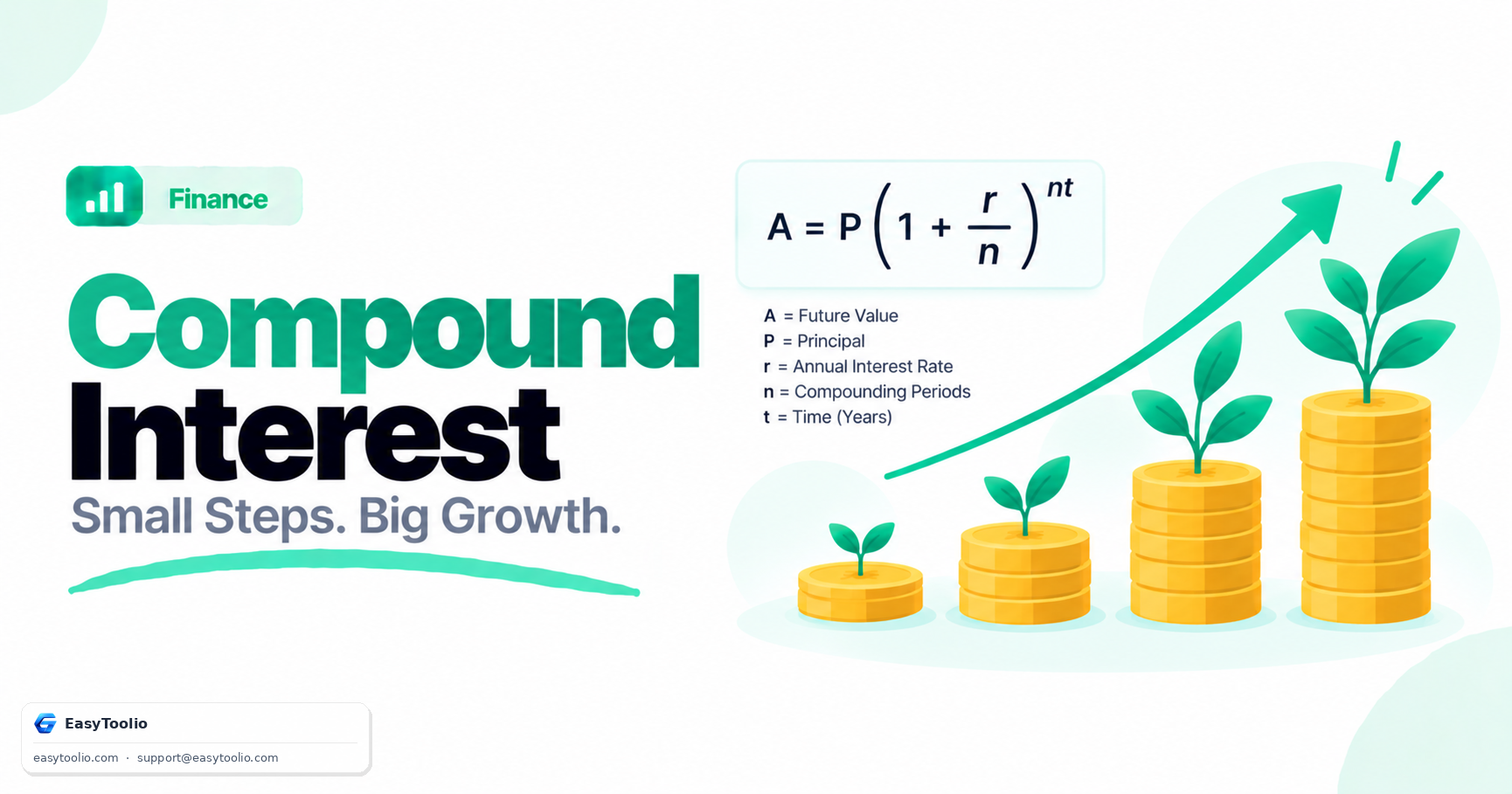
The calculator projects your balance using the compound interest future value formula: Final Balance = P x (1 + r/n)^(n x t) + PMT x [((1 + r/n)^(n x t) - 1) / (r/n)], where P is your initial deposit, PMT is your regular contribution, r is the annual interest rate, n is the compounding frequency, and t is the time in years. The first term grows your starting lump sum, while the second term grows your ongoing periodic contributions before adding both together.

02

Compounding Frequency and Contribution Schedule Matter

Choosing monthly compounding instead of annual compounding lets interest get added to your balance 12 times a year instead of once, so it compounds on itself more often and produces a higher final balance for the same nominal rate. Switching your contribution schedule from yearly to monthly deposits the same total amount earlier and more often, giving each rupee more time in the account to earn interest.

03

Worked Savings Growth Example

Starting with an initial deposit of ₹50,000 and contributing ₹5,000 every month at a 7.5% annual rate compounded monthly for 5 years, your total deposited principal is ₹3,50,000 (₹50,000 plus 60 months of ₹5,000). The projected final balance is approximately ₹4,35,300, meaning you earn around ₹85,300 in compound interest over the period.

04

Nominal vs Real Returns and Related Tools

The projected balance shown is a nominal figure before accounting for inflation or tax on interest income, so for a more realistic purchasing-power estimate, reduce your expected return by your anticipated inflation rate and marginal tax rate before running the calculation. If you instead know your target amount and want to solve for the required monthly contribution, use the Savings Goal Calculator, or compare a fixed-return alternative with the Recurring Deposit Calculator.

Good to know

Questions, answered

Quick answers about how this tool works.

While an RD calculator is specific to bank deposit term schemes with quarterly compounding, the Savings Calculator is a goal-oriented planning tool that allows reverse calculation (solving for required monthly/weekly contributions to hit a target goal) and customizable compounding frequencies.

Future Value is calculated as FV = P × (1 + r/n)^(n×t) + PMT × [((1 + r/n)^(n×t) - 1) / (r/n)], where P is initial deposit, PMT is regular contribution, r is annual interest rate, n is compounding frequency, and t is time in years.

Goal Planner mode reverses the compounding formula. Given your target savings goal amount, initial deposit, return rate, and time horizon, it calculates the exact regular contribution (monthly, weekly, or yearly) required to achieve your target.

More frequent compounding (e.g., monthly vs annually) means interest is added to your principal more often, allowing your money to earn interest on interest faster and resulting in a higher final balance.

Yes! Enter your target emergency fund amount (e.g. 6 months of living expenses) in Goal Planner mode to see exactly how much you need to set aside every month to reach your safety net.

The results show nominal savings growth before adjusting for inflation or tax. To estimate real, after-tax purchasing power, reduce your expected interest rate by your estimated tax rate and the expected inflation rate before running the calculation.

Popular Tools on EasyToolio

Swipe

What do you need to work out next?

Search 190+ free tools by name, or pick a category below. Every one runs instantly in your browser — no signup, nothing to install.

More Finance tools