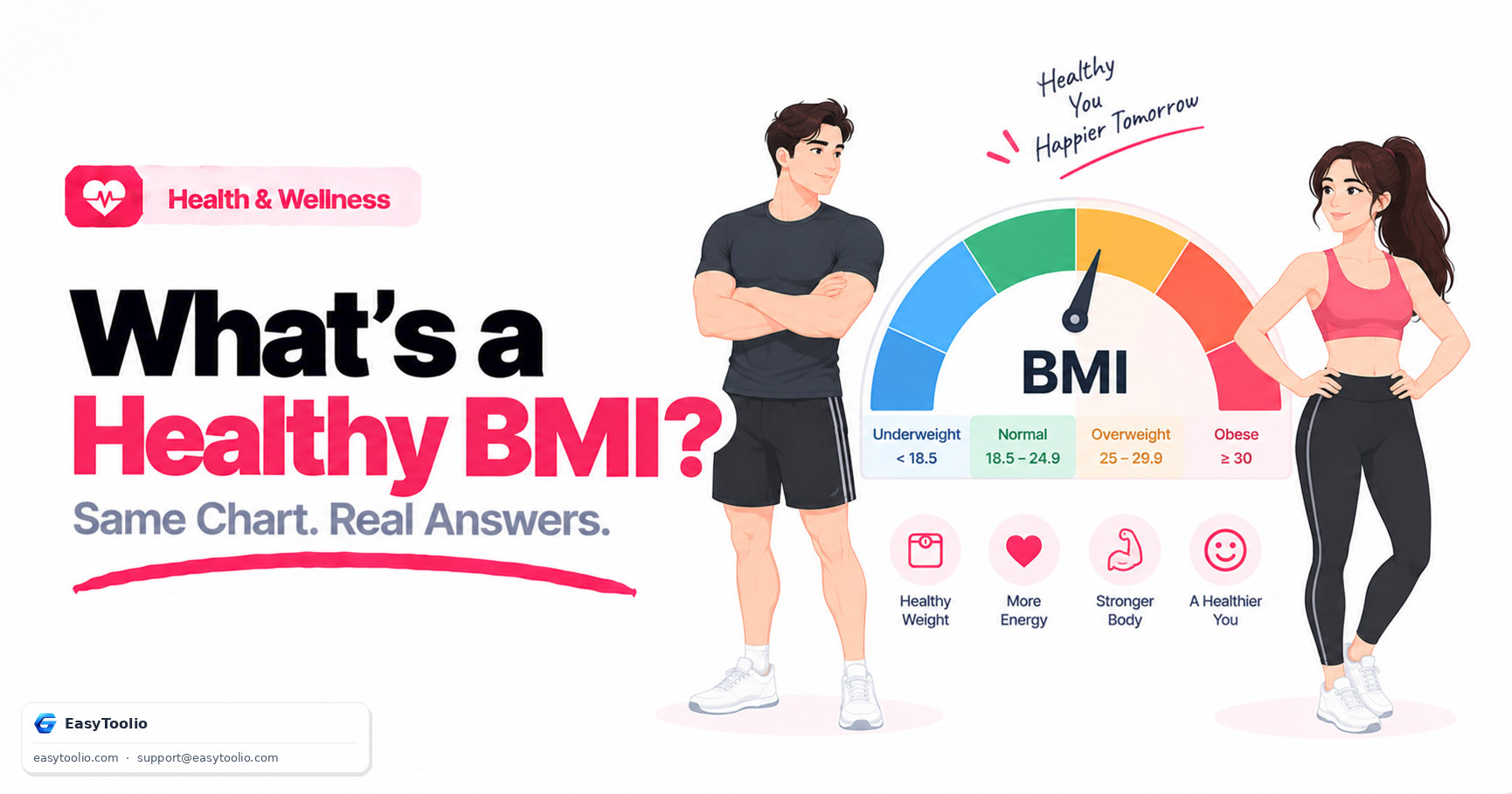
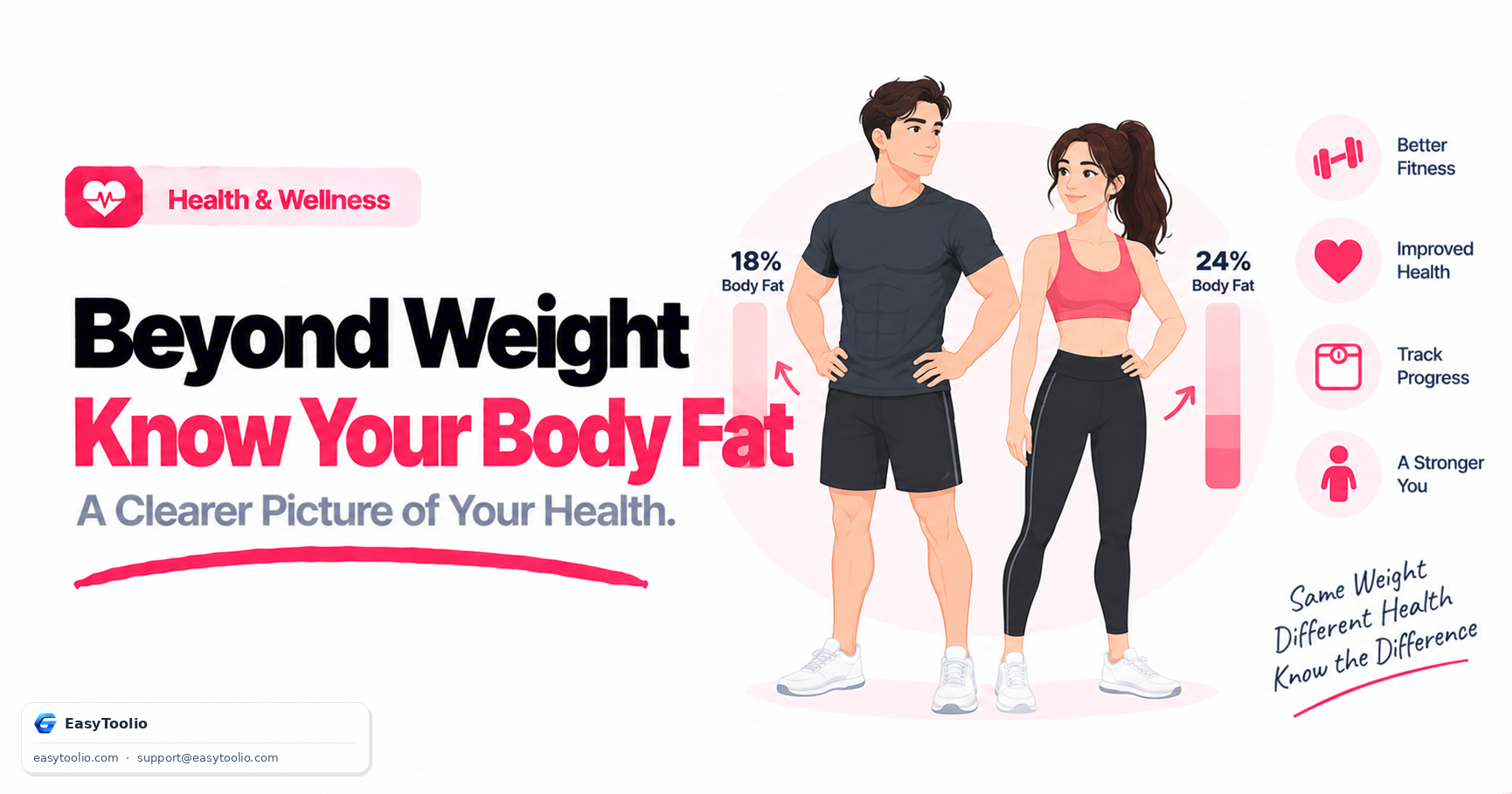
While BMI tells you how your weight compares to your height, body fat percentage tells you how much of your body is actually fat versus lean mass (muscle, bone, organs, water). It is a more accurate measure of health and fitness than BMI — but it is harder to measure.
Why Body Fat Percentage Matters
Two people can have identical BMI and very different health profiles. A 90 kg person with 12% body fat is an athlete; a 90 kg person with 35% body fat faces significantly elevated health risks. Body fat percentage captures what BMI misses.
Healthy Body Fat Ranges
The American Council on Exercise (ACE) classification for adults:
For Men:
| Category | Body Fat % |
|---|---|
| Essential fat | 2–5% |
| Athletic | 6–13% |
| Fitness | 14–17% |
| Acceptable | 18–24% |
| Obese | 25%+ |
For Women:
| Category | Body Fat % |
|---|---|
| Essential fat | 10–13% |
| Athletic | 14–20% |
| Fitness | 21–24% |
| Acceptable | 25–31% |
| Obese | 32%+ |
Women carry more essential fat than men due to hormonal and reproductive physiology — a normal body fat of 22% for a woman is healthy, while the same figure for a man would be in the "acceptable" (not optimal) range.
How to Measure Body Fat Percentage
1. DEXA Scan (Most Accurate)
Dual-energy X-ray absorptiometry gives precise body composition breakdown (fat, lean mass, bone density). Error margin: ±1–2%. Expensive and requires a clinic.
2. Hydrostatic Weighing (Gold Standard for Research)
Underwater weighing based on body density. Very accurate (±1.5%) but requires specialized equipment.
3. Skinfold Calipers (Accessible, Reasonable Accuracy)
Trained technicians measure fat at 3–7 sites on the body. Error: ±3–4% with a skilled tester; higher with inconsistent technique.
4. BIA Scales (Home Use)
Bioelectrical impedance scales pass a small current through the body to estimate fat. Error: ±3–8%, highly affected by hydration. Useful for tracking trends, not absolute values.
5. US Navy Body Fat Formula (No Equipment Needed)
The U.S. military uses a circumference-based formula that requires only a tape measure:
For Men: Body Fat % = 86.010 × log₁₀(abdomen − neck) − 70.041 × log₁₀(height) + 36.76
For Women: Body Fat % = 163.205 × log₁₀(waist + hip − neck) − 97.684 × log₁₀(height) − 78.387
Measurements in centimetres. This formula has an error margin of approximately ±3–4% and is a practical, free option for most people.
BMI vs Body Fat: Which Should You Track?
| Measure | Pros | Cons |
|---|---|---|
| BMI | Free, instant, globally standardised | Cannot distinguish muscle from fat |
| Body Fat % | Accurate health picture | Harder/costlier to measure accurately |
For most people: use BMI as a quick screen, and use body fat percentage for meaningful fitness tracking. If you are strength training, body fat percentage will show progress that BMI completely misses (as you gain muscle and lose fat simultaneously, your BMI may barely change).
Calculate Your Body Fat Now
Our Body Fat Calculator uses the US Navy formula to estimate your body fat percentage from simple measurements. No lab visit required — just a tape measure.
You can also run your BMI Calculator alongside it for a more complete picture of your current body composition.
Frequently Asked Questions
Q: What is a healthy body fat percentage for men and women? A: Per the ACE classification, "acceptable" body fat is 18–24% for men and 25–31% for women, with women carrying more essential fat (10–13%) than men (2–5%) due to hormonal and reproductive physiology.
Q: What is the most accurate way to measure body fat percentage without a lab? A: The US Navy circumference-based formula, which uses only a tape measure and has an error margin of approximately ±3–4%, close to the ±3–4% of professional skinfold calipers.
Q: Should I track BMI or body fat percentage for fitness progress? A: Use BMI as a free, instant screen, but track body fat percentage for meaningful fitness progress, since strength training can keep BMI nearly unchanged while body fat percentage shows real gains in muscle and loss of fat.