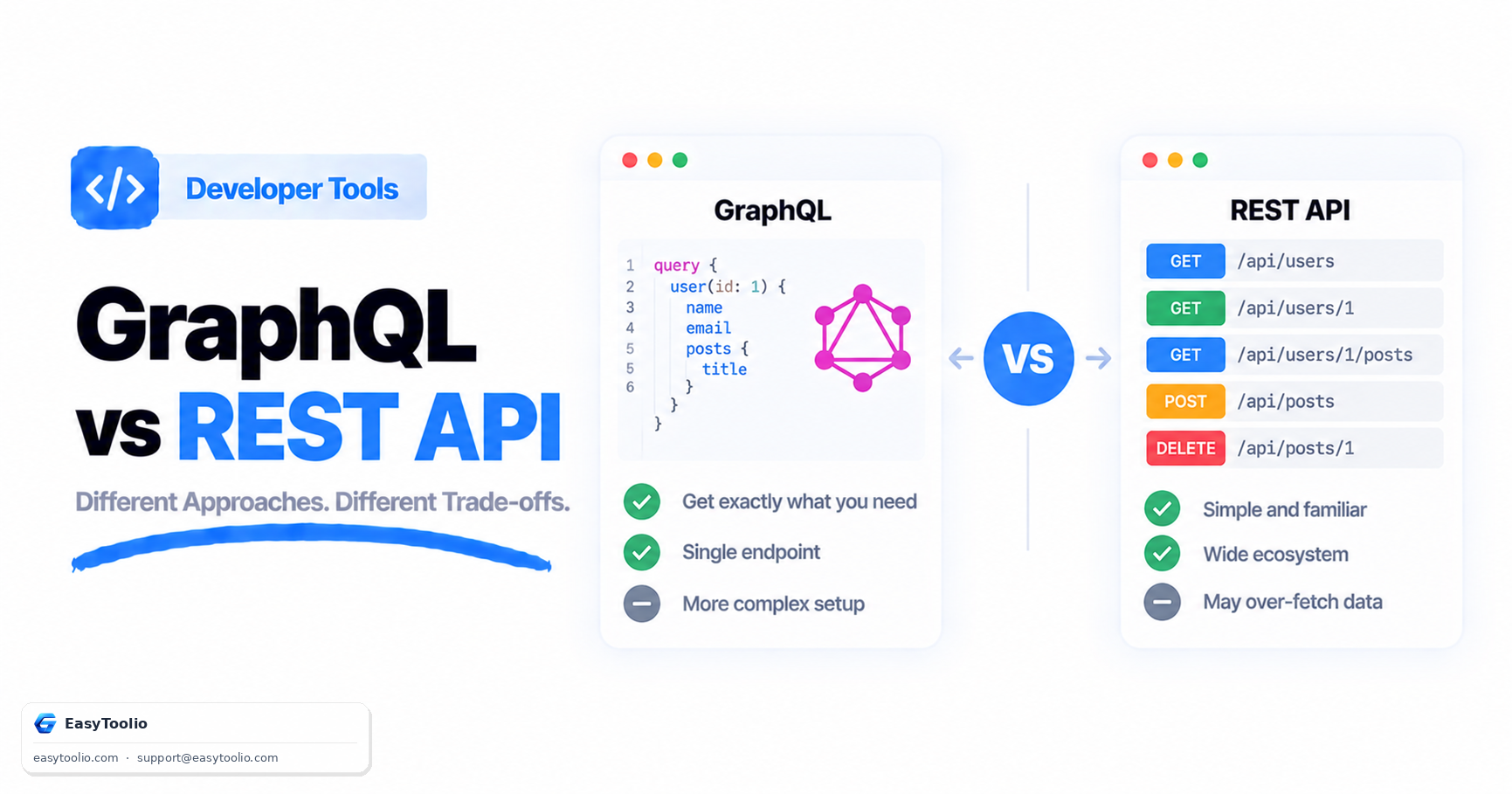
When designing modern backend architectures, software engineers routinely evaluate GraphQL against traditional REST (Representational State Transfer) APIs. While both paradigms facilitate client-server communication over HTTP, they operate on fundamentally different abstractions: REST is an architectural style centered on discrete network resources, whereas GraphQL is a strongly typed query language and execution engine for client-driven data fetching.
Direct Answer: Use REST APIs when building microservices with standardized HTTP caching, linear resource CRUD operations, or where strict public API caching headers (such as Cache-Control and ETag) are required. Use GraphQL when building multi-platform apps (web, mobile, wearable) that require complex nested data in a single round-trip, where payload minimization is critical, or where microservices must be aggregated into a single unified schema.
1. Architectural Core: Resource Endpoints vs Query Execution
The primary architectural distinction between REST and GraphQL lies in how client requests map to server-side code execution:
- REST API: Employs multiple discrete URL endpoints (e.g.,
/api/users/42,/api/users/42/posts). Each endpoint maps to an HTTP method (GET,POST,PUT,DELETE) representing an operation on a specific resource. - GraphQL: Exposes a single HTTP endpoint (typically
POST /graphql). Clients send declarative query documents specifying exact fields. The server parses, validates, and executes the query against a strongly typed schema via resolver functions.
REST Architecture:
Client ──GET /api/users/42──────► Server ──► Returns Full User JSON
Client ──GET /api/users/42/posts► Server ──► Returns Full Posts JSON array

GraphQL Architecture:
Client ──POST /graphql (Query: { user(id:42) { name posts { title } } }) ──► Server ──► Returns Exact Requested Shape JSON
For testing API endpoints, inspect headers, and format payloads, developers can utilize the API Tester and JSON Formatter.
2. Over-Fetching, Under-Fetching & N+1 Query Problem
Data transfer efficiency differs dramatically between the two standards:
- Over-Fetching: In REST, calling
GET /api/users/42returns all properties defined by the server DTO (e.g., 40 fields including address, preferences, and billing history), even if the UI component only requires the user's display name. GraphQL eliminates over-fetching by enforcing field-level filtering. - Under-Fetching: In REST, rendering a profile page with recent posts often requires multiple sequential HTTP requests (
GET /users/42, followed byGET /users/42/posts, followed byGET /posts/101/comments). GraphQL resolves nested relationships in a single HTTP request. - The N+1 Query Problem: Because GraphQL allows clients to request arbitrary nested fields, backend resolvers can trigger N+1 database queries if unmanaged. Developers must implement batching mechanisms (such as DataLoader) to merge SQL queries on the backend.
3. Head-to-Head Architectural Comparison
| Feature / Metric | REST API (RFC 7231) | GraphQL (GraphQL Spec) |
|---|---|---|
| Data Fetching Paradigm | Server-defined fixed DTO endpoints | Client-defined declarative queries |
| HTTP Transport | Utilizes full HTTP verb spectrum (GET, POST, PUT, PATCH, DELETE) |
Typically single POST /graphql endpoint |
| Network Roundtrips | Multiple requests for nested resources | Single request for deeply nested graphs |
| Caching Layer | Native HTTP edge/CDN caching via Cache-Control, Vary, ETag |
Requires client-side normalized cache (e.g., Apollo Client, Relay) |
| Type System | Optional (OpenAPI / Swagger documentation) | Mandatory strongly typed Schema Definition Language (SDL) |
| Deprecation | Endpoint versioning (/v1/users, /v2/users) |
Field-level @deprecated directive annotations |
| Error Handling | Standard HTTP Status Codes (HTTP Status Checker) (e.g., 404, 401, 500) | Always returns HTTP 200 OK with errors array in JSON payload |
4. Practical Payload & Query Example
REST Approach:
Two HTTP requests required:
GET /api/v1/authors/7 HTTP/1.1
Host: api.example.com
Followed by:
GET /api/v1/authors/7/books HTTP/1.1
Host: api.example.com
GraphQL Approach:
A single POST request with JSON body:
{
  "query": "query GetAuthorDetails($id: ID!) { author(id: $id) { name email books { title ISBN } } }",
  "variables": { "id": "7" }
}
Response payload:
{
  "data": {
    "author": {
      "name": "Ada Lovelace",
      "email": "ada@example.com",
      "books": [
        { "title": "Analytical Engine Notes", "ISBN": "978-0123456789" }
      ]
    }
  }
}
Developers validating HTTP header configurations and status codes can check headers using the HTTP Header Analyzer.
5. Frequently Asked Questions (FAQs)
Does GraphQL replace REST APIs entirely in production systems?
Not necessarily. Most production architectures run GraphQL as a client-facing aggregation layer (a "Backend for Frontend") sitting in front of existing REST or gRPC microservices rather than replacing them outright. Public APIs with heavy CDN caching requirements, webhooks, and file upload/download endpoints often remain REST because HTTP caching semantics and binary transport are simpler to reason about outside a query engine.
Why does GraphQL always return HTTP 200 even when an error occurs?
Because the GraphQL specification separates transport-level success (the HTTP request was received and processed) from execution-level success (whether resolvers returned data without errors). A partially failed query can still return HTTP 200 with a populated data field alongside an errors array describing which fields failed, so clients must inspect the JSON body itself rather than relying on the HTTP status code alone.
Can GraphQL responses be cached the same way REST responses are cached with a CDN?
Not natively. Because GraphQL typically exposes a single POST /graphql endpoint, standard HTTP caching mechanisms like Cache-Control, ETag, and CDN edge caching (which key on URL and method) don't apply the same way. Teams work around this with persisted queries (mapping queries to cacheable GET requests with a hash ID) or by normalizing responses in a client-side cache such as Apollo Client or Relay.
References: GraphQL Specification (GraphQL Foundation); IETF RFC 7231 (HTTP/1.1 Semantics and Content).