
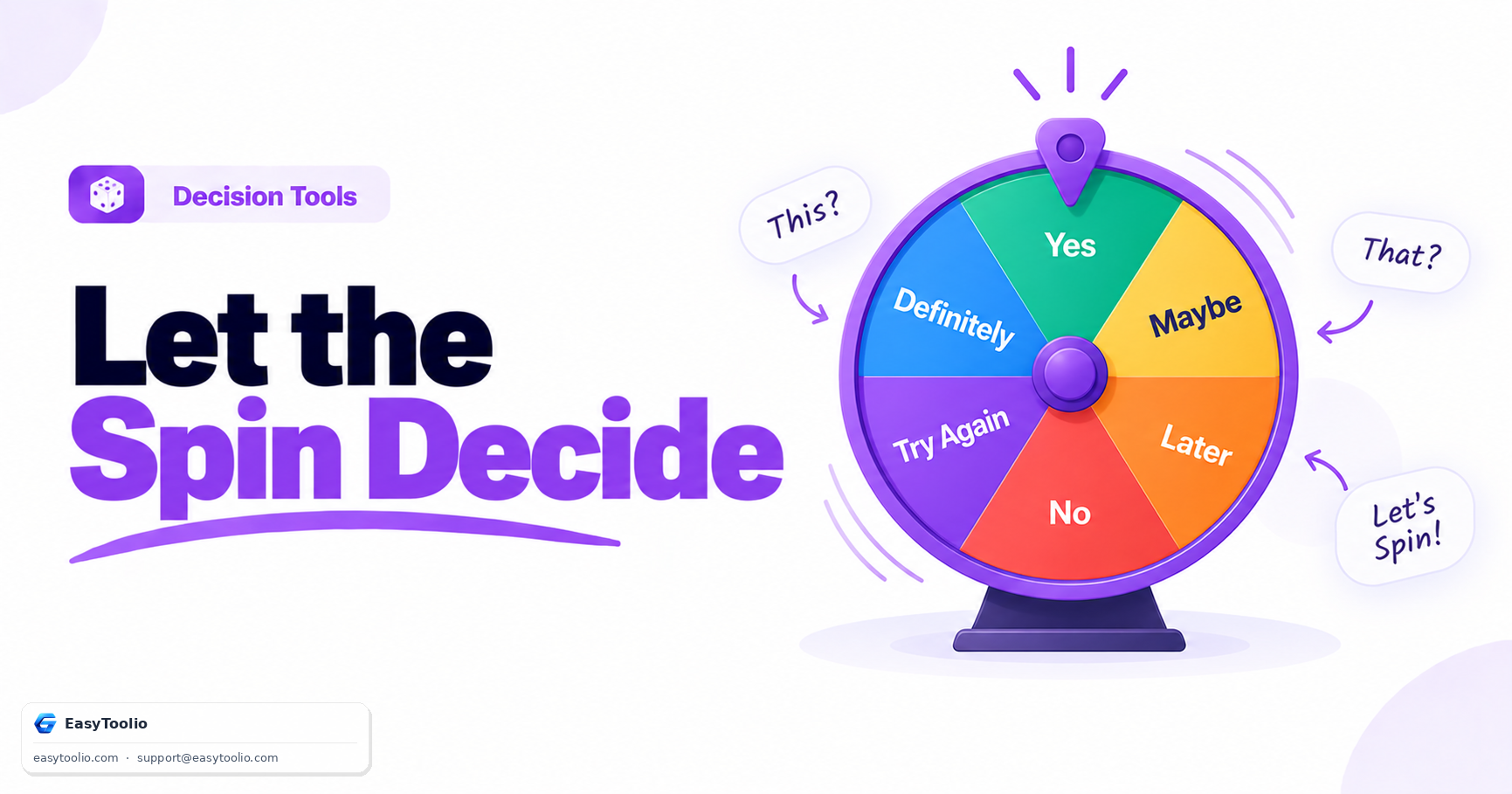
Picking a restaurant, choosing a raffle winner, or deciding who goes first in a game becomes a lot less awkward when you let a spin wheel decide. Unlike a coin flip, which only works for two options, a spin wheel scales to any number of choices while keeping the outcome genuinely random and free of human bias.
What Makes a Spin Wheel Fair
A spin wheel divides a circle into equal (or intentionally weighted) segments, each representing one option. When spun digitally, the stopping point is determined by a random number generator that selects an angle uniformly across the full 360 degrees. If a wheel has n equally sized segments, each option has a probability of:
P(any single segment) = 1/n
For example, a wheel with 8 equal segments gives each option exactly 1/8, or 12.5%, chance of being selected. Because the random angle is generated independently of segment size or position, no option is favored unless you deliberately assign it a larger slice — which many tools allow for weighted decisions, like giving a "big prize" a smaller segment on purpose.
Digital vs. Physical Spin Wheels
A physical wheel (like those used in game shows) depends on friction, momentum, and where your hand releases it, which introduces small mechanical biases similar to the wobble bias found in coin flips. A digital spin wheel removes this problem entirely by using a software random number generator (RNG) to pick the outcome mathematically, rather than relying on physics. This makes an online Spin Wheel more consistent for situations where fairness actually matters, such as raffles, giveaways, or classroom selections, because every segment has a mathematically verifiable equal chance.
When to Use a Spin Wheel vs. a Coin Flip
- Two options only, no weighting needed → a coin flip is faster
- Three or more options → a spin wheel is the natural choice
- Yes/No decisions where you want a visual, engaging format → a Yes or No Wheel works well for quick binary calls with a fun presentation
- Assigning different odds to different outcomes (e.g., prize tiers) → a weighted spin wheel is ideal since you can size segments proportionally
Worked Example
Say you're picking a random winner from 5 team members for a task nobody wants to do. Each person gets an equal 72-degree segment on the wheel (360° ÷ 5 = 72°). The RNG generates a random stopping angle between 0° and 360°. Whichever segment contains that angle wins. Each person's probability of being chosen is exactly 1/5, or 20%, matching the segment's proportion of the circle — regardless of segment order or wheel rotation speed.
If you wanted to bias the wheel (say, giving one person a "double chance"), you'd simply make their segment twice as wide — 120° instead of 60° on a 6-person wheel — which mathematically doubles their probability to 1/3.
Practical Use Cases
- Choosing a restaurant, movie, or activity among a group of friends
- Running fair giveaways or raffle drawings for social media contests
- Randomly selecting names for classroom participation or team assignments
- Deciding turn order in board games or sports
- Making quick yes/no calls with the Yes or No Wheel when you're stuck between two choices
Frequently Asked Questions
Q: Is a digital spin wheel actually random? A: Yes, digital spin wheels use a random number generator (RNG) to select a stopping angle, which is far more consistent and free of mechanical bias than a physical wheel spun by hand.
Q: Can I use a spin wheel to weight some options more than others? A: Absolutely. By making a segment larger or smaller relative to the full 360-degree circle, you directly change that option's probability of being selected.
Q: What's the difference between a spin wheel and a coin flip? A: A coin flip only handles two equally likely outcomes, while a spin wheel can fairly randomize any number of options and supports custom weighting when needed.