Both tools produce a compatibility-flavored output from a name or a birth date, and it's tempting to lump them together as "the same kind of fun quiz." That framing is fair for one of them and genuinely unfair to the other, and being honest about which is which matters both for setting the right expectations and for not accidentally trivializing a belief system some people take seriously.
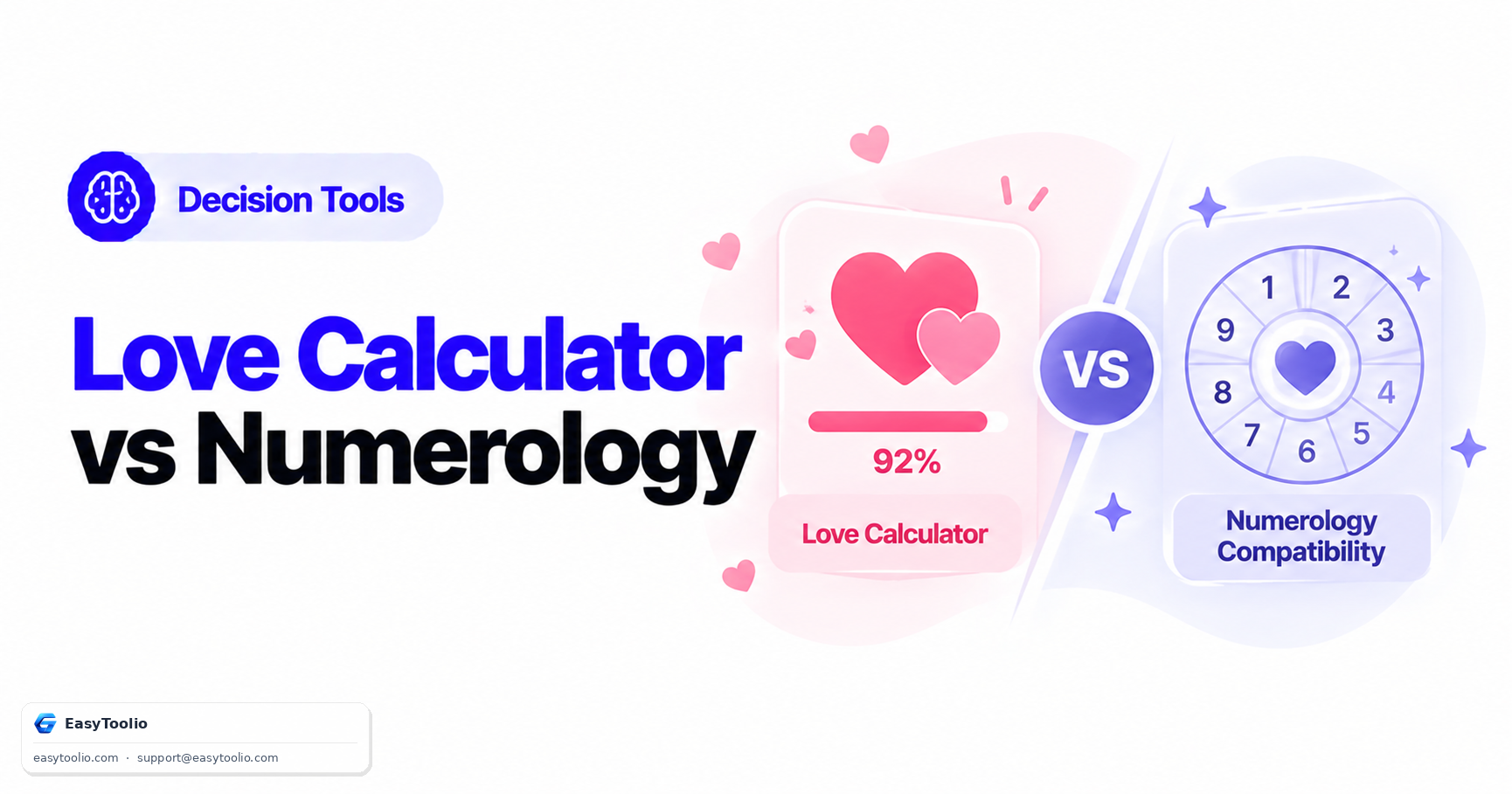
Direct Answer: A love calculator is explicitly designed as entertainment — it takes two names, runs them through an algorithm (often a name-letter-based formula with no claimed scientific or predictive basis), and outputs a percentage purely for fun, with no pretense that the number means anything about a real relationship's prospects. Numerology compatibility is different in kind: it draws on an established belief system with defined calculation methods — most commonly deriving each person's Life Path number from their birth date and comparing the two according to specific numerological compatibility rules — that practitioners treat as a genuine framework for insight, not a joke. Treating the two as equivalent "just for fun" tools undersells numerology's actual methodology and the sincerity with which many practitioners and users approach it.
Where Each Sits on the Spectrum
There's a real, meaningful spectrum from "purely playful, no pretense of validity" to "a belief system with internally consistent rules taken seriously by practitioners," and these two tools sit at genuinely different points on it:
| Aspect | Love Calculator | Numerology Compatibility |
|---|---|---|
| Claimed basis | None — explicitly entertainment | A belief system with defined calculation rules |
| Input | Two names (sometimes birth dates as a variant) | Birth dates, used to derive Life Path numbers |
| Calculation method | Often a simple name-letter algorithm, sometimes randomized presentation | Defined numerological reduction rules (digit-summing to a Life Path number) |
| How practitioners treat it | Purely for fun; no serious interpretive framework | As a genuine interpretive framework, with established compatibility meanings per number pairing |
| Appropriate framing | "A fun name-based percentage generator" | "An introduction to a belief system's compatibility method" |
How a Love Calculator Actually Works
A typical love calculator takes two names and runs them through some combination of letter-counting, character-value summing, or similar algorithmic transformation to produce a percentage. Some versions incorporate birth dates as an additional input for a more elaborate-feeling calculation, but the underlying mechanism is still an algorithm designed to produce an engaging, shareable output rather than one grounded in any established predictive framework. This is precisely why it's fair to call it entertainment without qualification — there's no tradition or methodology being represented, just a fun generator. Try it yourself with our love calculator, understanding going in that the number is meant purely as a lighthearted icebreaker, not a real assessment.
How Numerology Compatibility Actually Works
Numerology compatibility, in contrast, follows a defined calculation method that traces back to an established (if not scientifically validated) belief tradition. The most common approach derives each person's Life Path number by reducing their full birth date to a single digit (or a recognized "master number" like 11, 22, or 33) through repeated digit-summing, and then evaluates compatibility between two Life Path numbers according to numerology's own established interpretive rules — certain number pairings are considered harmonious, others more challenging, following a consistent internal logic that numerology practitioners have developed and refined over a long tradition.
The key distinction isn't whether numerology is scientifically validated — it isn't, by mainstream scientific standards — it's that it has an actual defined methodology and an interpretive tradition behind it, which is categorically different from an algorithm built purely for shareable entertainment value. Explore your own numbers with our numerology calculator as a genuine introduction to how the Life Path method works, distinct from a purely-for-fun name generator.
Why Conflating the Two Undersells Numerology
Lumping numerology compatibility in with a love calculator as "basically the same kind of fun app" flattens a real distinction that matters to people who engage with numerology seriously — whether as a spiritual practice, a reflective self-understanding tool, or a cultural tradition. It's the difference between dismissing an entire interpretive framework as equivalent to a novelty generator, versus acknowledging that numerology has its own internally consistent rules and a lineage of practice behind it, even while being honest that neither tool offers scientifically validated predictions about real-world relationship outcomes.
The honest, non-dismissive framing for both: a love calculator is unambiguous fun with zero pretense of insight, and numerology compatibility is a belief-system-based framework that some people use for genuine reflection and others use more casually — but it's not the same category of thing as a randomized name-percentage generator, and shouldn't be described as if it were.
Frequently Asked Questions
Is a love calculator based on any real relationship science?
No — it's explicitly designed as an entertainment tool using a name-based or similar algorithm with no claimed grounding in relationship psychology or any predictive research. It's meant to be a fun, shareable moment, not an assessment.
Is numerology considered a science?
No, numerology is not recognized as a science by mainstream academic or psychological standards — it's a belief system and interpretive tradition, similar in category to astrology, rather than an empirically validated predictive method. That said, it does have its own internally defined and consistently applied calculation rules, which distinguishes it from a purely randomized entertainment generator.
What is a Life Path number and how is it calculated?
A Life Path number is derived by reducing all the digits in a person's full birth date down to a single digit through repeated addition, with certain totals (commonly 11, 22, and 33) treated as "master numbers" that are kept unreduced in most numerology systems because they're considered to carry distinct significance.
Can two people have the same Life Path number and still be considered compatible?
Numerology compatibility isn't strictly about matching numbers — different numerological traditions and practitioners have their own frameworks for which specific number pairings, whether matching or different, are considered harmonious or challenging, based on the established interpretive meaning assigned to each number.
Should I take either of these results seriously?
That's a personal choice — a love calculator is designed with zero pretense of validity and is best enjoyed purely as entertainment, while numerology compatibility carries more genuine interpretive weight for people who engage with the belief system seriously. Neither is scientifically validated in the empirical sense, so how much weight to give either result is entirely up to personal belief and intent.
References: General numerology tradition and Life Path number calculation conventions as documented in numerology reference literature; standard framing of astrology/numerology-adjacent tools as entertainment versus belief-system practice.