Walk past a Peepal tree or a temple sanctum on a Monday morning and you'll often find devotees circling it slowly, lips moving in silent prayer, counting under their breath. This practice — Parikrama or Pradakshina — is one of the most widespread yet least explained rituals in Hindu devotional life. Here's what it means, why the number 108 keeps appearing, and how to keep an accurate count.
What Is Parikrama / Pradakshina?
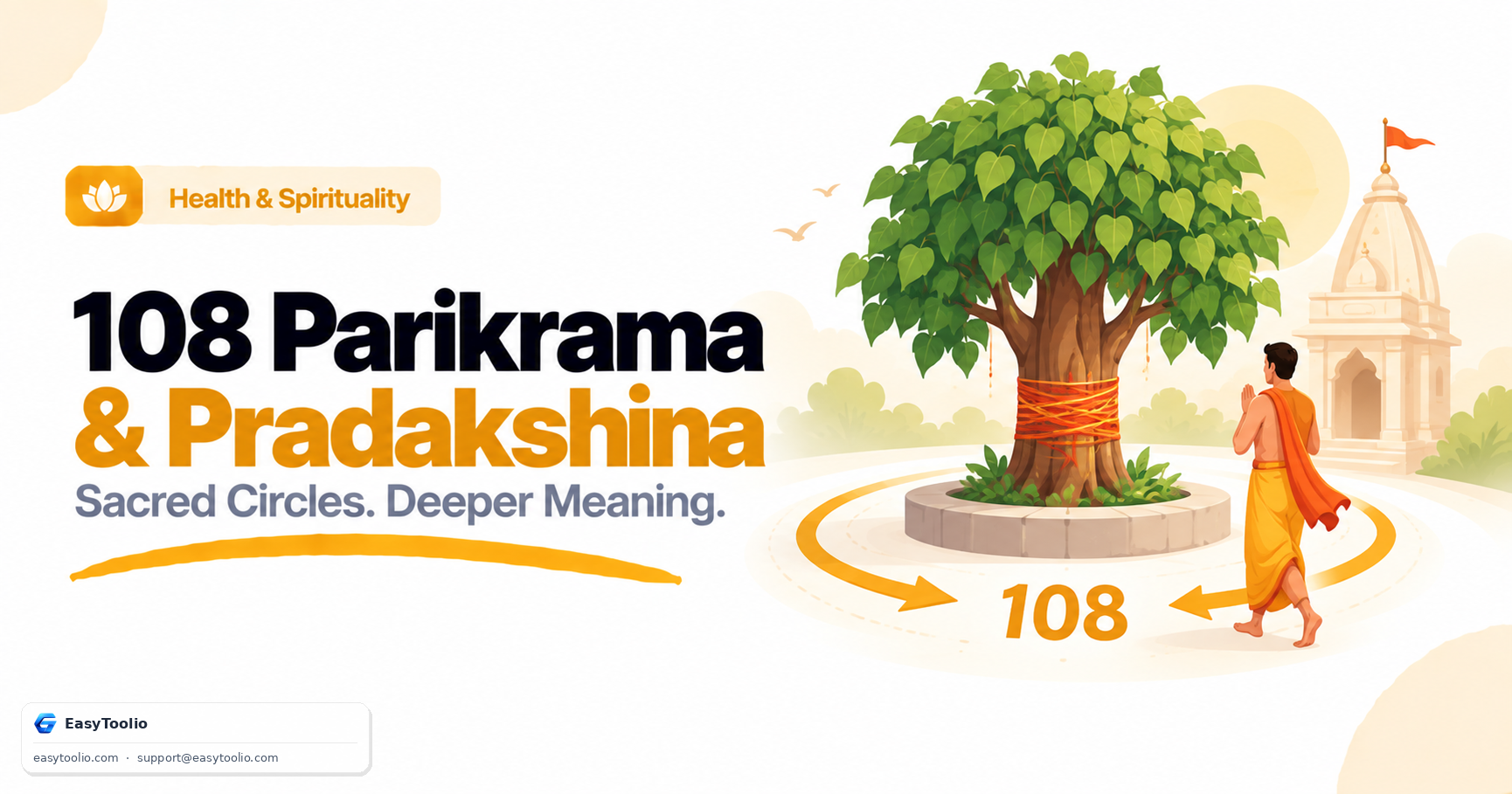
Parikrama (from Sanskrit, meaning "the path around") and Pradakshina (meaning "to the right") both refer to the practice of circumambulation — walking in a circle around a deity, deity's image, temple structure, sacred tree, or holy site, traditionally in a clockwise direction, keeping the sacred object to one's right hand side.
The two terms are often used interchangeably in everyday speech, though Pradakshina more specifically emphasizes the "keeping to the right" directional aspect, while Parikrama is used more broadly for circumambulating an object, place, or even a larger pilgrimage circuit (like the Parikrama of Govardhan Hill or the Narmada Parikrama, which can span hundreds of kilometers over weeks).
The clockwise direction itself carries traditional symbolic meaning — mirroring the perceived movement of celestial bodies and the sun's daily path, and is considered a gesture of respect that places the sacred object at the center of one's devotional focus throughout the walk.
Why Is 108 the Sacred Number?
The number 108 recurs across Hindu, Buddhist, and Jain traditions far too consistently to be coincidental, and several explanations are traditionally offered — not mutually exclusive, but layered:
1. The 108 beads of a japa mala. A traditional prayer mala used for chanting mantras (like the Gayatri Mantra or any Ram Naam japa) has exactly 108 beads, plus one additional "guru bead" that marks the start/end point.
2. Nakshatras × Padas. Vedic astrology divides the zodiac into 27 Nakshatras (lunar mansions), each further divided into 4 Padas (quarters) — 27 × 4 = 108. Many traditional texts treat this astrological structure as a cosmic underpinning for why 108 recurs as a sacred number across Vedic practice. (Read our Nakshatra guide for the full 27-star breakdown.)
3. Sanskrit alphabet symbolism. Some traditional interpretations connect 108 to the combinations of Sanskrit's phonetic structure (54 letters, each with a masculine and feminine/Shiva-Shakti aspect: 54 × 2 = 108).
4. Distance and proportion symbolism. Certain traditional texts also cite astronomical proportions (such as approximate Earth-Sun-Moon distance ratios expressed in solar/lunar diameters) as symbolic support for 108's significance, though these are best understood as traditional numerological framing rather than literal scientific measurement.
Whichever explanation resonates, the practical result is the same: 108 repetitions or circuits is treated across multiple traditions as a spiritually complete, whole number for devotional practice.
Common Occasions for 108 Parikrama
Devotees typically perform 108 Parikrama or Pradakshina during:
- Around a Peepal tree — considered sacred and associated with Lord Vishnu in Hindu tradition; especially common on Saturdays and during the auspicious month of Kartik
- Around a Tulsi plant — a household devotional practice, especially popular among women observing Tulsi Vivah or daily Tulsi puja
- Temple sanctum (Garbhagriha) — circling the inner sanctum of a temple, particularly during major festivals or on the deity's dedicated day of the week
- On Mondays (Somvar) — traditionally associated with Lord Shiva; devotees often perform Parikrama around a Shiva temple or Shivling
- On Purnima (full moon) and Ekadashi — considered especially auspicious days for extended devotional practice, including longer Parikrama counts
- Fasting days (Vrat) — many devotees combine a fast with 108 Parikrama as part of a complete day of devotional discipline
Traditional Benefits Attributed to Parikrama
Tradition and practicing devotees attribute several benefits to regular Parikrama practice — again, best understood as traditional spiritual belief and lived experience rather than clinically validated claims:
- Physical movement and mindfulness — the slow, repetitive walking combined with silent prayer is described by many practitioners as meditative and calming
- Spiritual discipline — completing a fixed count is traditionally seen as an act of devotional commitment and focus
- Symbolic humility — circling with the sacred object always to one's right is traditionally read as an act of respect and surrender
- Community and ritual rhythm — for many households, it is a shared family practice tied to specific days of the week or lunar calendar dates
How to Count 108 Parikrama Accurately
Physically counting 108 laps around a tree or temple is harder than it sounds — it's easy to lose track after the first 20–30 rounds, especially while simultaneously reciting a mantra or observing a fast (which can affect concentration).
Traditional methods people use include:
- Moving one bead of a mala with each completed circuit (108 beads = 108 circuits)
- Placing small stones or seeds in a pile, moving one over per round
- Having a family member tally verbally
Each of these works, but all are prone to human error, particularly during long temple visits, festival crowds, or multi-hour fasting days when focus naturally dips.
Using a Digital Counter for Parikrama
A simple digital tap-counter removes this uncertainty entirely. Our 108 Pradakshina Parikrama Counter lets you tap once per completed circuit, shows your running total clearly, and alerts you when you've reached 108 — so you can stay present in the practice itself rather than mentally rehearsing a number. It works equally well for a single temple visit or an extended Parikrama pilgrimage broken across multiple sessions.
Frequently Asked Questions
Q: Which direction should I walk during Parikrama — clockwise or counter-clockwise? A: Clockwise, keeping the deity, temple, or sacred tree to your right-hand side — this is the traditional convention embedded in the word "Pradakshina," which literally means "to the right," and is read as a gesture of respect toward the sacred object.
Q: Why is 108 specifically considered the sacred number for Parikrama? A: Several traditional explanations are offered together, including the 108 beads on a japa mala, the Vedic astrological structure of 27 Nakshatras × 4 Padas each = 108, and Sanskrit phonetic symbolism — the consistent result across all of them is that 108 is treated as a spiritually complete number for devotional practice.
Q: What is the easiest way to keep count during a long Parikrama session? A: Traditional methods include moving one mala bead per completed circuit or having someone tally verbally, but a digital counter removes the risk of losing count, which is especially useful during festival crowds or extended fasting days when concentration is harder to maintain.