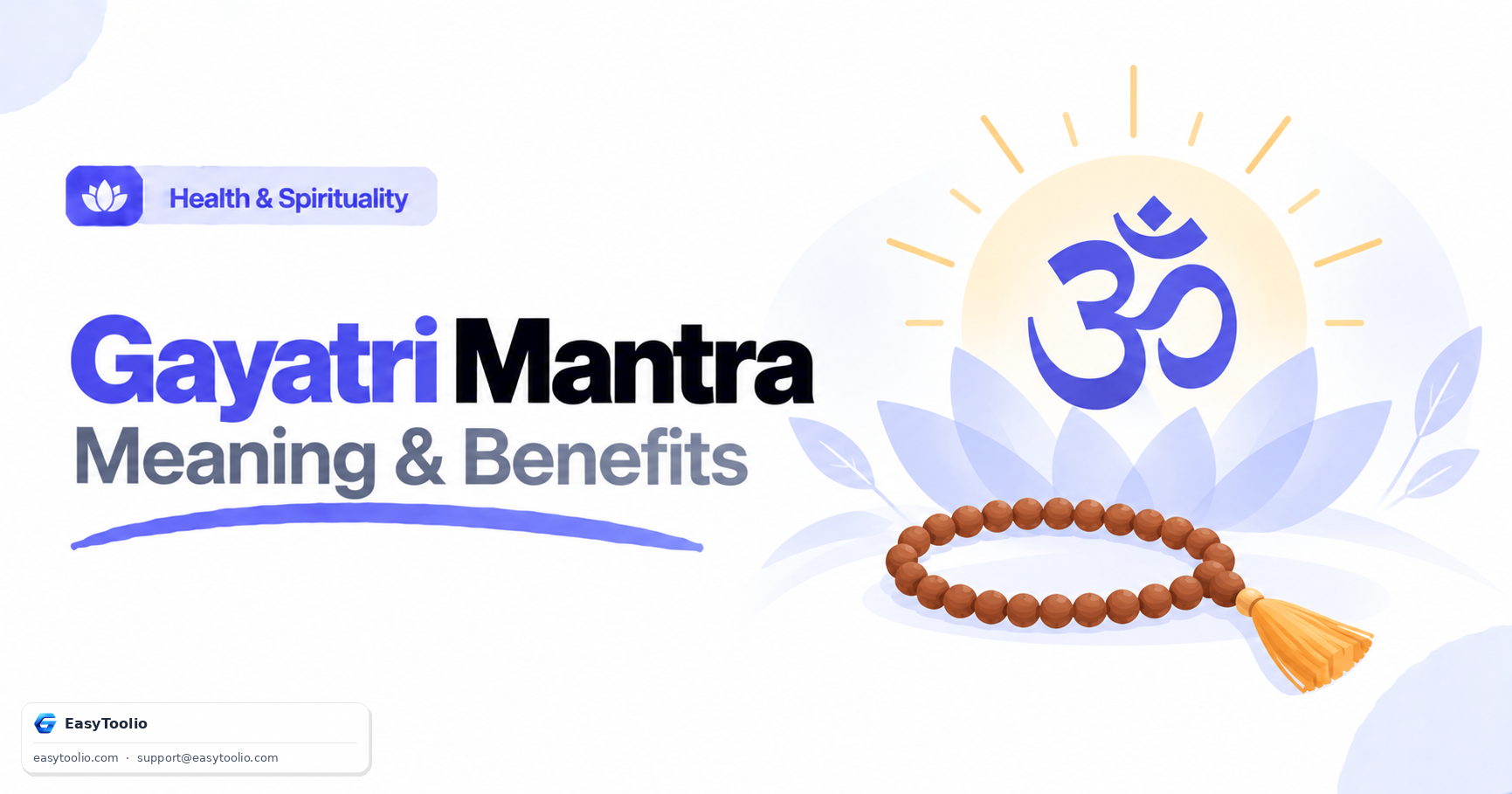
The Gayatri Mantra is often described as the most important mantra in the Vedic tradition — recited daily by millions across India for thousands of years, yet its actual meaning is understood by surprisingly few of the people who chant it. Understanding what you're saying — and how the traditional recitation counts work — deepens the practice considerably.
Origins: Where the Gayatri Mantra Comes From
The Gayatri Mantra appears in the Rigveda (Mandala 3, Hymn 62, Verse 10), one of the oldest sacred texts in the world, composed in the Gayatri metre (a specific Vedic poetic meter of 24 syllables, from which the mantra takes its name). It is dedicated to Savitr (the solar deity representing divine illumination) and is often personified as the Goddess Gayatri, considered the mother of the Vedas in later tradition.
Sage Vishwamitra is traditionally credited as the seer (rishi) who received this mantra.
The Full Mantra and Word-by-Word Meaning
Sanskrit: Om Bhur Bhuvah Swaha Tat Savitur Varenyam Bhargo Devasya Dheemahi Dhiyo Yo Nah Prachodayat
Word-by-word breakdown:
| Sanskrit | Meaning |
|---|---|
| Om | The primordial sacred sound |
| Bhur Bhuvah Swaha | The three realms — physical, mental/astral, and celestial (earth, atmosphere, heaven) |
| Tat | That (referring to the Divine) |
| Savitur | Of the Sun / the illuminating, life-giving source |
| Varenyam | Worthy of worship, adorable |
| Bhargo | Divine light, radiance, that which burns away impurities |
| Devasya | Of the divine |
| Dheemahi | We meditate upon, we contemplate |
| Dhiyo | Intellect, understanding |
| Yo | Who, which |
| Nah | Our |
| Prachodayat | May inspire, illuminate, direct |
A commonly rendered overall translation: "We meditate on the glory of that Being who has produced this universe; may He enlighten our minds."
The mantra is essentially a prayer for the illumination of the intellect — not a request for material gain, but for clarity of thought and right understanding.
Traditional Benefits Attributed to the Gayatri Mantra
Vedic and later Hindu tradition attributes a wide range of benefits to regular Gayatri Mantra practice. It's worth framing these accurately: these are traditional and experiential claims passed down through spiritual practice and reported by many practitioners today, not clinically proven medical outcomes.
Commonly cited traditional benefits include:
- Mental clarity and focus — many practitioners describe improved concentration with regular practice
- Reduced stress and anxiety — the rhythmic, meditative repetition is described as calming
- Spiritual growth — considered by tradition to purify the mind and support progress on a spiritual path
- A sense of connection to something larger — commonly reported among long-term practitioners across traditions
If you have anxiety, sleep issues, or a mental health concern, treat mantra practice as a complementary calming ritual, not a substitute for medical or psychological care.
How Many Times Should You Chant It?
The traditional gold standard is 108 repetitions, counted using a japa mala (prayer bead necklace) of 108 beads plus one "guru bead" that marks the start/end point without being counted.
For those with less time, common alternative counts are:
- 3 times — a minimal daily practice, often done at sunrise
- 9 times — a slightly extended version for busy mornings
- 11 times — another traditional shorter count
- 21 times — used by some practitioners as an intermediate goal building toward 108
The specific count matters less than consistency — traditional teaching generally emphasizes daily repetition over occasional long sessions.
Best Time to Chant
Traditional practice recommends three specific windows, all tied to transitions in natural light — considered symbolically aligned with the mantra's dedication to Savitr, the solar deity:
- Brahma Muhurta — approximately 90–48 minutes before sunrise, considered the most auspicious window for spiritual practice in Vedic tradition
- Sunrise (Pratah Sandhya) — the most commonly practiced time for householders
- Sunset (Sayam Sandhya) — the traditional third recitation window, marking the day's close
Facing east during sunrise chanting and west during sunset chanting is a common traditional convention, though daily consistency matters more than exact directional alignment.
Using a Counter for Your Practice
Counting 108 repetitions by memory alone is genuinely difficult to sustain, especially during longer sadhana (dedicated spiritual practice) sessions, and losing count mid-recitation can be distracting. This is exactly the gap our Gayatri Mantra Counter is built for — a simple digital tap-counter that tracks your repetitions accurately, so you can stay focused on the mantra itself rather than mentally tallying beads.
If your practice includes multiple mantras or a longer mala rotation, our general-purpose Japa Mala Counter works the same way for any mantra, tracking full mala rounds (each round = 108 counts) so you always know exactly where you are in a longer session.
Frequently Asked Questions
Q: What does the Gayatri Mantra actually mean? A: It is a prayer addressed to the divine solar principle (Savitr), asking that our intellect be illuminated and guided — a commonly used translation is "We meditate on the glory of that Being who has produced this universe; may He enlighten our minds."
Q: How many times should I chant the Gayatri Mantra each day? A: The traditional standard is 108 times using a japa mala, though shorter counts of 3, 9, or 11 times are common for a daily practice when time is limited — consistency of daily practice is generally considered more important than the specific count.
Q: When is the best time to chant the Gayatri Mantra? A: Traditional practice recommends Brahma Muhurta (roughly 90–48 minutes before sunrise), sunrise itself, or sunset — all three windows are tied to transitions in natural light, symbolically connected to the mantra's dedication to the solar deity Savitr.