Scrolling through a database of 10,000+ baby names one at a time is a genuinely bad way to find a name you'll actually use — most of them won't fit your culture, your intended meaning, or even the sound you're going for, and you'll burn hours before narrowing anything down. The actual value of a name generator isn't the size of its database; it's how well its filters cut that database down to a shortlist that's actually relevant to you.
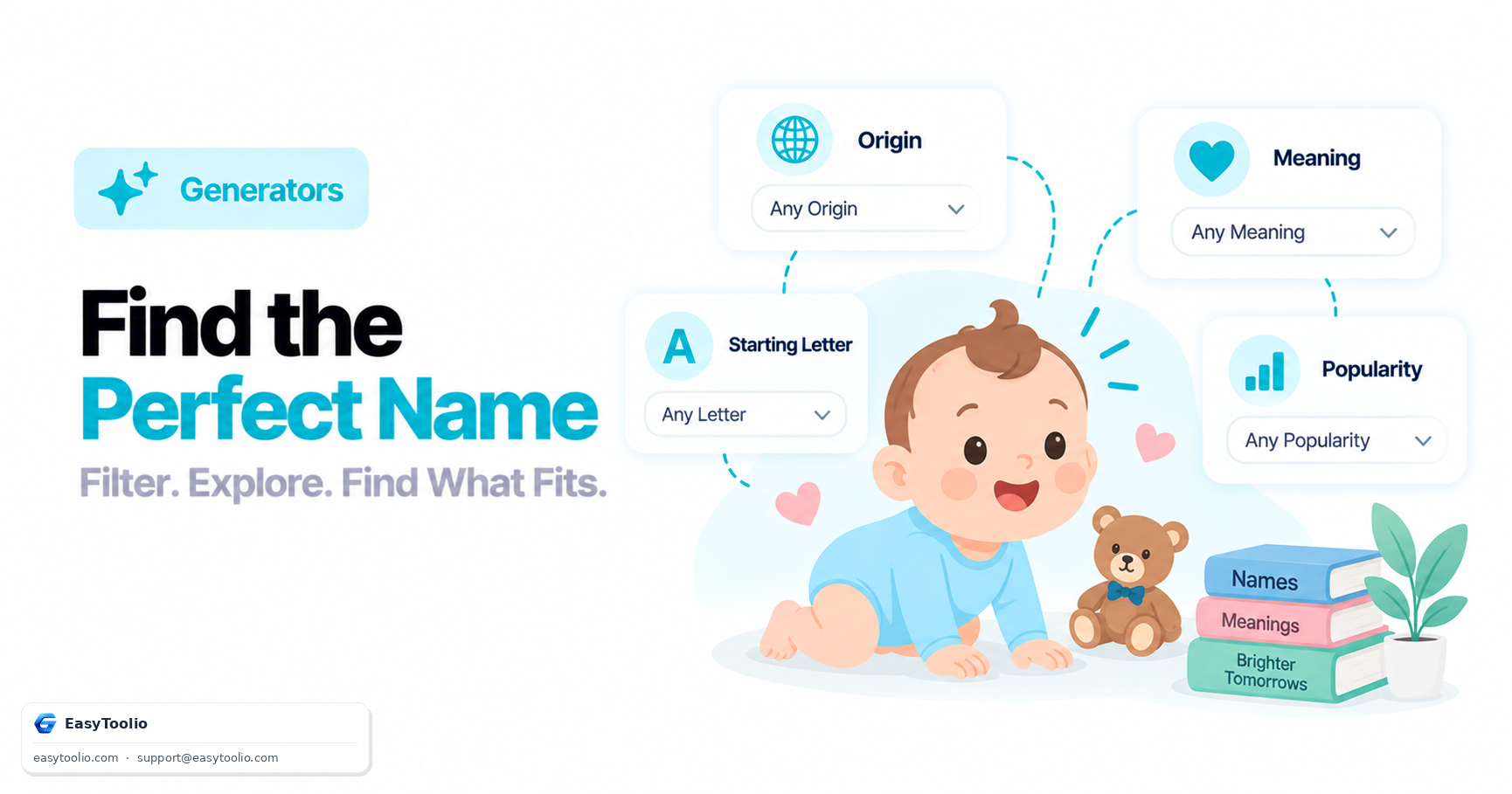
Direct Answer: A baby name generator becomes useful once you apply filters that meaningfully narrow the pool — origin/culture (Sanskrit, Hebrew, Celtic, etc.), gender, starting letter, specific meaning ("means strength" or "means light"), and syllable count or sound pattern — turning an unmanageable list of thousands into a shortlist of a few dozen names that actually match what you're looking for. Beyond filtering, checking a name's current popularity ranking (to avoid something either overused in your region or so rare it invites constant mispronunciation) and verifying its meaning across the cultures it might be recognized in are the two extra steps that separate a name people will actually love in ten years from one they'll want to change.
Filtering by Origin and Culture
Origin filtering is usually the single most powerful narrowing step, because it immediately cuts a global name database down to names that fit a specific linguistic or cultural tradition — Sanskrit, Arabic, Hebrew, Celtic, Yoruba, Japanese, and dozens more. This matters for reasons beyond aesthetics:
- Family or religious tradition — many families want a name rooted in a specific heritage or religious naming convention.
- Pronunciation consistency — a name that's phonetically natural in one language may be genuinely difficult to pronounce correctly for speakers of another, which matters if the child will grow up across multiple linguistic contexts.
- Sibling-name cohesion — parents often want a new name to share an origin or "feel" with an existing child's name.
Try filtering by origin and gender together in our free baby name generator to get a shortlist that's actually relevant instead of scrolling an unfiltered global list.
Filtering by Meaning
Many parents start not from a sound they like but from a meaning they want — "strength," "light," "gift from god," "beloved." A generator that indexes names by meaning lets you search from that direction directly rather than looking up each candidate name's meaning one at a time.
| Desired Meaning | Example Names Across Origins |
|---|---|
| Strength / courage | Valeria (Latin), Aryan (Sanskrit), Ethan (Hebrew) |
| Light / bright | Noor (Arabic), Prakash (Sanskrit), Lucia (Latin) |
| Gift / blessing | Nadia (Arabic/Slavic), Devendra (Sanskrit), Matthew (Hebrew) |
| Beloved / dear | Amara (multiple origins), Priya (Sanskrit), David (Hebrew) |
Worth noting: the same name can carry different meanings, or even different connotations entirely, in different source languages, so it's worth double-checking a meaning against more than one reference if the name has roots in more than one tradition.
Filtering by Starting Letter, Syllables, and Sound
Some naming decisions are driven by practical or aesthetic constraints rather than meaning or origin at all:
- Starting letter — a family tradition of naming children with the same initial, or matching a grandparent's name's first letter.
- Syllable count — parents with a long surname often deliberately choose a shorter first name (one or two syllables) to keep the full name from feeling unwieldy, while a short surname has more room for a longer first name.
- Sound/rhythm with the middle and last name — testing the full name out loud, since a name that reads fine alone can create an awkward rhyme or repeated sound once combined with a middle and last name.
Using Popularity Trend Data to Avoid Two Opposite Problems
Name popularity data — the kind published annually by agencies like the US Social Security Administration or equivalent national statistics bodies — is useful for avoiding two opposite mistakes:
- Too common — a name currently in the national top 10 means a real chance your child shares a name with several classmates; some parents are fine with this, others specifically want to avoid it.
- Too rare or unfamiliar — an extremely uncommon name may lead to a lifetime of mispronunciation, misspelling, and having to explain or repeat it constantly, which isn't disqualifying but is worth a deliberate choice rather than an accident.
| Popularity Tier | Trade-off |
|---|---|
| Top 20 nationally | Familiar, easy to spell/pronounce, but shared with many peers |
| Top 100–500 | Recognizable but distinctive, a common "sweet spot" |
| Outside top 1000 / rare | Highly distinctive, but expect frequent mispronunciation and spelling corrections |
A rising-trend name (climbing steadily in rank over the past several years) is worth flagging too — a name outside the top 500 today might be in the top 50 by the time your child starts school, which is relevant if uniqueness specifically matters to you.
Sibling-Name Matching
If you already have one or more children, many parents deliberately choose a new name that "matches" in some dimension — shared origin, similar syllable count, a complementary meaning, or a consistent naming style (all classic, all nature-themed, all family names). A generator that lets you filter by the same criteria you'd apply to an existing child's name makes this consistency check much faster than manually cross-referencing candidate names against your first child's name.
Checking Meaning Across Cultures Before Settling
A name that sounds pleasant and has a lovely meaning in one language can occasionally carry an unrelated, awkward, or even negative meaning in another language your family or community might recognize. This is genuinely worth ten minutes of research before finalizing a name, especially for families with connections across more than one linguistic or cultural community — a quick cross-check against a second-language dictionary or a native speaker's opinion catches this far more reliably than assuming a name's meaning is universal.
Frequently Asked Questions
Should I prioritize meaning or sound when choosing a name?
There's no universally correct order — some parents start with meaning and narrow to names that sound good together, others start with sound and check meaning afterward as a final filter. The generator approach works either way since you can filter by meaning first or browse by origin/sound first.
How do I know if a name is too popular right now?
Check recent national naming-statistics data (published annually in most countries) for the name's current rank; a name inside the top 20–50 is a reasonable signal that your child is likely to share it with classmates, though trends shift year to year.
Is it a problem if a name is hard to pronounce in English?
Not inherently, but it's worth a deliberate decision rather than an oversight — some families embrace a name from their heritage regardless of local pronunciation difficulty, while others choose a name that reads more phonetically for the environment their child will grow up in.
Can a name generator help match a sibling's existing name?
Yes, if it supports filtering by the same criteria (origin, syllable count, first letter, meaning theme) you'd want to match against your existing child's name, which is much faster than manually comparing candidate names one at a time.
Do baby name meanings ever conflict between sources?
Yes, occasionally — a name with roots in more than one language or historical tradition can have genuinely different attributed meanings depending on the source, so cross-checking against more than one reference is worthwhile if the meaning is a deciding factor for you.
References: US Social Security Administration Baby Names data methodology; general onomastics (the study of proper names) conventions for name origin and meaning classification.