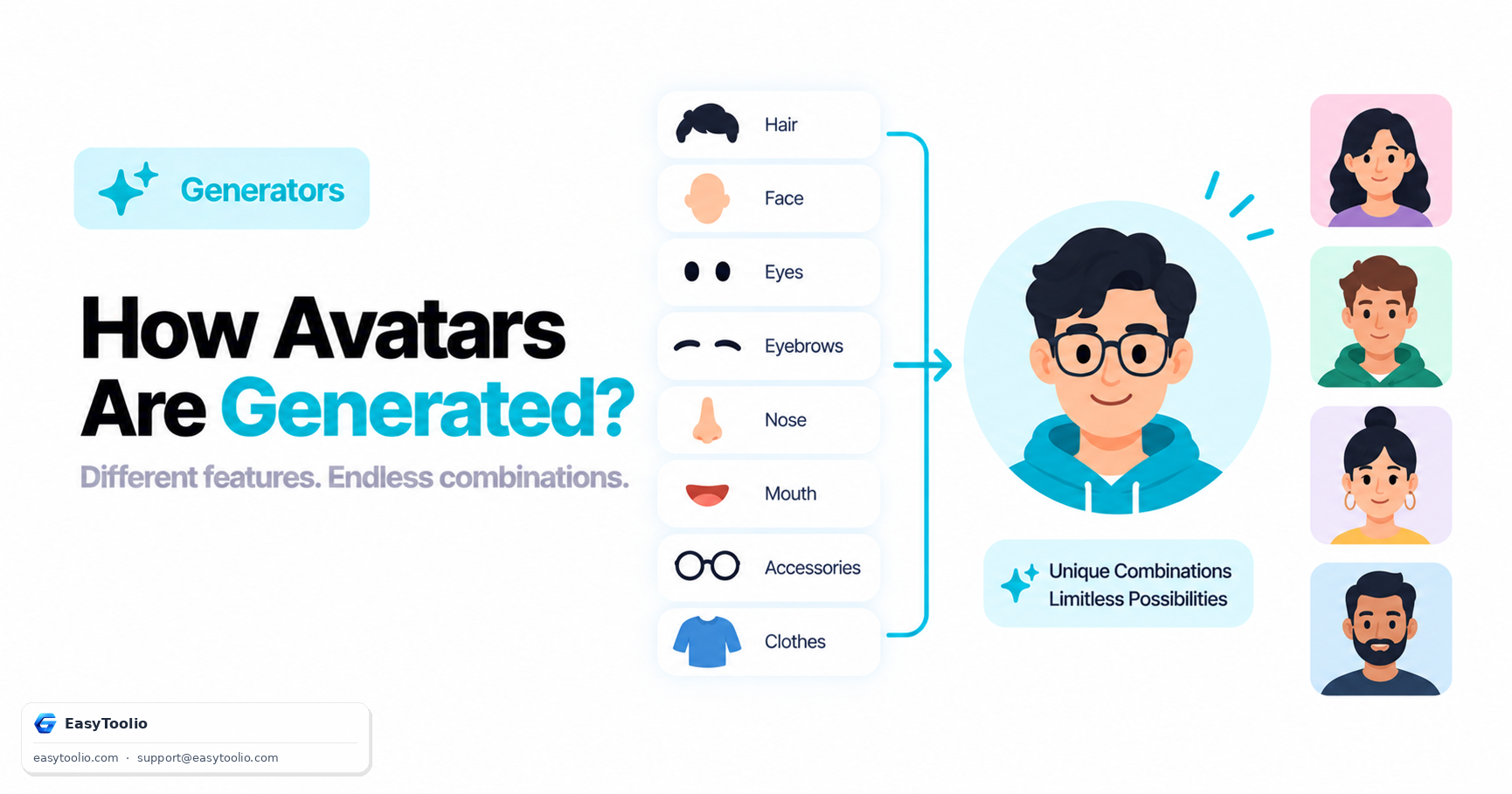
An avatar generator can offer millions of visually distinct results from what is, under the hood, a fairly small set of source art assets. That's not an illusion or a trick — it's a deliberate design pattern called layered/procedural composition, and understanding it explains both why avatar generators feel endlessly varied and why two people can occasionally end up with suspiciously similar-looking results.
Direct Answer: A procedural avatar generator works by treating each visual feature — face shape, hair style, eye style, mouth, accessories, background color — as an independent layer, each with its own small library of options (say, 20 hairstyles, 15 eye styles, 10 face shapes), and then randomly selecting one option per layer and compositing them together; with even a modest number of layers and options per layer, the total number of possible combinations multiplies into the tens of thousands or millions, far exceeding what any human artist could draw individually. This differs fundamentally from an identicon, which is deterministic rather than random — it derives its visual pattern directly from a hash of an input (like a username or email address), so the same input always produces the exact same avatar every time, with no randomness involved at all.
The Layered Composition Model
Instead of an artist drawing one complete avatar image at a time, a procedural generator's asset library is organized into independent categories, each containing multiple interchangeable options for that one feature:
| Layer | Example Options Available |
|---|---|
| Face/head shape | Round, oval, square, heart-shaped |
| Skin tone | 6–10 shades |
| Hair style | Short, long, curly, bald, buzzed, braided |
| Hair color | 8–12 colors |
| Eyes | Round, almond, narrowed, wide, closed |
| Mouth/expression | Smiling, neutral, open, smirking |
| Accessories | Glasses, hat, earrings, none |
| Background color/pattern | Solid colors, gradients, patterns |
The generator's job at generation time is simple: pick one option from each layer (either randomly or based on user selection) and stack them in a fixed rendering order — background first, then head shape, then features on top, then accessories last — so the layers composite correctly into one coherent image.
Why a Small Asset Library Produces Huge Variety
This is basic combinatorics: if you have 8 layers and each layer offers just 10 options, the total number of unique combinations is 10⁸ — one hundred million distinct avatars, from only 80 individual pieces of source art. Even a much smaller, more realistic library still produces enormous variety:
4 face shapes × 10 hair styles × 8 hair colors × 6 eye styles
× 5 mouth styles × 4 accessory options × 8 background colors
= 4 × 10 × 8 × 6 × 5 × 4 × 8 = 307,200 unique combinations
That's over 300,000 visually distinct avatars from a genuinely modest set of drawn assets — which is exactly why avatar generators can offer "endless" variety in their marketing without needing a correspondingly enormous art budget. Generate a unique combination instantly with our free avatar generator rather than uploading a real photo if you want a fast, anonymous profile image.
Randomized Avatars vs. Identicons: A Fundamental Difference
It's easy to lump every auto-generated avatar into one category, but there are two genuinely different mechanisms at play depending on the use case:
| Aspect | Randomized Avatar Generator | Identicon |
|---|---|---|
| How it's generated | Random selection across feature layers | Deterministic hash of an input (username, email, IP) |
| Same input twice | Produces a different result each time (unless a seed is saved) | Always produces the identical result |
| Visual style | Illustrated, human/cartoon-like features | Usually abstract geometric patterns, not humanlike |
| Typical use case | Profile picture, character creation, placeholder | Default avatar for users who haven't uploaded a photo |
| Purpose | Personalization, fun, uniqueness | Visual consistency and quick recognizability tied to identity |
An identicon (popularized by services like Gravatar and GitHub's default avatars) takes a cryptographic hash of some identifying string, then maps chunks of that hash's bits to visual parameters — a grid pattern, a set of colors, a symmetry rule. Because a hash function always produces the same output for the same input, the same email address or username generates the exact same identicon every single time, with zero randomness. This determinism is the entire point: it gives every user a distinct-looking default avatar without storing an actual image, and it stays visually consistent across sessions and devices without any server-side avatar storage at all.
Common Use Cases
- Placeholder profile pictures — giving every new user a visually distinct avatar before they upload a real photo, rather than showing an identical generic silhouette for everyone.
- Anonymous forum or app identities — letting users have a memorable, personalized visual identity without revealing their actual appearance.
- App onboarding flows — letting a new user "build" a character as part of account setup, which increases engagement and personal investment compared to a default asset.
- Game character creation — a lightweight way to offer visual customization without commissioning full custom art for every possible player combination.
Frequently Asked Questions
Can two different people get the exact same avatar from a randomized generator?
Yes, it's mathematically possible, though unlikely with a large enough combinatorial space — with hundreds of thousands or millions of possible combinations, the odds of an exact collision are low but never zero, especially as more users generate avatars over time.
Why do some avatar generators let me save a "seed" instead of a random result?
A saved seed lets you (or someone else) regenerate the exact same combination of features later, which is useful if you want a consistent avatar across multiple platforms or want to share a specific combination with someone else without exporting the image file itself.
What's the advantage of an identicon over a randomized avatar for a website's default profile picture?
An identicon requires no stored image at all — it's computed on the fly from the user's identifying data — and guarantees the same user always sees the same default avatar, which matters for recognizability in a way that a re-randomized avatar wouldn't.
Do procedural avatar generators use AI image generation?
Not typically — the layered composition method described here is a simpler, faster, and more consistent technique than AI image generation, and it guarantees every output looks stylistically coherent since all the source art is drawn in one consistent style beforehand.
Can I use a generated avatar commercially?
This depends entirely on the specific tool's license terms — some generators explicitly grant free commercial use of generated combinations, while others restrict use to personal profiles only, so check the specific tool's terms before using a generated avatar in branding or commercial material.
References: General conventions for procedural/layered character generation in digital design; identicon concept as popularized by Gravatar and GitHub's default avatar system.