Search "CGPA to percentage" and you will almost always land on one formula: multiply by 9.5. It is quoted constantly, applied automatically, and — critically — not a universal rule. It is a specific conversion factor tied to a specific grading context, and applying it blindly to a different board, university, or country's CGPA scale can produce a meaningfully wrong percentage.
Direct Answer: The commonly cited formula, Percentage = CGPA × 9.5, originates from a specific CBSE-style 10-point grading scale convention and is not a universal mathematical rule. Different educational boards, universities, and countries use different grade-point scales (commonly 4.0, 5.0, or 10.0) and different official conversion tables between grade points and percentage, so the correct multiplier — or the correct conversion method entirely — depends on which institution issued the CGPA. Students should always confirm the official conversion formula published by their own specific board or university rather than assuming any single multiplier applies to their result.
1. Where the "× 9.5" Formula Comes From
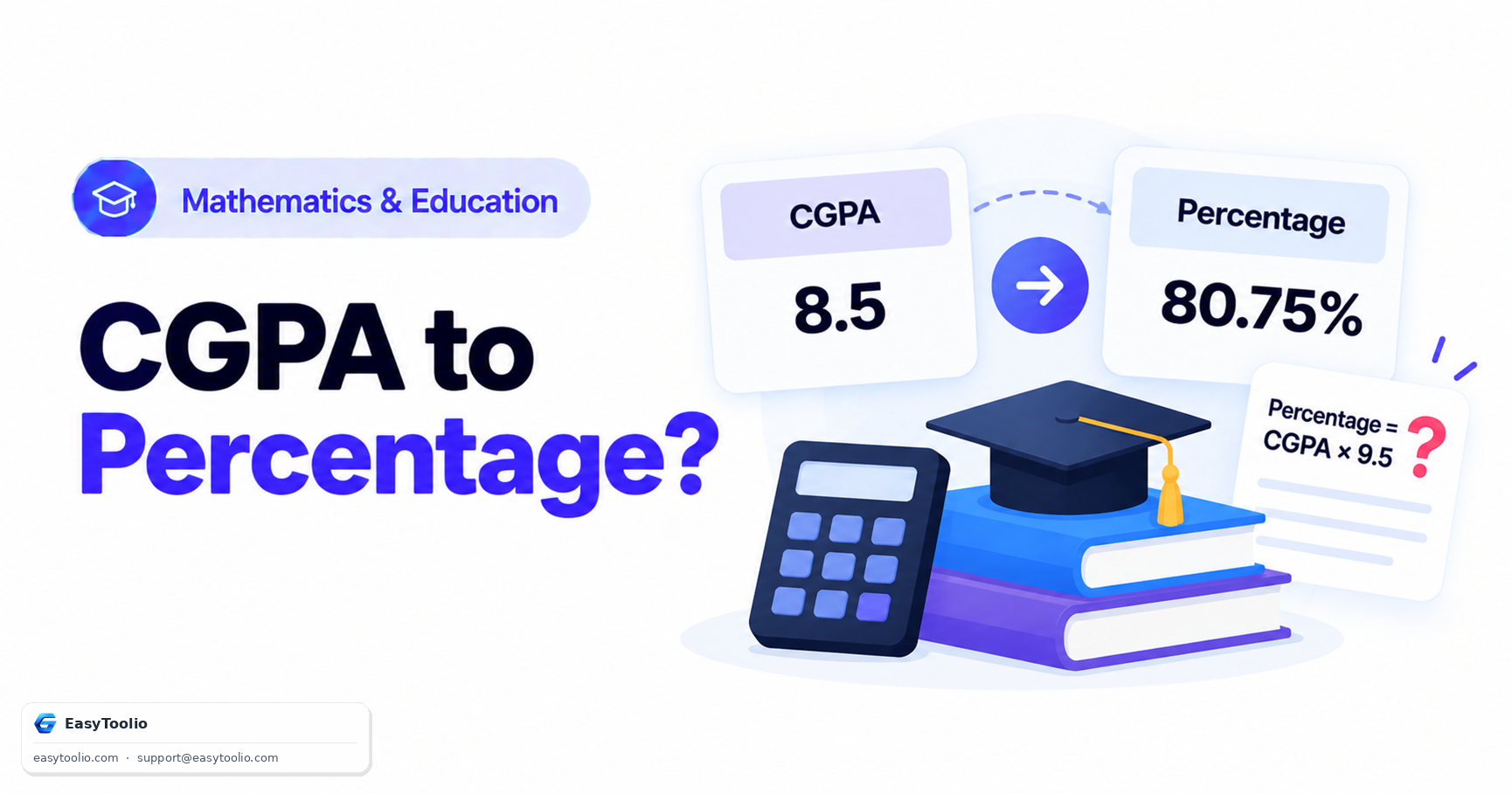
The formula Percentage = CGPA × 9.5 is associated with certain CBSE (Central Board of Secondary Education, India) grading conventions on a 10-point CGPA scale, where it has been used as an approximate conversion for specific examination results. It is not derived from a universal mathematical relationship between grade points and percentage marks — it is a specific institutional convention, applicable only within the context it was defined for.
Percentage (CBSE convention) = CGPA × 9.5
Example: A CGPA of 8.6 under this specific convention converts to 8.6 × 9.5 = 81.7%.
2. Why This Multiplier Is NOT Universal
Applying the ×9.5 formula outside the specific context it was designed for produces incorrect results, for several concrete reasons:
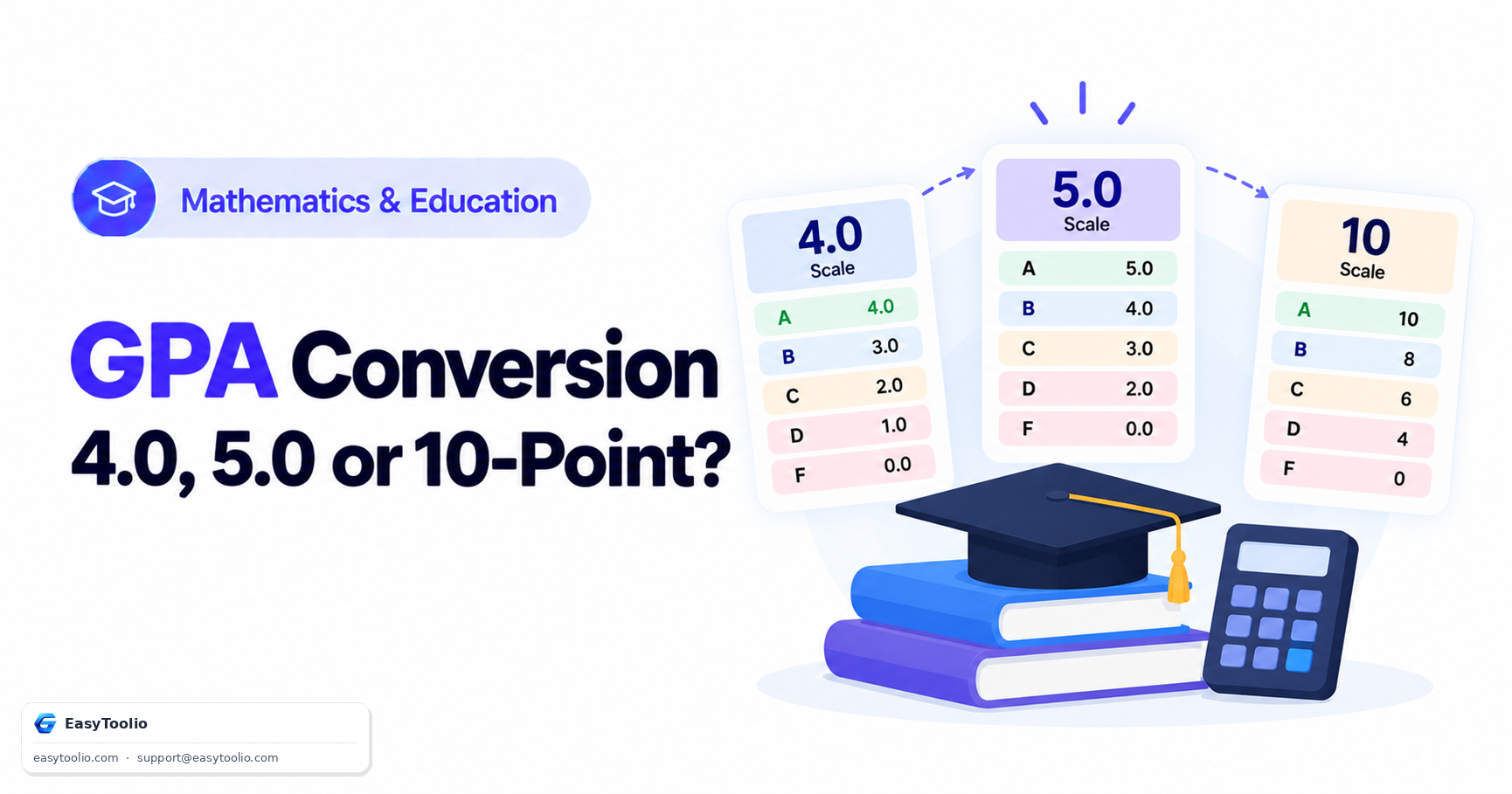
- Different grade-point scales entirely. Not every institution uses a 10-point CGPA scale. Many universities — particularly in the US, and many international programs — use a 4.0 scale, where a straightforward ×9.5-style multiplier makes no mathematical sense at all (a 4.0 GPA × 9.5 would produce 38%, which is meaningless).
- Different official conversion tables. Many universities publish their own official grade-point-to-percentage equivalence tables (often nonlinear, varying by grade band), rather than using a single flat multiplier. Two institutions on the same 10-point scale can still have different official conversion tables.
- Some boards issue percentage and CGPA independently. In some systems, percentage is calculated directly from raw marks obtained, and CGPA is a separate, parallel reporting mechanism — there is no formula meant to convert one into the other because they are not designed to be interchangeable.
- Weighted vs. unweighted scales. Some grading systems weight certain courses (honors, AP, major-subject courses) more heavily when computing an aggregate score, which further breaks any simple linear multiplier between CGPA and percentage.
3. Comparison of Common Grade-Point Scale Systems
| Scale | Common Region/Context | Typical Conversion Approach |
|---|---|---|
| 10-point CGPA scale | Common in Indian secondary/higher education boards | Some boards publish a specific multiplier or lookup table (e.g., the ×9.5 CBSE convention) for specific exams |
| 4.0 GPA scale | Common in US undergraduate/graduate programs | Percentage equivalence, where used at all, is typically derived from a letter-grade-to-percentage range table, not a flat multiplier |
| 5.0 GPA scale | Used by some international and secondary programs | Institution-specific conversion tables; not interchangeable with 4.0 or 10.0 scale conversions |
Because these scales measure fundamentally different things with different grade bands, there is no single formula that correctly converts any CGPA to any percentage — the correct method always depends on which scale and which institution's table applies.
4. What Students Should Actually Do
- Identify the exact scale your CGPA is reported on (4.0, 5.0, 10.0, or another system).
- Check your institution's official conversion table or policy document — most universities and boards publish an explicit, authoritative conversion method for exactly this purpose (often required for job applications or further-study admissions abroad).
- Do not assume a formula found online applies to your specific board or university just because it is widely repeated — the ×9.5 formula is a real convention, but only within its specific originating context.
- When in doubt, request an official conversion certificate from your institution's examination or registrar's office — many universities issue these precisely because ad hoc formulas are unreliable for official purposes (visa applications, foreign university admissions, employer verification).
Use cgpa-to-percentage-calculator for a quick estimate under the common convention, calculate a raw GPA from your grades with gpa-calculator, convert the other direction with percentage-to-cgpa-calculator, and calculate a semester-wise SGPA using sgpa-calculator.
5. Frequently Asked Questions (FAQs)
Is the CGPA × 9.5 formula official or just a widely used estimate?
It is associated with a specific board-level convention in certain contexts, but it is frequently applied online as a generic shortcut well beyond that original context. Always verify against your own institution's official published conversion method before treating any multiplier as authoritative.
Can I convert a 4.0-scale GPA to a percentage using the same ×9.5 method?
No. That formula assumes a 10-point CGPA scale as its starting basis; applying it to a 4.0-scale GPA produces a mathematically meaningless result. A 4.0-scale GPA requires a different conversion approach entirely, typically based on letter-grade-to-percentage range tables specific to that institution.
Why do foreign universities sometimes ask for an official conversion certificate instead of accepting a calculated percentage?
Because CGPA-to-percentage conversion methods vary so widely between institutions and countries, admissions offices often require an authoritative, institution-issued conversion (rather than a student's self-calculated figure) to ensure consistent, verifiable comparison across applicants from different grading systems.
References: CBSE (Central Board of Secondary Education) grading convention documentation; institutional grade-point conversion policies as published by individual universities.