A 3.7 GPA, a 4.2 GPA, and an 8.8 CGPA could all represent students near the top of their respective classes — or wildly different levels of performance — and there is no way to tell which without knowing the underlying scale, the grading curve, and whether the GPA is weighted or unweighted. GPA conversion charts exist to bridge these systems, but they are approximations, not exact equivalences.
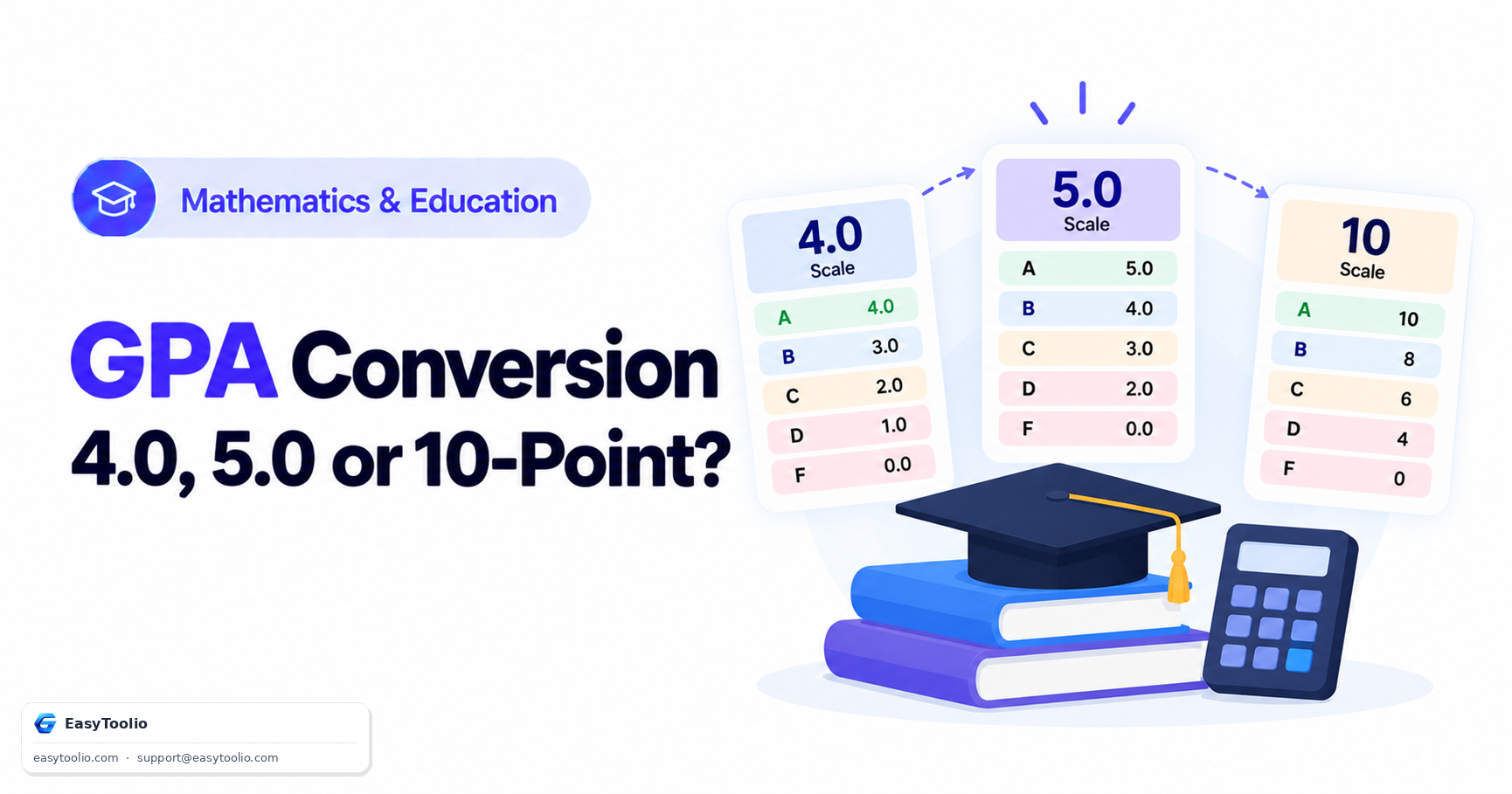
Direct Answer: Letter grades map to numeric grade points differently depending on the scale system in use — commonly 4.0, 5.0, or 10-point scales — and each institution additionally sets its own grade-band boundaries (what percentage range earns an A versus a B, for instance). Because of this, a straight proportional conversion between two GPA scales (for example, simply scaling a 4.0 GPA up to a "5.0-equivalent" by multiplying by 1.25) is misleading: it ignores differences in weighted versus unweighted GPA calculations and differences in each institution's grading curve. Students applying internationally should present their GPA alongside their institution's official grading scale and, where required, request an official conversion or explanation letter rather than relying on an informal chart alone.
1. How the Three Common Scales Differ
| Scale | Typical Grade-Point Mapping (illustrative) | Common Region/Context |
|---|---|---|
| 4.0 Scale | A = 4.0, B = 3.0, C = 2.0, D = 1.0, F = 0.0 (institution-specific pluses/minuses adjust this) | Widely used in US undergraduate and graduate education |
| 5.0 Scale | Often used to reward advanced/honors coursework with an extra point of "weight" above the standard 4.0 ceiling | Some US high schools (weighted GPA) and some international systems |
| 10-Point Scale | Grade points typically assigned per letter/grade band, then averaged as CGPA | Common in Indian and several other national higher-education systems |
Each scale is a self-contained system — the grade points only have meaning relative to that scale's own maximum and its own grade-band definitions. A 4.2 on a 5.0 scale is not "the same performance" as a 4.2 on a 4.0 scale (where it would not even be achievable under an unweighted system) — the two numbers come from different measurement systems entirely.
2. Why Straight Percentage-Based Conversion Is Misleading
A tempting shortcut is to treat GPA as a simple fraction of its maximum and rescale it — for example, converting a 3.6/4.0 GPA to a "/5.0 equivalent" by computing 3.6 ÷ 4.0 × 5.0 = 4.5. This kind of proportional rescaling has real limitations:
- Weighted vs. unweighted GPA: A weighted GPA (which awards extra points for honors, AP, or IB-level courses) can legitimately exceed 4.0 on what is nominally a "4.0 scale," while an unweighted GPA cannot. Comparing a weighted GPA from one school to an unweighted GPA from another using a flat proportional formula compares two different things as if they were the same measurement.
- Different grading curves: One institution's "A" might require 90%+ raw marks; another's might set the threshold at 93%+ or use a curve relative to the class's performance that year. A proportional GPA conversion assumes uniform grade-band boundaries across institutions, which is rarely true.
- Non-linear grade-point spacing: Some scales do not space grade points evenly across the percentage range (for example, the gap between a B+ and an A- may not represent the same underlying percentage gap as the difference between a C+ and a B-). A linear proportional formula cannot capture this.
Because of these factors, GPA conversion charts published by universities and credential-evaluation services should be treated as institutional approximations for admissions comparison purposes, not as mathematically exact equivalences.
3. Practical Guidance for Students Applying Internationally
- Always report your GPA together with its scale and your institution's grading policy — a bare number like "3.8" is meaningless to an admissions committee without knowing it is out of 4.0, out of 5.0 (weighted), or something else entirely.
- Check whether the receiving institution or country has a published equivalency table — many university admissions offices and credential evaluation services (used heavily for study-abroad and immigration applications) maintain their own conversion guidance specifically because informal online charts are inconsistent.
- Request an official transcript with grading-scale explanation from your school's registrar — this is often the document international admissions offices actually rely on, rather than a self-reported converted number.
- If asked to convert to a percentage or another scale for an application form, show your work — state the original GPA, the original scale, and the conversion method used, so the receiving reader can judge the conversion themselves rather than seeing an unexplained number.
Calculate a GPA from letter grades and credit hours using gpa-calculator, convert individual raw marks to letter grades with grade-calculator, estimate a percentage-scale equivalent using cgpa-to-percentage-calculator, and compute a simple average of raw scores across subjects with average-calculator.
4. Frequently Asked Questions (FAQs)
Is a 5.0-scale GPA always "better" than a 4.0-scale GPA?
Not necessarily. A 5.0 scale (often used for weighted GPA including honors/AP courses) has a higher numeric ceiling, so a raw number comparison across scales is meaningless without knowing whether weighting was applied and how the receiving institution interprets each scale.
How do admissions offices actually compare GPAs from different countries?
Many use dedicated credential-evaluation services or their own internally maintained conversion tables built from historical data about specific institutions and grading systems, rather than a single universal formula — this is a large part of why international applications often require official transcripts rather than self-reported converted GPAs.
Should I convert my GPA myself before submitting an application?
Only if the application explicitly asks for a converted figure. When in doubt, present your original GPA with its native scale and grading policy explanation, and let the receiving institution apply its own established conversion process — a well-documented original figure is generally more trustworthy than a self-converted one.
References: Common GPA scale conventions (4.0, 5.0, 10-point) as published by US and international educational institutions; general credential-evaluation practices for cross-border academic comparison.