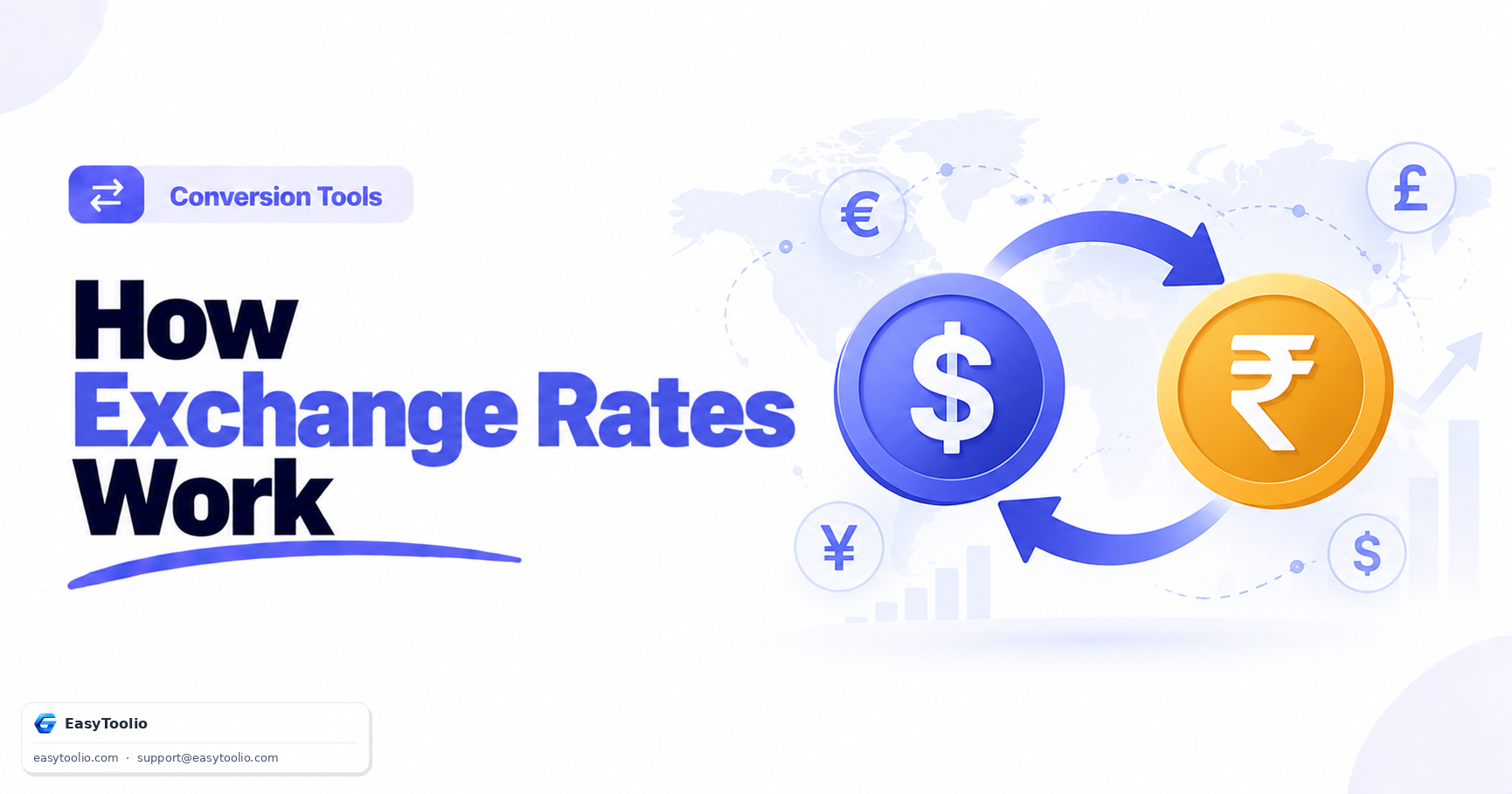
If you have ever converted the same amount of money twice in one day and gotten two slightly different results, you have already discovered the core truth about exchange rates: they never sit still. Currency values move constantly based on global trading activity, and understanding why helps you convert money more accurately and avoid overpaying when you exchange currency for travel, shopping, or business.
How Exchange Rates Are Actually Determined
Exchange rates for major currencies like USD, EUR, GBP, and JPY are set by the foreign exchange (forex) market, the largest and most liquid financial market in the world, with trillions of dollars traded daily between banks, financial institutions, corporations, and governments. There is no single central authority that "sets" a rate the way a government sets a tax rate. Instead:
- Interbank rates are the wholesale rates large banks trade at with each other, based on real-time supply and demand for each currency pair.
- Mid-market rate is the midpoint between the buy and sell price on the interbank market, and it is the benchmark most currency converters display.
- Retail rates (what you get at a bank, airport kiosk, or currency exchange counter) are the mid-market rate plus a markup or margin the provider adds to make a profit.
Rates fluctuate in real time based on interest rate decisions, inflation data, political stability, trade balances, and overall market sentiment. A central bank raising interest rates, for example, typically strengthens a currency because it attracts foreign investment seeking higher returns.
Why the Rate You See Always Has Some Lag
Because currencies trade continuously across global markets (forex trading runs 24 hours a day on weekdays across different time zones), any published rate is technically a snapshot of a value that is already moving. A good Currency Converter pulls from frequently updated data feeds, often refreshed every few minutes, to keep that lag as small as possible. But no converter can show you a rate that is truly "live to the millisecond" the way a professional trading terminal might, and for everyday conversions that level of precision is not necessary anyway.
This is also why the rate you see online rarely matches exactly what a bank or exchange counter charges you: they are using the mid-market rate as a reference point, then applying their own markup and fees on top.
Getting the Most Accurate Conversion for Your Situation
- Use mid-market rate tools for planning, not final transactions. They tell you the true value of a currency pair, which helps you judge whether a bank's offered rate is reasonable.
- Compare markup across providers before exchanging cash. Airport kiosks often have the worst rates due to high markups and convenience fees; banks and online transfer services are usually more competitive.
- Watch for "0% commission" claims. Providers advertising no commission frequently build their margin directly into a worse exchange rate instead.
- Convert larger amounts less frequently to minimize the number of times you pay a transaction fee or markup.
- Check the rate close to the time of your transaction, especially for volatile currency pairs, since a rate checked days earlier may no longer reflect current market conditions.
Mid-Market Rate vs. Retail Exchange Rate
| Aspect | Mid-Market Rate | Retail Exchange Rate |
|---|---|---|
| Who uses it | Banks trading with each other | Individual consumers |
| Markup | None | Typically 1-5% or more |
| Where you see it | Currency converter tools, financial news | Banks, exchange counters, airport kiosks |
| Best for | Reference and comparison | Actual cash or card transactions |
| Updates | Continuously during market hours | Set periodically by the provider |
Frequently Asked Questions
Q: Why did my currency converter show a different rate than my bank? A: Converters typically display the mid-market rate, while banks add a markup and sometimes a flat fee on top, so the rate you're charged is always slightly worse than the reference rate.
Q: How often do exchange rates change? A: Major currency pairs can change many times per minute during active trading hours, since they respond continuously to global supply and demand, economic data releases, and market sentiment.
Q: Is it better to exchange currency before or after traveling? A: It depends on the destination and provider, but comparing your home bank, a specialized currency service, and rates on arrival (avoiding airport kiosks) usually gets you closer to the mid-market rate than committing to one option blindly.