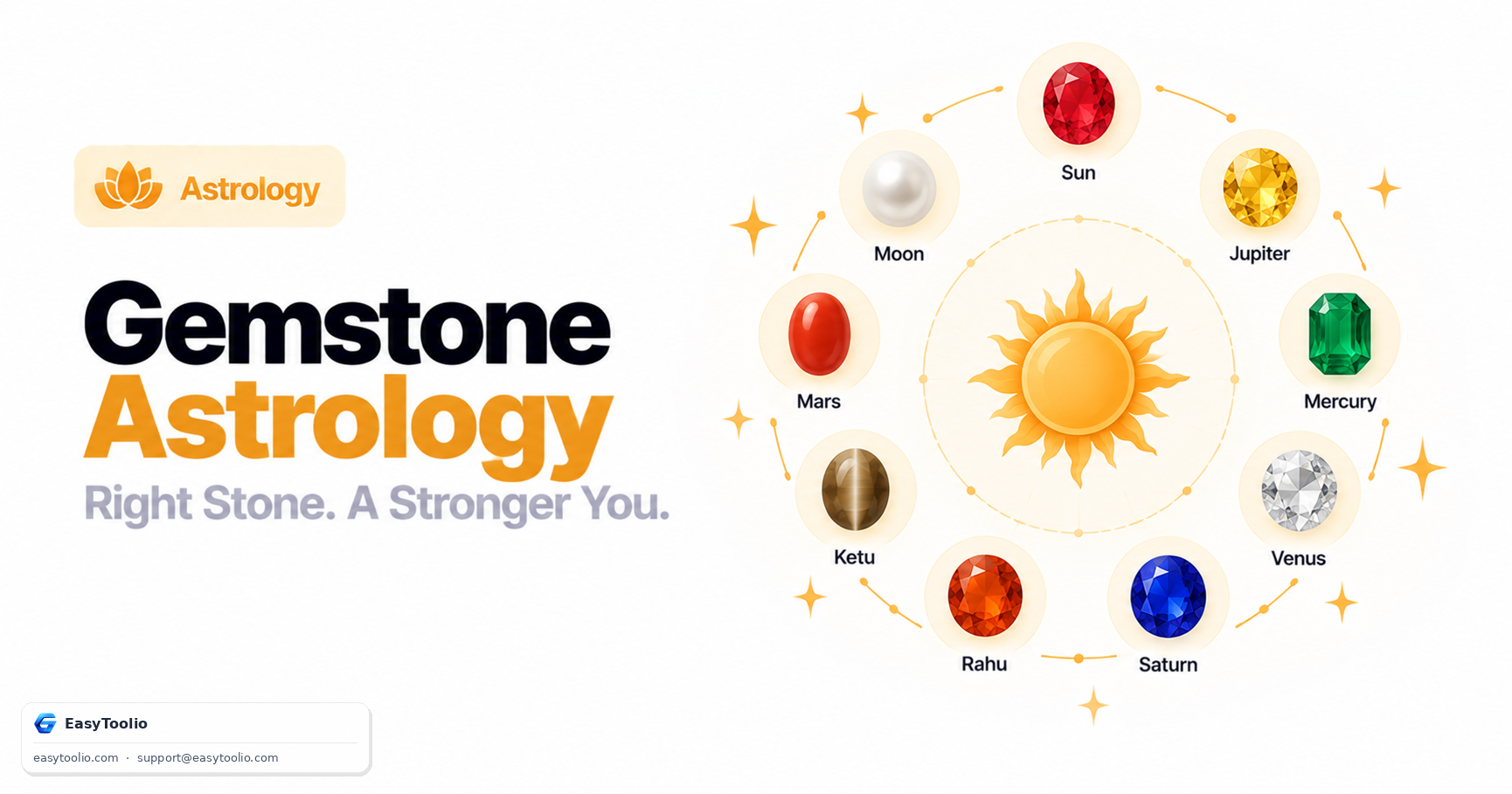
Walk past any jewelry counter in a market that caters to Vedic astrology clients and you'll see trays sorted by planet, not by cut or carat — a shelf of rubies for the Sun, a shelf of pearls for the Moon, a shelf of blue sapphires kept separate and often behind glass because of how strongly that particular stone is believed to act. The system behind this sorting is old, specific, and far more rule-bound than "pick a stone you like."
Gemstone astrology, or ratna shastra, is the branch of Vedic astrology concerned with using specific gemstones to amplify the beneficial influence of a planet that is weak, poorly placed, or otherwise in need of support in a person's birth chart — or, less commonly, to soften a harmful placement.
Direct Answer: Vedic astrology assigns one primary gemstone to each of the nine grahas (planetary influences): Ruby to the Sun, Pearl to the Moon, Red Coral to Mars, Emerald to Mercury, Yellow Sapphire to Jupiter, Diamond to Venus, Blue Sapphire to Saturn, Hessonite (Gomed) to Rahu, and Cat's Eye (Lehsunia) to Ketu. These nine together are called the Navratna ("nine gems"). An astrologer determines which single stone to recommend by examining which planet in the birth chart is debilitated, weakly placed, poorly aspected, or running an unfavorable planetary period (dasha), then recommends the gemstone tied to that specific planet rather than wearing all nine at once.
1. The Nine Navratna Gemstones and Their Planets
| Planet (Graha) | Gemstone | Typical Setting Metal |
|---|---|---|
| Sun (Surya) | Ruby (Manik) | Gold, worn on ring finger |
| Moon (Chandra) | Pearl (Moti) | Silver, worn on little finger |
| Mars (Mangal) | Red Coral (Moonga) | Gold or copper, ring finger |
| Mercury (Budh) | Emerald (Panna) | Gold or silver, little finger |
| Jupiter (Guru) | Yellow Sapphire (Pukhraj) | Gold, index finger |
| Venus (Shukra) | Diamond (Heera) | Gold, platinum, or silver, middle/ring finger |
| Saturn (Shani) | Blue Sapphire (Neelam) | Silver or panchdhatu, middle finger |
| Rahu | Hessonite (Gomed) | Silver or panchdhatu, middle finger |
| Ketu | Cat's Eye (Lehsunia) | Silver or panchdhatu, middle finger |
Each stone is believed to resonate with and channel the specific energy of its assigned planet, which is why the tradition treats them as functionally different rather than interchangeable "lucky stones."
2. How an Astrologer Decides Which Planet Needs Strengthening
Recommending a gemstone is not a matter of picking whichever planet rules your zodiac sign. An astrologer typically looks at several factors together: whether a planet is debilitated (placed in the sign of its weakest expression), whether it is the lord of a difficult house for that particular chart, whether it is afflicted by a malefic aspect or conjunction, and — very commonly — which planetary period (mahadasha or antardasha) the person is currently running or about to enter, since a gemstone is often prescribed specifically to ease or amplify the effects of an approaching period.
This is why two people with the same Sun sign can receive entirely different gemstone recommendations — the rest of the chart (Moon sign, ascendant, house placements, current dasha) determines the actual planetary weak point being addressed, not the sign alone. Getting this input chart correct is the whole basis of the recommendation, which is why a proper reading uses full birth details — date, time, and place — rather than a sun-sign shortcut. Our gemstone recommendation calculator uses these birth details to identify which planetary influence a chart suggests strengthening.
3. Purity, Carat, and Setting Rules
Traditional guidance treats a gemstone as ineffective, or even counterproductive, if it does not meet certain quality thresholds. The commonly cited rules include:
| Requirement | Traditional Guidance |
|---|---|
| Natural vs. synthetic | Must be a natural, untreated stone — lab-created or heavily treated stones are considered to lack the planet's natural resonance |
| Minimum carat | Often cited as a minimum of roughly 3–5 carats depending on the stone and the wearer's body weight, though practices vary by lineage |
| Setting metal | Each planet has a traditionally associated metal (gold for Sun/Jupiter, silver for Moon, etc.) that the stone should touch the skin through |
| Finger placement | Each stone is prescribed to a specific finger believed to correspond to that planet's channel in the body |
Because genuine, untreated stones at several carats can be expensive, and because incorrect stones are believed capable of aggravating rather than helping a placement, the tradition places heavy emphasis on verifying both the astrological recommendation and the stone's authenticity before purchase.
4. Precautions Before Wearing a Gemstone
Several precautions are commonly advised in classical and contemporary practice alike. A trial period is often recommended — wearing the stone for a few days or weeks and observing for any adverse physical or emotional reaction before committing to it long-term. Certain stone combinations are traditionally avoided entirely, most notably wearing Blue Sapphire (Saturn) and Ruby (Sun) or Pearl (Moon) together, since Saturn and the Sun/Moon are considered planetary adversaries in this system. Stones are also typically purified and energized through a short ritual (often involving raw milk, Ganga water, or a specific mantra japa) before being worn for the first time, and are conventionally put on during a planetary hour or specific weekday associated with that planet.
Frequently Asked Questions
Can I wear more than one Navratna gemstone at the same time?
Generally not recommended without astrological guidance — certain combinations, especially Blue Sapphire with Ruby or Pearl, are considered astrologically conflicting because Saturn is viewed as adversarial to the Sun and Moon in this system.
Does my zodiac sign alone determine my gemstone?
No — a proper recommendation is based on the full birth chart, including which planet is weak, afflicted, or ruling an upcoming dasha period, not on sun sign alone.
What happens if I wear the wrong gemstone?
Traditional practice holds that an incorrectly matched stone can amplify the negative expression of that planet rather than its beneficial expression, which is why a trial period and proper chart analysis are commonly advised before long-term wear.
Are synthetic or lab-created gemstones effective for astrological purposes?
Traditional practice specifies natural, untreated stones, on the reasoning that a lab-created stone lacks the same natural planetary resonance — though this is a belief-based distinction rather than a scientifically tested one.
How long does it take to feel an effect from wearing a gemstone?
Practitioners commonly cite anywhere from a few weeks to a few months, though this varies widely by individual chart and is not something with a standardized, verifiable timeline.
References: Varahamihira, "Brihat Samhita" (chapters on gemology); traditional Navratna classification as used in contemporary Vedic astrological consultation.