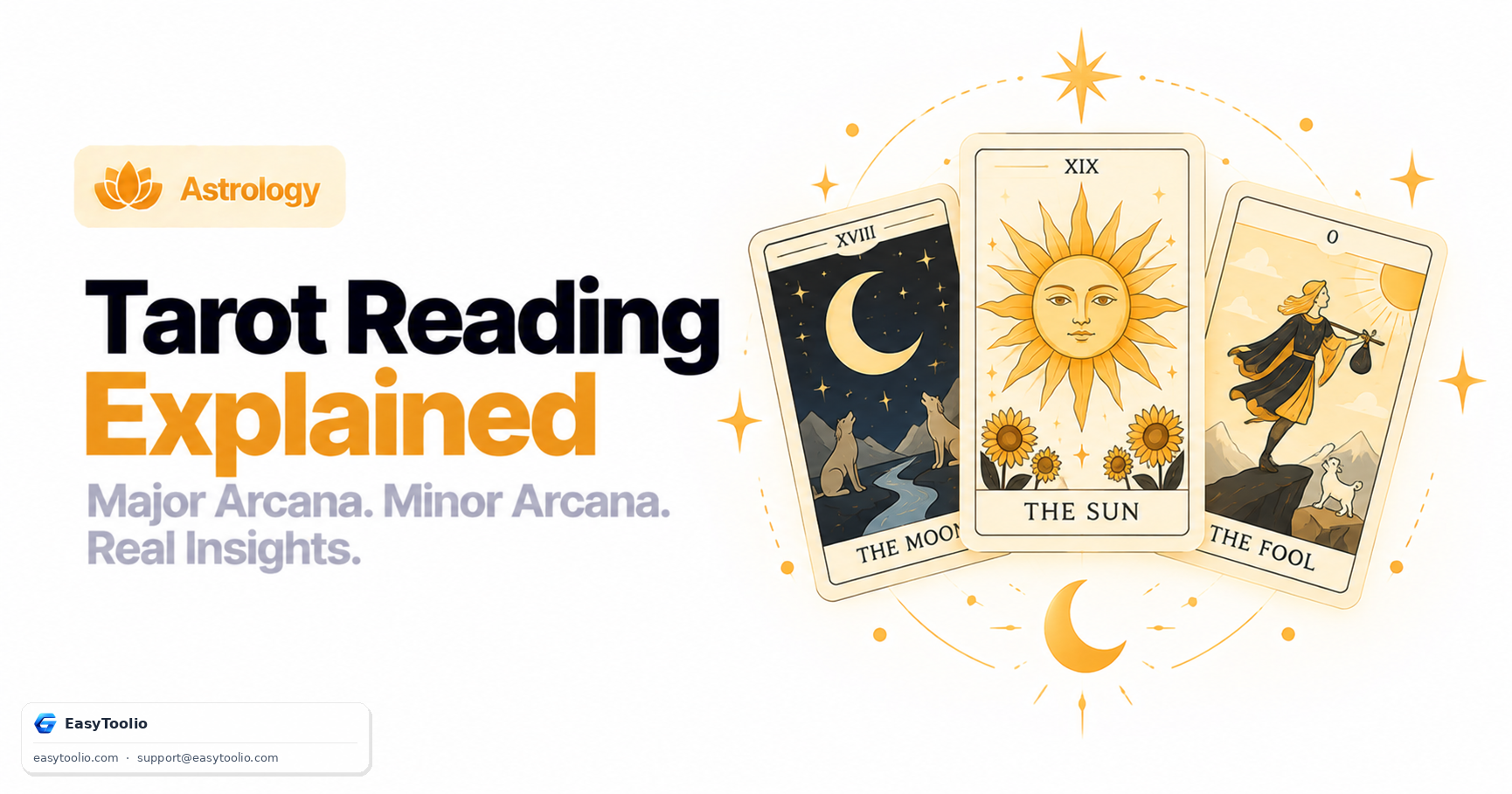
You draw a card online, and it's The Tower — a building on fire, figures falling from it — right when you were hoping for reassurance about a decision. Before you close the tab, it helps to know what the deck is actually built to do, because a single striking image out of 78 cards is never meant to be read alone.
A tarot deck is not a single undifferentiated pile of fortune-telling cards; it has a deliberate internal structure, and that structure is exactly what separates a considered reading from a random guess.
Direct Answer: A standard tarot deck contains 78 cards split into two structurally different groups. The 22 Major Arcana (numbered 0 through 21, from The Fool to The World) represent significant life themes, turning points, and long-arc lessons — pulling one signals the reading touches something substantial rather than a passing detail. The 56 Minor Arcana are divided into four suits of 14 cards each — Wands, Cups, Swords, and Pentacles, mirroring the four suits of an ordinary playing-card deck — and they describe everyday circumstances, moods, and practical matters rather than sweeping life events. A card's meaning also shifts, rather than simply inverts, when drawn reversed (upside down), typically indicating the upright energy is blocked, delayed, or turned inward.
1. The 22 Major Arcana: A Numbered Sequence, Not a Random Set
The Major Arcana run in sequence from 0 (The Fool) to 21 (The World), and readers commonly refer to this sequence as "the Fool's Journey" — a symbolic arc from naive beginning to worldly completion, with each card marking a stage: initiation, structure, upheaval, and integration.
| # | Card | Core Theme |
|---|---|---|
| 0 | The Fool | New beginnings, leaping without full information |
| 3 | The Empress | Abundance, nurturing, creative growth |
| 6 | The Lovers | Choice, alignment of values, partnership |
| 10 | Wheel of Fortune | Cycles, change outside your control |
| 13 | Death | Ending one phase to allow another to begin |
| 16 | The Tower | Sudden, structural upheaval that clears false foundations |
| 21 | The World | Completion, integration, a cycle closing successfully |
Because each Major Arcana card carries this much narrative weight, seeing several of them in one spread is usually read as a sign that the question concerns a genuinely pivotal period, not a routine week.
2. The 56 Minor Arcana: Four Suits, Fourteen Cards Each
Each Minor Arcana suit runs Ace through 10, plus four court cards — Page, Knight, Queen, King — for 14 cards per suit, 56 total. The suits map to the four classical elements and to distinct areas of daily life.
| Suit | Element | Domain |
|---|---|---|
| Wands | Fire | Ambition, action, creative drive |
| Cups | Water | Emotion, relationships, intuition |
| Swords | Air | Thought, conflict, communication |
| Pentacles | Earth | Money, work, physical health |
Court cards are typically read as either an actual person relevant to the question or a mode of behavior the querent is being asked to adopt: a Page signals a learner or messenger, a Knight signals action or pursuit, a Queen signals mature, receptive mastery of the suit's domain, and a King signals authoritative, outward command of it.
3. Common Spreads: One Card, Three Card, and the Celtic Cross
A single-card draw is the simplest spread — a quick daily reflection or a direct answer to a narrow yes/no-style question. A three-card spread is usually laid out as past–present–future, or alternatively as situation–action–outcome, giving a card a fixed positional meaning rather than reading it in isolation.
The Celtic Cross is the most widely used in-depth spread, using ten cards in fixed positions:
| Position | Meaning |
|---|---|
| 1 | Present situation |
| 2 | Immediate challenge or obstacle |
| 3 | Conscious goal or focus |
| 4 | Subconscious influence or root cause |
| 5 | Recent past |
| 6 | Near future |
| 7 | Your own attitude or approach |
| 8 | External influences (people, environment) |
| 9 | Hopes or fears |
| 10 | Likely outcome |
The position a card lands in changes how it's interpreted just as much as the card itself does — the Ten of Swords in the "recent past" position reads very differently than the same card in "likely outcome."
If you want to work through a structured spread rather than pulling cards at random, our tarot reading tool walks you through a full draw with positional context for each card.
4. Reading Reversed Cards
When a card is drawn upside down relative to the reader, most modern practitioners treat it as a modifier rather than a flat opposite. A reversed card commonly suggests the upright energy is present but blocked, delayed, being resisted, or turned inward instead of expressed outwardly. The Ten of Cups upright, for example, typically signals family harmony and emotional fulfillment; reversed, it more often points to a disconnect within a family unit or a happiness that feels just out of reach rather than "the complete opposite of happiness."
Some readers choose not to use reversals at all, reading every card upright and instead relying on surrounding cards and spread position to capture nuance and tension — both approaches are considered legitimate within the practice, and it comes down to reader preference.
5. Common Mistakes New Readers Make
The most frequent error is looking up a single card's meaning online in isolation and treating that as the full answer, ignoring the position it landed in and the cards around it — tarot is conventionally read relationally, with adjacent cards qualifying and contextualizing one another. A second common mistake is treating any single card, including The Tower or Death, as a literal prediction of disaster; within the tradition these cards are read symbolically, representing necessary endings or upheaval that clears space for the next stage rather than literal catastrophe.
Frequently Asked Questions
How many cards are in a full tarot deck?
A standard tarot deck has 78 cards total: 22 Major Arcana and 56 Minor Arcana split across four suits of 14 cards each.
Is drawing the Death or Tower card actually bad?
No — within tarot tradition these cards are read symbolically as necessary endings or sudden restructuring that clears the way for something new, not as literal predictions of death or disaster.
What's the difference between tarot cards and oracle cards?
Tarot follows a fixed 78-card structure with standardized suits and numbering that's been consistent for centuries, while oracle decks have no fixed card count or structure and vary entirely by the deck's creator.
Do reversed cards always mean the opposite of the upright meaning?
Not exactly — most modern readers treat a reversed card as indicating the upright energy is blocked, delayed, or internalized rather than a flat opposite, though some readers skip reversals entirely and read every card upright.
Can I read tarot accurately for myself?
Many practitioners read for themselves regularly; the main challenge is maintaining objectivity about your own situation, which is why some readers prefer a second party for emotionally charged questions.
Which spread should a beginner start with?
A single-card daily draw or a three-card past–present–future spread is the standard starting point before moving to more complex layouts like the Celtic Cross.
References: A.E. Waite, "The Pictorial Key to the Tarot" (1910); the Rider-Waite-Smith deck, the most widely used modern reference standard for tarot structure and imagery.