
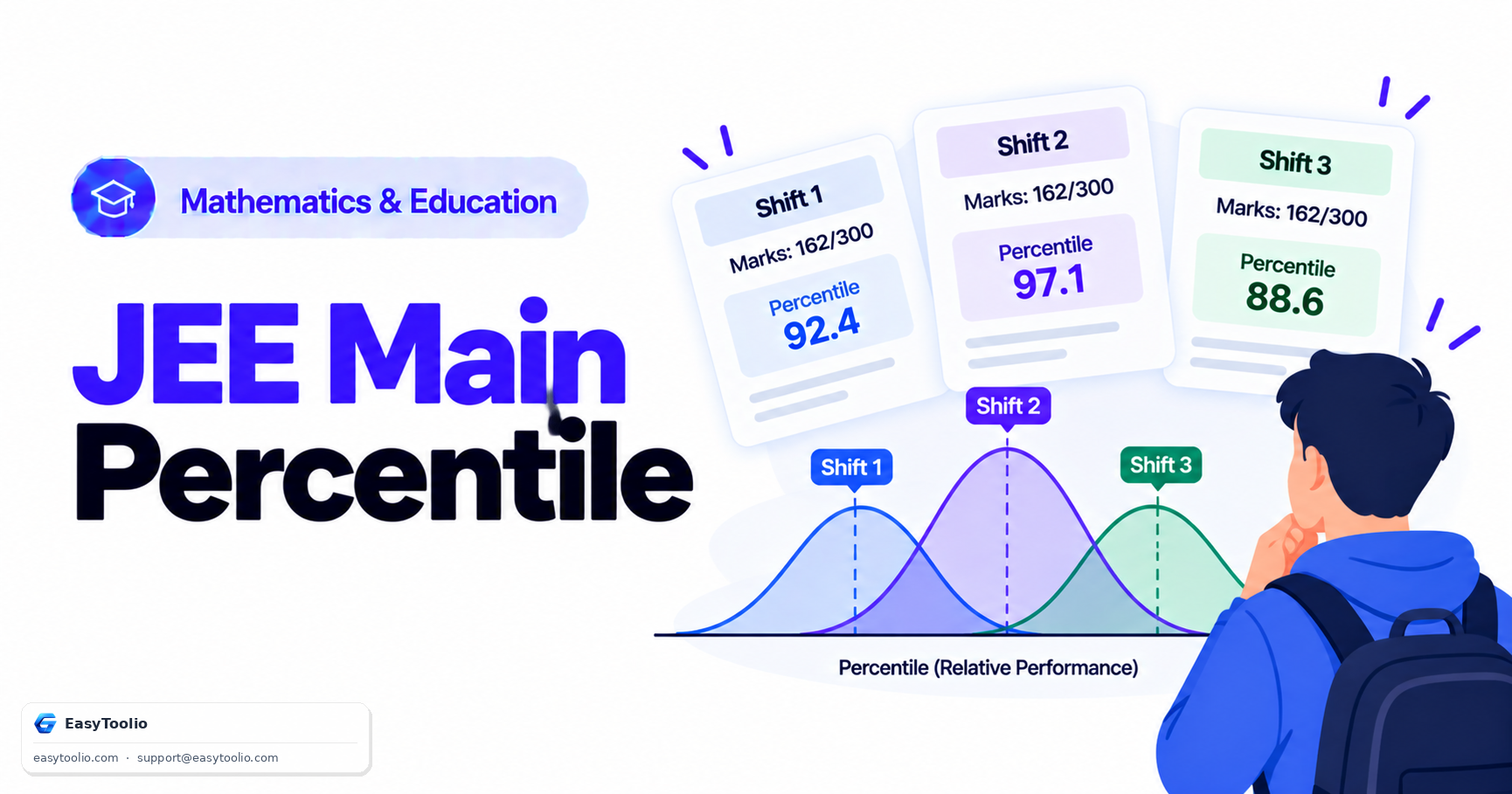
Two JEE Main candidates can score different raw marks and end up with the same percentile — or score the same raw marks and end up with different percentiles. That's not an error. JEE Main runs across multiple shifts and sessions, and paper difficulty varies between them even when the National Testing Agency (NTA) tries to keep them comparable. Percentile normalization exists specifically to correct for that.
The Formula, in NTA's Own Terms
Percentile Score = (m / N) × 100
- m — number of candidates in your specific shift/session who scored at or below your raw score
- N — total number of candidates who appeared in that same shift/session
This calculation happens separately within each shift, then all shifts' percentiles are merged into one common list for ranking. NTA's own methodology documentation — originally published for CUET-UG but describing the same equi-percentile method used across its multi-shift exams including JEE Main — confirms scores are calculated to seven decimal places (examples in the source document include values like 99.9691438 and 0.0035699), largely to break ties cleanly at the scale of hundreds of thousands of candidates.
A Concrete 2026 Example
In a public statement about JEE Main 2026, NTA confirmed that the raw marks needed to reach the 99th percentile ranged from 165 to 196 across different shifts — a 31-mark gap for the same percentile. NTA's own framing was direct: the shift a candidate was allotted "has no bearing on your rank." A harder shift's 99th percentile requires fewer raw marks than an easier shift's 99th percentile, by design — that's the entire point of normalizing.
What Normalization Is Not
- It's not the same as percentage. A 99.97 percentile does not mean a candidate got 99.97% of the marks — it means they scored better than 99.97% of candidates in their session.
- It doesn't reward or punish shift choice. There's no advantage to guessing an "easier" shift, since a candidate's score is only ever compared against others in their own shift before merging.
- It's not something a student can back-calculate from their raw score alone. That requires knowing where they ranked among everyone in their specific shift, which NTA computes centrally.
Why This Confuses So Many Candidates
Most students are used to school exams where marks map directly to a fixed scale — 90 out of 100 always means the same thing. JEE Main's normalization deliberately breaks that intuition: the same raw score can produce different percentiles depending on who else sat the same shift, and two candidates in different shifts with identical percentiles may have scored quite different raw marks. Understanding the mechanism doesn't change a candidate's rank, but it explains why comparing raw marks across shifts on forums and social media is a common but flawed way to gauge performance.
Frequently Asked Questions
Why does NTA use 7 decimal places? At the scale of lakhs of candidates, rounding to fewer decimals would create large groups tied at the same percentile — the extra precision keeps rankings distinct.
Can two candidates with the same raw marks in the same shift get different percentiles? No — within a single shift, identical raw marks produce identical percentiles by the formula itself.
Does a harder shift mean a lower final percentile for equally good performance? No — that's exactly what normalization is designed to prevent, by comparing a candidate only against their own shift before merging results.
Is this the same method used for other NTA exams? The underlying equi-percentile methodology in NTA's own documentation was published in the context of CUET-UG but describes the standard approach NTA uses across its multi-session exams, JEE Main included.
Sources: National Testing Agency — official normalization methodology document (nta.ac.in); Bhatt et al., "Normalization of marks in multi-session examinations," Current Science, Vol. 118, No. 1, January 2020; NTA public statement on JEE Main 2026 shift normalization, reported by Free Press Journal, April 21, 2026.