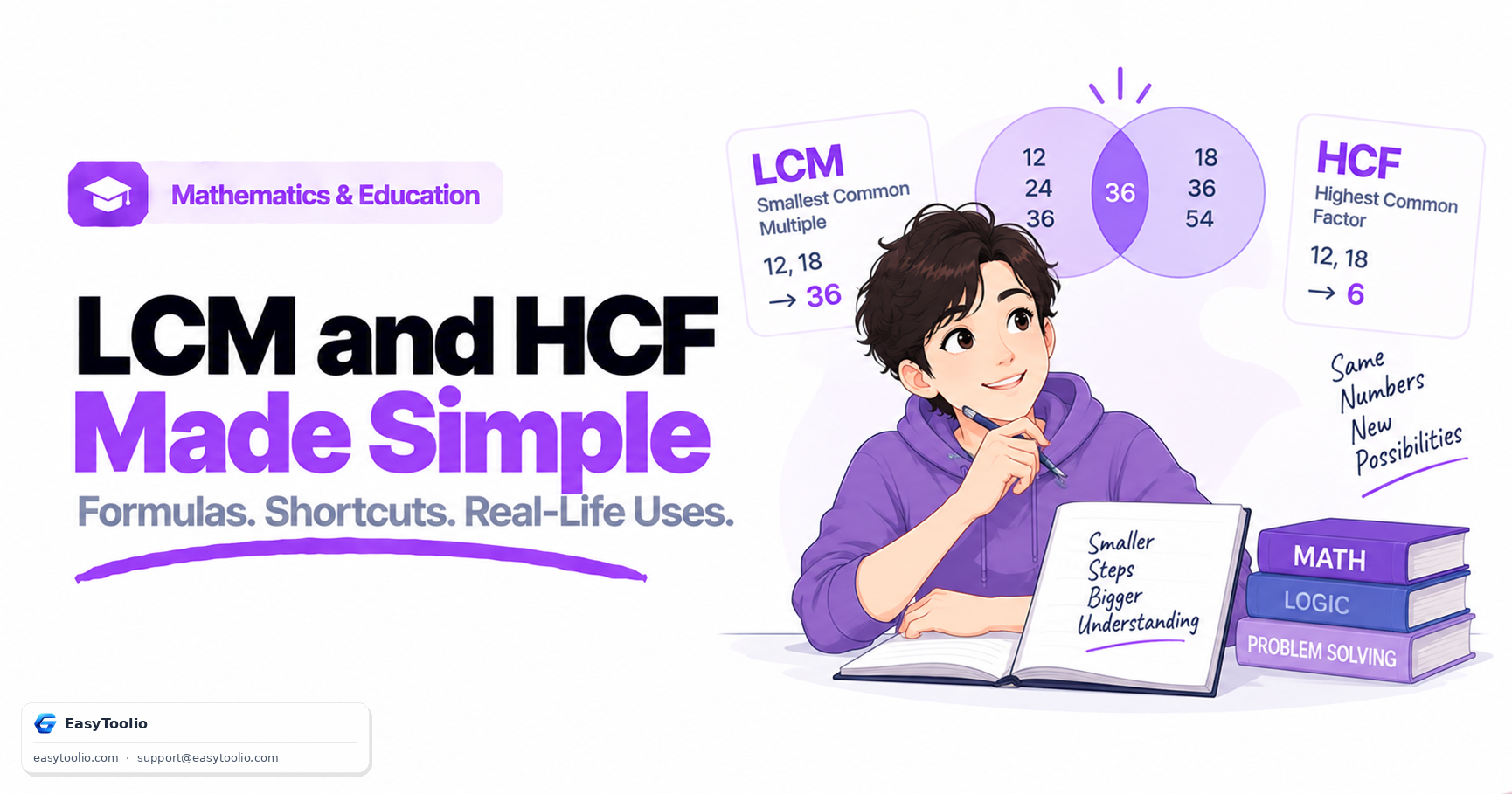
LCM and HCF are two of the most commonly taught number-theory concepts, and they are frequently confused with each other because both are computed from the same starting point: the prime factors of a set of numbers. They answer opposite questions.
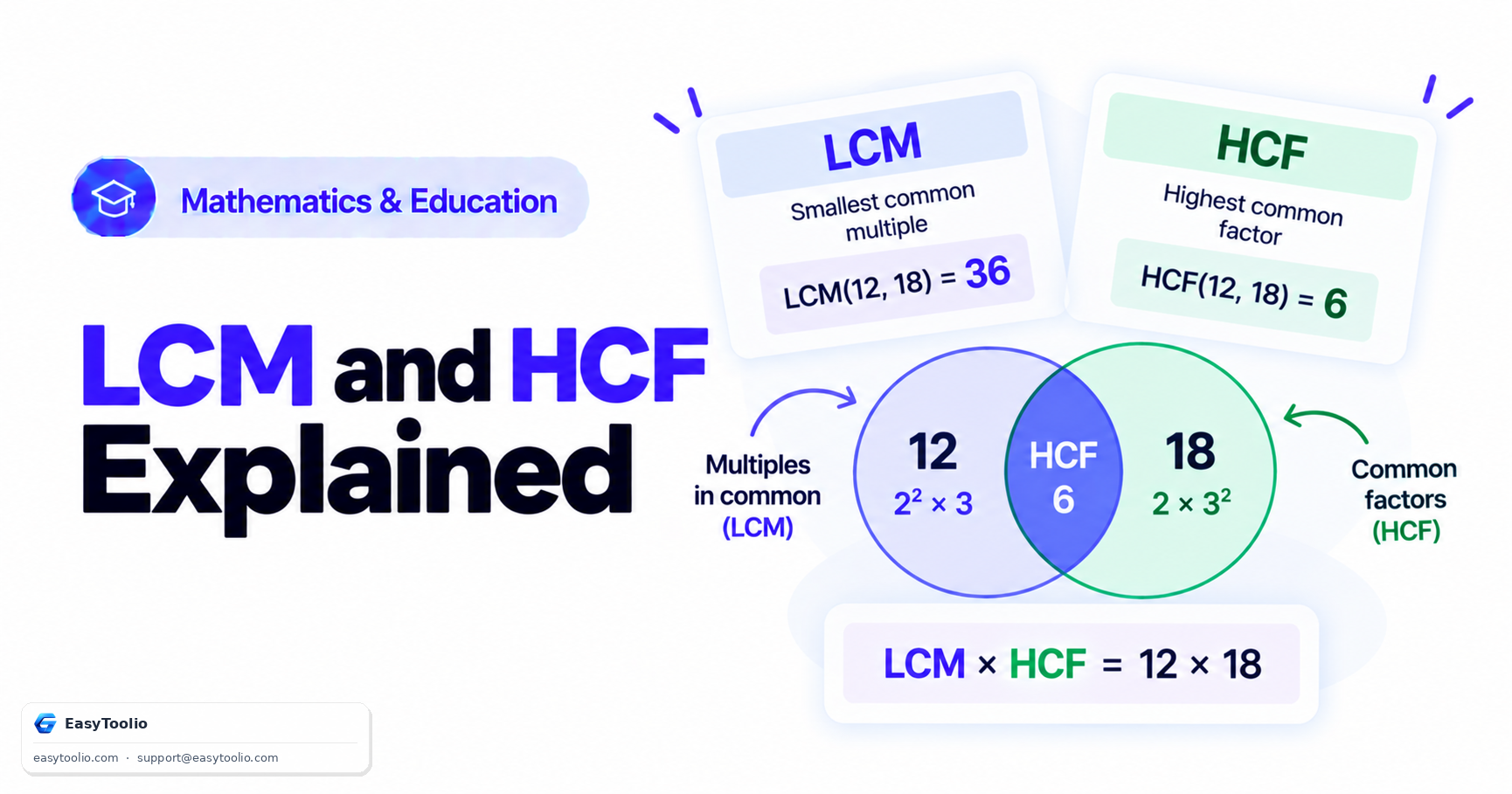
Direct Answer: The LCM (Lowest/Least Common Multiple) of two or more numbers is the smallest number that all of them divide into evenly. The HCF (Highest Common Factor), also called the GCD (Greatest Common Divisor), is the largest number that divides evenly into all of them. For exactly two numbers $a$ and $b$, the shortcut relationship LCM(a,b) × HCF(a,b) = a × b always holds.
1. Definitions
- LCM (Lowest Common Multiple): The smallest positive number that is a multiple of every number in the set. Used when you need a common cycle length or common denominator.
- HCF / GCD (Highest Common Factor / Greatest Common Divisor): The largest positive number that divides every number in the set with no remainder. Used when you need to simplify or break something into the largest possible equal groups.
For example, for the numbers 12 and 18:
- The LCM is 36 (the smallest number both 12 and 18 divide into evenly).
- The HCF is 6 (the largest number that divides both 12 and 18 evenly).
2. The Prime-Factorization Method
Both LCM and HCF can be found from the same prime factorization of each number.
Step 1 — Factor each number into primes:
12 = 2² × 3¹ 18 = 2¹ × 3²
Step 2 — For HCF, take the LOWEST power of each shared prime:
HCF = 2^(min(2,1)) × 3^(min(1,2)) = 2¹ × 3¹ = 6
Step 3 — For LCM, take the HIGHEST power of every prime that appears in either number:
LCM = 2^(max(2,1)) × 3^(max(1,2)) = 2² × 3² = 4 × 9 = 36
This confirms the earlier result: HCF(12, 18) = 6, LCM(12, 18) = 36.
3. The Shortcut: LCM x HCF = Product of the Two Numbers
For exactly two numbers (this shortcut does not extend directly to three or more numbers), the following relationship always holds:
LCM(a, b) × HCF(a, b) = a × b
Verification using 12 and 18:
LCM × HCF = 36 × 6 = 216 a × b = 12 × 18 = 216
Both sides equal 216, confirming the shortcut. This is useful in practice: if you already know one of the two values (say, you calculated the HCF using the Euclidean algorithm) and know both original numbers, you can find the LCM instantly by division rather than repeating a full factorization:
LCM(a,b) = (a × b) ÷ HCF(a,b)
For 12 and 18: LCM = (12 × 18) ÷ 6 = 216 ÷ 6 = 36.
Important caveat: this exact shortcut formula only works for two numbers. For three or more numbers, LCM and HCF must each be computed directly (e.g., via prime factorization or by combining pairs iteratively) — multiplying all the numbers together and dividing by their combined HCF does not generally give the correct LCM once a third number is involved.
4. When Each Is Actually Used
| Use Case | Which One | Why |
|---|---|---|
| Adding or comparing fractions with different denominators | LCM | Provides the smallest common denominator, avoiding unnecessarily large numbers |
| Two events with different repeating cycles (e.g., "bus A every 12 minutes, bus B every 18 minutes — when do they next align?") | LCM | Finds the next time both cycles complete simultaneously (36 minutes, in this example) |
| Simplifying a ratio or fraction to its lowest terms | HCF | Dividing both numbers by their HCF reduces the ratio/fraction as far as possible without changing its value |
| Dividing items into the largest possible equal groups (e.g., "36 apples and 24 oranges into identical gift bags with none left over") | HCF | The HCF gives the maximum number of identical groups possible |
Find the LCM and HCF of any set of numbers instantly using our lcm-hcf-calculator, and simplify or combine fractions using their common denominators with fraction-calculator.
5. Frequently Asked Questions (FAQs)
Is HCF the same thing as GCD?
Yes. HCF (Highest Common Factor) and GCD (Greatest Common Divisor) are two names for the identical concept — the largest number that divides a given set of numbers evenly. HCF is more commonly used in British and Indian curricula; GCD is more common in American curricula.
Does the LCM x HCF = a x b shortcut work for three numbers?
No. That exact relationship only holds for exactly two numbers. For three or more numbers, LCM and HCF must be calculated directly rather than derived from a simple multiplication shortcut.
Can the HCF of two numbers ever be one of the numbers itself?
Yes. If one number evenly divides the other (e.g., 4 and 12), the HCF equals the smaller number (HCF(4, 12) = 4), because 4 is itself the largest number dividing both evenly.
References: Standard number theory conventions (Fundamental Theorem of Arithmetic — unique prime factorization).