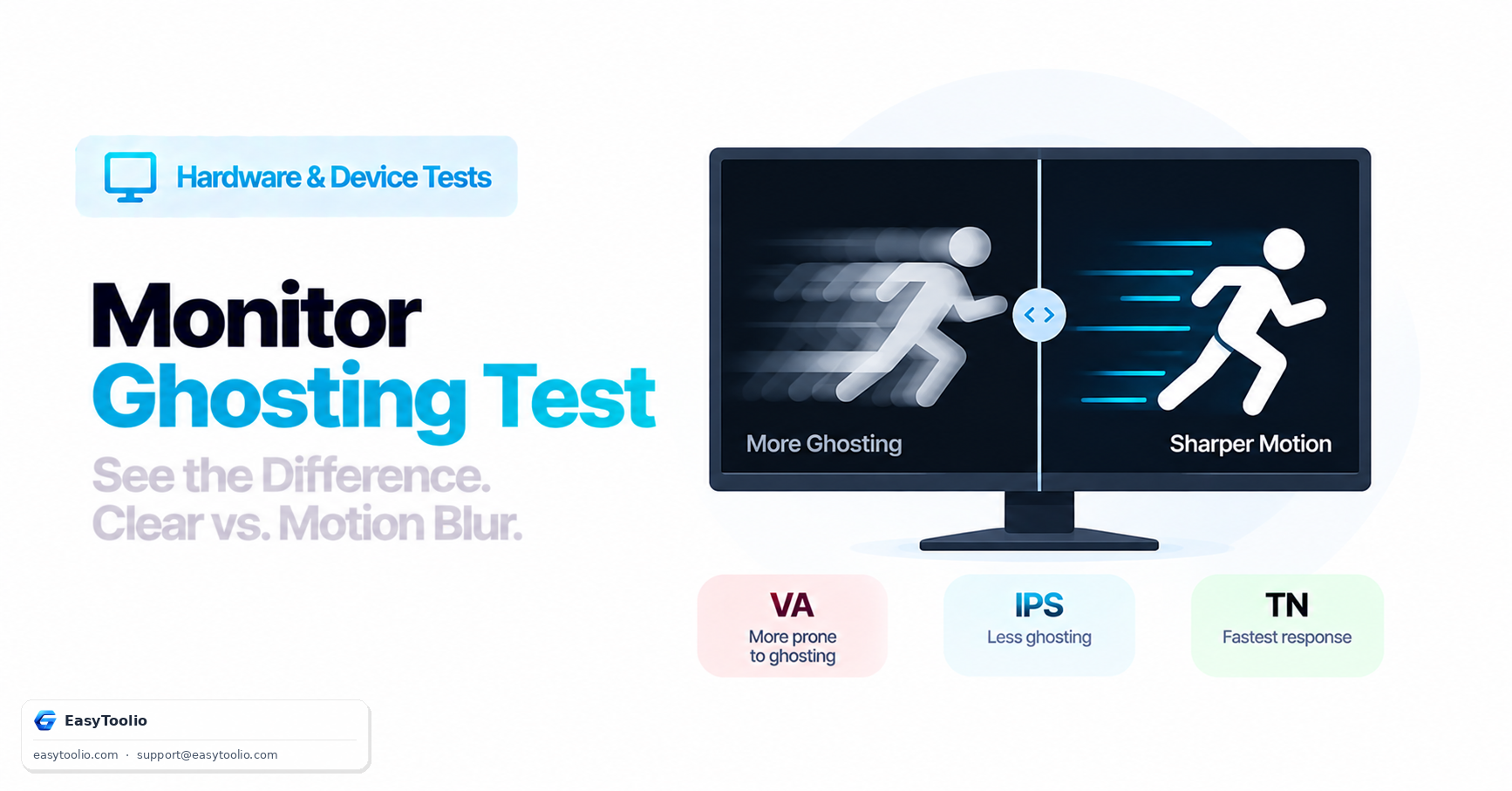
Anyone who has moved a fast-scrolling window or played a fast-paced game on a VA-panel monitor has likely noticed it: a faint trailing smear following bright objects across a dark background, most visible in dark-to-dark transitions. This is ghosting, and it's not the same thing as ordinary motion blur — it has a specific, measurable cause rooted in liquid crystal physics.
Direct Answer: Monitor ghosting is a visible trailing artifact caused by pixels not finishing their color transition before the next frame is displayed — the liquid crystal is still physically reorienting when the panel refreshes again. VA panels are structurally more prone to this than IPS or TN panels because their liquid crystal layer is engineered for higher native contrast, which requires a deeper range of crystal rotation — and that rotation is inherently slower for certain transitions, especially dark-to-dark grey levels. Response time is measured in milliseconds as GtG (grey-to-grey), and monitors compensate with overdrive circuitry, which trades ghosting reduction against a different artifact — overshoot — when pushed too aggressively.
1. What Ghosting Actually Is
Every LCD pixel changes color by physically reorienting its liquid crystal molecules to alter how much backlight passes through. That reorientation is not instantaneous — it takes a measurable amount of time. If the crystal hasn't finished rotating to its new target state before the display outputs the next frame, the pixel is rendered partway between its old color and its new one. When this happens continuously as an object moves across the screen, each frame leaves a faint trailing residue of the previous frame's color, visually perceived as a smear or "ghost" trailing the moving object.
This is distinct from general motion blur, which is a byproduct of sample-and-hold display timing (the eye perceiving a briefly-static frame as it tracks a moving object) and affects all fixed-refresh displays to some degree regardless of panel type. Ghosting is specifically about the panel failing to keep pace with its own refresh rate.
2. Why VA Panels Are More Prone to It
Vertical Alignment (VA) panels align liquid crystal molecules perpendicular to the glass substrate at rest, which is what gives VA its characteristically high native contrast ratio and deep blacks compared to IPS or TN. But that same alignment geometry requires the crystals to travel through a larger rotational range to reach many target states, and the transition is measurably slower for certain gray-level pairs — most notably dark-to-dark transitions, where the crystal is moving through the "slow" part of its response curve.
TN (Twisted Nematic) panels use the simplest and fastest-responding LC structure, which is why TN historically dominated competitive gaming monitors despite weaker color and viewing angles. IPS (In-Plane Switching) panels align crystals parallel to the substrate and generally sit between TN and VA for response time, with more uniform response across different gray-level transitions than VA typically achieves.
3. How Response Time Is Actually Measured: GtG
Manufacturers specify response time as GtG (grey-to-grey) in milliseconds — the time for a pixel to transition from one gray level to another and settle within a defined tolerance of the target value. Critically, GtG numbers published in marketing specs are typically a best-case or averaged figure across many transition pairs, not a worst-case guarantee. A panel can carry an impressive headline GtG spec while still exhibiting slow, ghosting-prone behavior on specific transitions (again, dark-to-dark is the classic weak point for VA) that aren't representative of the averaged number.
4. Overdrive and the Overshoot Tradeoff
To compensate for inherently slow LC response, monitors apply overdrive (sometimes labeled Response Time Overdrive or a named preset like "Fast"/"Extreme" in the OSD): the panel briefly applies a higher voltage pulse than the target state actually requires, pushing the crystal to its destination faster than it would move under normal drive voltage.
Done well, overdrive meaningfully reduces ghosting. Pushed too aggressively, it overshoots the target value entirely, and the pixel briefly passes past its intended color before settling — visible as a bright or dark halo trailing the opposite edge of a moving object, commonly called inverse ghosting. This is why the most aggressive overdrive preset on a monitor is not automatically the best setting; there is a genuine tradeoff between under-driven ghosting and over-driven overshoot, and the ideal setting is often a middle preset rather than the extreme one.
5. How a Browser-Based Moving-Block Test Reveals It
A moving-block ghosting test renders a high-contrast block moving across the screen at a controlled, steady speed against different background transitions — commonly a bright block against a dark background (to stress dark-to-dark and dark-to-light transitions) and variants at different backgrounds. Because the eye tracks the moving object, any trailing residue left behind by an incomplete pixel transition becomes visually obvious as a smear or halo following the block. This kind of test can't replace a photodiode-and-oscilloscope lab measurement for precise millisecond figures, but it reliably and visibly surfaces relative ghosting severity and overdrive artifacts — which is exactly the practical question a buyer or owner usually wants answered.
6. Frequently Asked Questions (FAQs)
Does a higher refresh rate fix ghosting?
Not directly. A higher refresh rate reduces sample-and-hold motion blur by shortening how long each frame is held, but it does not speed up the liquid crystal itself. If a panel's GtG response time can't keep pace with the shorter frame interval a high refresh rate demands, ghosting can actually become more noticeable, not less.
What exactly is inverse ghosting?
Inverse ghosting (overshoot) is a bright or dark halo trailing a moving edge, caused by overdrive voltage pushing a pixel past its intended target color before it settles back. It's the opposite failure mode from standard ghosting — too much correction rather than too little.
Are OLED displays immune to ghosting?
OLED panels are self-emissive and have no liquid crystal layer to reorient, giving them near-instantaneous pixel response times that effectively eliminate LC-based ghosting. They can, however, exhibit a different phenomenon — static image retention or burn-in from prolonged unchanging content — which is unrelated to motion ghosting.
References: VESA Adaptive-Sync and ClearMR display motion-clarity testing standards; general LCD panel response-time (GtG) measurement methodology.