Say you're building a support inbox. Every incoming ticket needs a department, a severity, and a yes/no on whether it's a refund request, before your workflow can do anything with it. The obvious move is to hand the ticket to GPT, Claude or Gemini with a "classify this" prompt. It works — but it's slow enough to notice, it costs real money at volume, and every so often the model wraps its answer in a sentence you have to regex out before your code can use it.
That's the specific problem Jev is built for. Here's the confusing part, though: Jev doesn't replace GPT, Claude or Gemini. It's not a chat model at all.
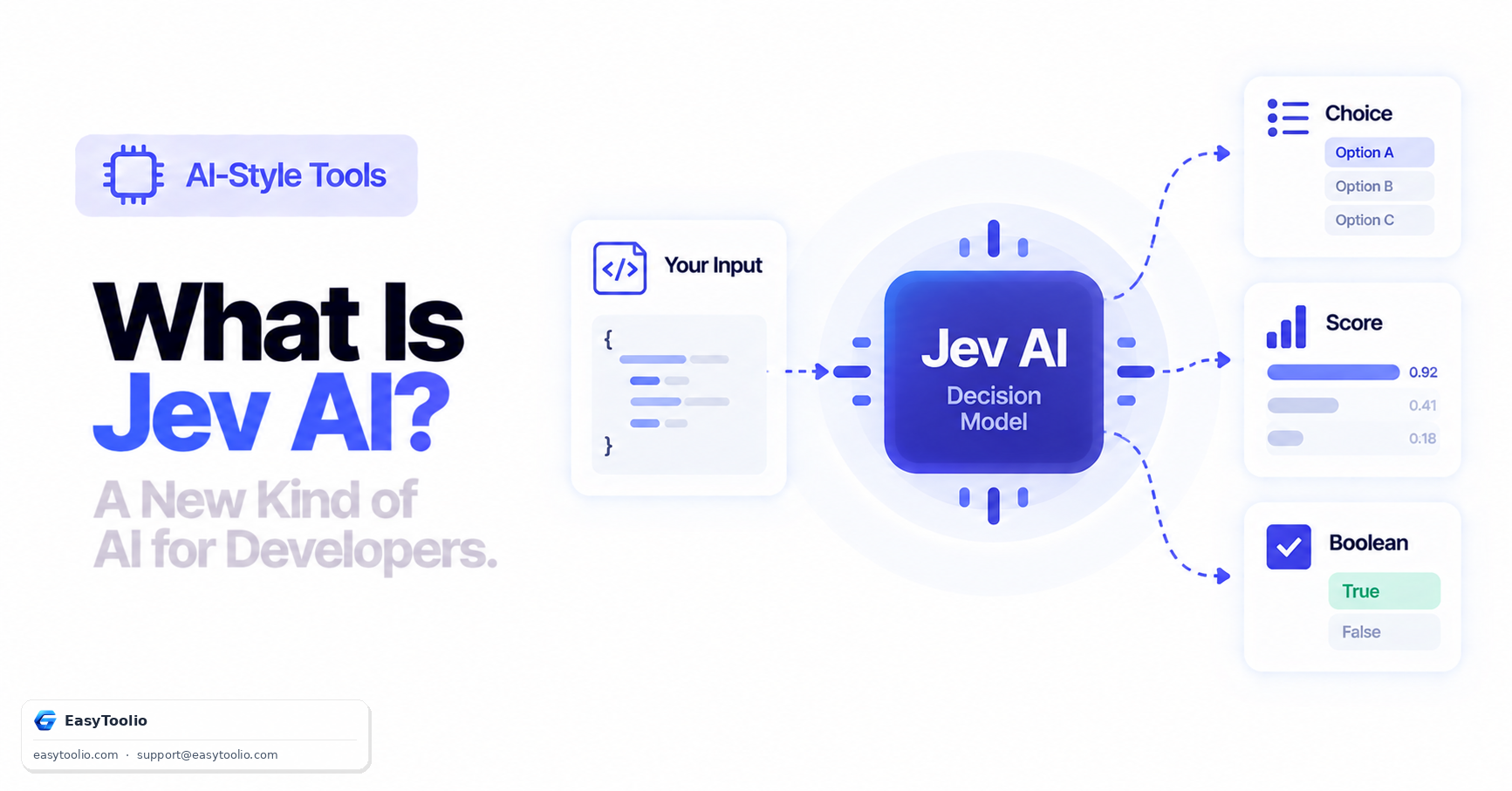
Direct Answer: Jev is a new type of AI model from TypeSafe AI, launched 15 September 2026, that TypeSafe calls a "System One model." Instead of generating text token by token, it takes a piece of state (a ticket, a document, an event) and a set of typed questions, and returns typed decisions — a Choice from a list you define, a Score against a rubric, or a Boolean (TypeSafe calls it "Noul") probability — each with a calibrated confidence value, computed in parallel rather than word by word. TypeSafe reports response times of 70–500ms and claims up to 193.6x faster and 444.6x cheaper results than frontier LLMs on its own workflow benchmarks; independent testers have replicated the speed and cost gap but found the accuracy picture more mixed. It's aimed at the "boring" decisions software makes thousands of times a day — routing, classification, scoring, verification — not at conversation, writing, or open-ended reasoning.
What Is Jev AI?
Jev is TypeSafe AI's first public model, introduced in TypeSafe's own launch post. TypeSafe describes it as a "System One model" — the name is a deliberate reference to Daniel Kahneman's Thinking, Fast and Slow, where "System 1" is fast, intuitive judgment and "System 2" is slow, deliberate reasoning. The pitch is that most software decisions — which team should see this ticket, does this look like fraud, is this comment spam — are System 1 problems, and using a full conversational LLM for them is like hiring a consultant to answer a multiple-choice question.
Structurally, Jev takes two inputs:
- State — a string or a JSON object/array describing the situation (a support ticket, a document, an event payload).
- Questions — a set of typed questions to evaluate against that state, each one a Choice, a Score, or a Boolean.
It returns typed answers with calibrated probabilities for every question, evaluated together rather than one after another.
Why Was Jev Created?
TypeSafe was founded in 2024 by Diogo Almeida — who spent roughly four years at OpenAI working on reinforcement learning from human feedback (RLHF) and helped build InstructGPT, ChatGPT and GPT-4 — along with co-founders Erik Gafni and Sasha Sheng. The company stayed in stealth for about two years before publicly launching Jev alongside a $40 million seed round led by DCVC on 15 September 2026; Forbes reported the round valued TypeSafe at roughly $200 million.
Almeida has framed the company's founding question as: "Models have been superhuman at chat for years, so where is all the automation?" — a line reported in TechCrunch's coverage of the launch. His argument is that conventional LLMs are excellent at conversation but a poor structural fit for high-volume automation, because they're built to produce free-form text, and typed values are something you have to coax out of them with prompting and hope the schema holds. (Background on the company itself is also summarized in Jev's Wikipedia entry.)
How Jev Works
Conceptually, Jev sits closer to a classifier than to a chatbot, but with LLM-style flexibility in what you can ask it about:
 ┌───────────────┐      ┌────────────────────────┐      ┌───────────────────────┐
 │     STATE      │      │          JEV            │      │    TYPED DECISIONS     │
 │  (ticket, doc, │ ───> │  evaluates all questions │ ───> │  Choice  + probabilities│
 │  event, text)  │      │  in parallel — no token   │      │  Score   + probabilities│
 │                │      │  by token generation       │      │  Boolean + probability  │
 └───────────────┘      └────────────────────────┘      └───────────────────────┘
TypeSafe trains Jev with a method it calls Reinforcement Learning for Calibrated Decisions (RLCD), which it contrasts with the RLHF used to tune chat models — the company's argument is that RLHF optimizes for human-preferred phrasing, which isn't the same thing as a well-calibrated probability. TypeSafe hasn't published the underlying architecture, parameter count, or a paper; it describes Jev only as "transformer-based" with a "parallel sampler," trained on synthetic data. Wikipedia's summary of the launch notes that "outside observers have suggested the model may be built on an open-weight LLM" — that's speculation from commentators, not a confirmed fact, and TypeSafe has not addressed it directly.
Because there's no token-by-token generation, TypeSafe says the model literally cannot emit malformed output — every answer is guaranteed to match the schema you defined. That's a real guarantee, but it's narrower than it sounds, which the Limitations section below covers.
Jev's Decision Types
Every Jev request is built from one or more of three question types, all evaluated against the same shared state:
Choice — pick one option from a list of up to 255, each described in plain language.
Input state:
"My subscription payment failed."Question: "Which team should handle this?" with optionsbilling,technical,account. Output:billingat 84% probability,technicalat 16%,accountnear 0% — with an overall confidence score TypeSafe computes from the shape of that distribution, not just the top probability.
Your application code then reads result.answers.department.choice and routes the ticket — the model doesn't decide what happens next, your code does.
Score — rate the state against an ordered rubric (2 to 10 levels).
Question: "How severe is this issue?" with levels from "cosmetic" up to "blocking and causing financial loss." Output: a score index plus a probability distribution across all levels, so you can see whether the model was confident or split between two adjacent levels.
Boolean (TypeSafe's internal name: "Noul," short for Bernoulli) — a yes/no question that returns a single probability between 0 and 1 rather than a hard true/false.
Question: "Is the customer asking for money back?" Output:
0.91— your code decides what probability threshold counts as "yes" for your workflow; Jev doesn't pick that threshold for you.
Jev vs Traditional LLMs
The architectural difference is the whole story here:
| Traditional LLM (GPT / Claude / Gemini) | Jev | |
|---|---|---|
| Output | Free-form text, generated token by token | Typed values (Choice/Score/Boolean) with probabilities |
| Can hold a conversation | Yes | No — no chat interface, no free text output |
| Structured output | Coaxed via prompting / JSON mode; can still drift | Guaranteed by design — TypeSafe says malformed output is not possible |
| Latency | Seconds, scales with output length | TypeSafe reports 70–500ms, largely flat regardless of how many questions you ask at once |
| Confidence signal | Not native; must be inferred or separately prompted for | Native — every answer ships with a calibrated probability |
| Best suited for | Writing, conversation, open-ended reasoning, code generation | Routing, classification, scoring, verification |
A useful way to hold this: Jev doesn't do a worse job of being a chatbot. It doesn't attempt to be one at all.
Jev vs GPT vs Claude vs Gemini
There's no single "best" model here — these systems solve different problems, and framing it as a leaderboard misses the point. TypeSafe itself doesn't claim Jev is smarter than GPT-6 Astra or Claude; it claims Jev is faster and cheaper for the narrow slice of work it's built for.
| Task | Jev | GPT / Claude / Gemini |
|---|---|---|
| Open-ended text generation | Not supported — no free-text output at all | This is their core strength |
| Coding | Not supported | Strong; the right tool for this |
| Deep multi-step reasoning | Not designed for it | Strong, especially reasoning-tuned models |
| Classification / routing | Purpose-built for this | Usable, but slower and needs prompt engineering to stay reliable |
| Scoring / rubric evaluation | Purpose-built, returns calibrated probabilities natively | Usable via prompted rubrics; confidence has to be requested and is less reliably calibrated |
| Structured/typed decisions | Schema match guaranteed by design | Requires JSON mode / function calling; can still drift on edge cases |
| Confidence / probability output | Native to every answer | Not native; has to be prompted for and isn't a first-class output |
| Agent orchestration (the "traffic cop" step) | Well suited — fast enough to gate every step | Workable but adds latency and cost to a step that's often just "which branch do I take" |
| Latency | TypeSafe reports 70–500ms | Typically seconds for a full generation |
| Cost at high volume | TypeSafe reports $0.042 per million input tokens, output free | Meaningfully higher per call once you include output tokens — for scale, a frontier model like GPT-6 Astra prices output at $50 per million tokens, five times its input price |
| Conversational nuance / open-ended chat | Not applicable | This is the actual use case they're built for |
Read that table as "which tool for which job," not "which model wins." A production agent will often use both: an LLM to understand the situation, Jev to decide what happens next.
Practical Jev AI Use Cases
Realistic, narrow-decision problems where Jev's shape fits well:
- Support ticket routing — department, severity, and refund-intent as three parallel questions against one ticket, as in the example above.
- AI-agent routing — the "which tool/skill should handle this step" decision inside an agent loop, gating expensive LLM calls behind a cheap, fast triage step.
- Model selection — deciding whether a request is simple enough for a cheap model or needs a frontier model, before you pay for the frontier model's tokens.
- Risk / fraud scoring — a Score question against a transaction or account event, feeding a threshold your application enforces.
- Prompt-injection / anomaly detection — a Boolean check on incoming content before it reaches a tool-using agent.
- Human-review triage — routing low-confidence outputs from any pipeline (including an LLM's own output) to a human queue instead of auto-approving them.
- Workflow continuation — deciding which branch of a multi-step automation to take next, based on the current state.
- Content classification at scale — tagging, categorizing, or moderating large volumes of user-generated content where per-item LLM calls don't pencil out economically.
- SaaS onboarding automation — scoring a new signup's intent or plan fit to decide which onboarding flow to trigger.
Jev AI Advantages
- Speed. TypeSafe's own figures (70–500ms) are corroborated directionally by independent testers — in Every's own hands-on test, Mike Taylor ran 777 judgments across 37 documents in under 0.7 seconds, and Dan Shipper measured a median 0.35 seconds per passage against 8.83 seconds for Claude's Fable 5.1 on the same writing-quality checks.
- Cost at volume. At $0.042 per million input tokens with free output, and Shipper's test putting the cost roughly 580x lower than the comparison run, high-volume classification stops being a line item you have to budget carefully around.
- Guaranteed schema. You don't need retry logic for malformed JSON from this model — TypeSafe's parallel, non-autoregressive design means the output always matches the type you asked for.
- Native confidence. Every answer ships with a probability, which is exactly the signal you need to build an automatic-approve-vs-human-review threshold, without extra prompting.
- Parallel questions, flat latency. Asking Jev five questions about one piece of state costs about the same latency as asking one, because they're evaluated together rather than as five sequential calls.
Jev AI Limitations and Risks
Be clear-eyed about what "can't hallucinate" actually means here: it means the shape of the answer is always valid, not that the content is correct. TypeSafe's guarantee is a type guarantee, not a semantic one. Developers using Jev in practice have reported exactly this failure mode — a ticket confidently classified as billing when it was actually technical, passing every structural check while being simply wrong. Schema validation catches malformed answers; it does nothing for a well-formed wrong one.
A few other things worth knowing before you build on this:
- TypeSafe's own benchmark numbers are self-measured against a moving target, not ground truth. TypeSafe's workflow-evaluation harness scores agreement against the averaged answers of other LLMs (GPT-6 Astra and Claude's Fable 5.1), not against a verified correct answer. On that same harness, Jev scored around 67.8% agreement versus roughly 74.1% for GPT-5.6 Sol — TypeSafe's own numbers show it isn't uniformly more "accurate," it's dramatically faster and cheaper, which is a different claim. TypeSafe itself states its demo workflows likely sit "at the high end of real-world gains."
- Independent results are mixed on accuracy, not just enthusiastic. Bryo AI's CTO Nikhil Mudholkar found Jev 10–20x cheaper than Gemini for email classification, but rated Gemini "slightly more accurate." Dan Shipper's writing-defect test had Jev catch 6 of 7 planted defects against Claude's 7 of 7.
- Opacity. Independent AI commentator Simon Willison's write-up notes that unlike a chat model, Jev gives you no reasoning to inspect — "the only thing you're going to get back is a floating point number." He also demonstrated a bias concern: asking Jev to rank Bay Area cities produced results that looked like they encoded socioeconomic bias (Cupertino ranked highest, East Palo Alto lowest) rather than whatever the question was actually meant to measure.
- It's new, and closed. No published architecture, no parameter count, no weights, no self-hosting — it's an early-access API only, roughly a week old as of this writing. Hacker News' 256-comment launch thread included the skeptical take that this is "just BERT with more data" wearing new branding; that's a real school of thought worth taking seriously even if you don't fully agree with it.
- Confidence thresholds still need human judgment. A 91% probability isn't automatically "safe to auto-approve" — what threshold is acceptable depends entirely on how expensive a wrong answer is in your specific workflow, and that's a decision your application has to encode, not one Jev makes for you.
None of this means Jev is unreliable — the independent tests above are broadly positive on speed and cost. It means "typed and fast" is not the same claim as "correct," and your integration needs to treat every Jev answer as a well-formed suggestion, not a verified fact.
Jev AI + GPT/Claude/Gemini: The Hybrid Architecture
In practice, the systems that get the most out of Jev use it alongside a generative model, not instead of one:
 request ──> Jev (route / score / gate, ~100ms) ──> low confidence? ──> GPT/Claude/Gemini (understand, generate, reason)
                    │                                                              │
                    └────────────── high confidence ──> application executes ──────┘
Jev handles the cheap, high-frequency "which branch" decision that gates the loop; the generative model gets called only when the situation actually needs writing, conversation, or deep reasoning — which is also the expensive, slow path you want to call as rarely as possible. Vercel has described exactly this pattern in its own agent-architecture guidance: use Jev as the fast decision layer in front of, not a replacement for, a general-purpose model.
Who Owns the Decision: Jev Suggests, Your Application Decides
This matters most for anything irreversible. Jev — like any model — should never be handed direct authority over payments, refunds, account deletion, or other side effects that can't be undone. The distinction to build around is:
- The model suggests a decision — a Choice, a Score, a Boolean, each with a probability.
- Your application executes (or doesn't).
Authorization, business rules, confidence thresholds, the actual side effect, audit logging, and any human-approval step all belong in your application code, not in the model call. A 99% confidence Boolean saying "yes, refund this" is a strong signal — it is not, by itself, a refund. Your code decides what probability clears the bar, logs why, and only then calls the refund API.
Example for Developers (Laravel)
As of this writing, TypeSafe and Vercel have documented one client integration: the AI SDK's experimental_evaluate() function in JavaScript/TypeScript, called through Vercel's AI Gateway guide for Jev (model id typesafe-ai/jev). There is no published PHP SDK and no documented plain-REST schema for the evaluate endpoint, so don't guess at one — the practical pattern for a Laravel app today is a thin Node proxy that uses the official SDK, called from Laravel over HTTP. If you want to inspect the raw JSON response shape before wiring up the Laravel side, our API Tester can fire a request and show you the full response body, and our JSON Formatter will pretty-print it so the answers object is easy to read.
A small Node/Next.js route using the documented interface:
// api/evaluate-ticket.ts — uses the officially documented AI SDK interface
import { experimental_evaluate as evaluate } from 'ai';

export async function POST(req: Request) {
  const ticket = await req.json();

  const result = await evaluate({
    model: 'typesafe-ai/jev',
    state: {
      subject: ticket.subject,
      message: ticket.message,
      plan: ticket.plan,
    },
    questions: {
      department: {
        type: 'choice',
        instructions: 'Which team should handle this?',
        criteria: {
          billing: 'Charges, invoices, and refunds',
          technical: 'Bugs, outages, and integration failures',
          account: 'Login, permissions, and profile changes',
        },
      },
      requestsRefund: {
        type: 'boolean',
        instructions: 'Is the customer asking for money back?',
      },
    },
  });

  return Response.json(result.answers);
}
Laravel calling that proxy, and — this is the important part — deciding what to do with the answer itself rather than trusting it blindly:
use Illuminate\Support\Facades\Http;

$response = Http::timeout(2)
    ->post(config('services.jev_proxy.url') . '/api/evaluate-ticket', [
        'subject' => $ticket->subject,
        'message' => $ticket->message,
        'plan'    => $ticket->plan,
    ]);

$answers = $response->json();

// The model suggests; the application decides. A refund is a side effect,
// so it needs a real threshold and an audit trail — not just a probability.
$ticket->update(['department' => $answers['department']['choice']]);

if (($answers['requestsRefund']['probability'] ?? 0) >= 0.9) {
    RefundReviewQueue::add($ticket); // still queued for review, not auto-executed
}
If Jev or the proxy is unreachable, or the confidence is low, fall back to your existing routing logic or a human queue — never let this call become a hard dependency for getting a ticket into the right hands.
Is Jev AI Worth Using?
There's no single yes/no answer here — it depends on what you're building.
Good fit: high-volume routing, classification, or scoring where you currently pay a chat LLM to answer what's really a multiple-choice or yes/no question, and where a wrong answer is cheap to catch (retryable, reviewable, non-destructive).
Possible fit: agent orchestration and model-selection gating, where the speed and cost gains are real but you should measure accuracy on your own data before trusting it at the confidence thresholds you'll actually use — TypeSafe's and independent testers' numbers don't necessarily transfer to your specific task.
Poor fit: anything that needs free-text generation, genuine conversation, deep multi-step reasoning, or authority over irreversible actions like payments, refunds, or account deletion. That's still squarely GPT/Claude/Gemini territory, with your application — not the model — holding the authority to act.
Frequently Asked Questions
What is Jev AI in simple terms?
It's a model from TypeSafe AI that takes a description of a situation and a set of yes/no, multiple-choice, or rating-style questions, and answers them instantly with a confidence score — instead of writing you a sentence.
Who created Jev AI?
TypeSafe AI, founded in 2024 by Diogo Almeida (a former OpenAI researcher who worked on RLHF and ChatGPT) with co-founders Erik Gafni and Sasha Sheng. Jev launched 15 September 2026 alongside a $40 million seed round led by DCVC.
Is Jev AI an LLM like GPT or Claude?
No. It's transformer-based but doesn't generate free-form text — it only returns typed Choice, Score, or Boolean answers. TypeSafe calls it a "System One model" rather than a large language model.
What are Choice, Score, and Boolean (Noul) decisions?
The three question types Jev supports: Choice picks one option from a list you define, Score rates against an ordered rubric, and Boolean (TypeSafe's internal name is "Noul") returns a yes/no probability between 0 and 1.
How much does Jev AI cost?
TypeSafe and Vercel list it at $0.042 per million input tokens, with output tokens free, as of September 2026. Verify current pricing directly with TypeSafe or Vercel's AI Gateway before budgeting, since early-access pricing can change.
Is Jev really 193x faster than GPT, Claude, and Gemini?
That figure is TypeSafe's own vendor-reported number from its workflow-evaluation benchmarks, not an independent measurement, and TypeSafe itself notes its demos likely represent the high end of real-world gains. Independent testers (Every) have found comparable multiples on their own tests, but accuracy results in the same tests were mixed rather than uniformly in Jev's favor.
Can Jev AI replace GPT, Claude, or Gemini in my app?
Not for anything that needs writing, conversation, or deep reasoning — Jev doesn't do that at all. It's designed to sit alongside a generative model, handling the fast routing/classification/scoring decisions so the generative model is only called when it's actually needed.
Can I self-host Jev or get access to the model weights?
No. As of this writing, Jev is an early-access API-only product via TypeSafe and partners like Vercel AI Gateway and Cloudflare Workers AI. No weights, architecture paper, or self-hosting option has been published.
Where can I access the Jev AI API today?
Through Vercel's AI Gateway (model id typesafe-ai/jev, via the AI SDK's experimental_evaluate function, requiring AI SDK 7+) or Cloudflare Workers AI. Direct access from TypeSafe is early-access/waitlist-based.
Key Takeaways
- Jev is not a chat model — it returns typed Choice/Score/Boolean decisions with calibrated probabilities, not generated text.
- TypeSafe's speed and cost claims (70–500ms, up to ~193x/444x) are vendor-reported on TypeSafe's own harness; independent tests (Every) found comparable speed/cost gains but a mixed, not uniformly better, accuracy picture.
- A guaranteed schema is not the same as a correct answer — treat every Jev decision as a suggestion your application verifies, not a fact.
- Confidence thresholds and human review still matter, especially for anything expensive to get wrong.
- Never give Jev — or any model — direct authority over payments, refunds, account deletion, or other irreversible actions; your application owns authorization, thresholds, and audit logging.
- The strongest pattern seen so far is hybrid: Jev as the fast decision layer gating a generative model, not a replacement for one.
Use Jev when your application needs a bounded, typed decision made fast and cheap at volume. Use GPT, Claude, or Gemini when it needs generation or deeper reasoning. In most real systems, the two end up working together, not competing.
Sources: TypeSafe AI's official launch post ("Introducing System One Models & Jev"); Vercel's AI Gateway Knowledge Base guide and blog coverage of Jev's launch and adoption; TechCrunch's reporting on TypeSafe's founding, funding and early developer reactions; independent testing and commentary from Every (Dan Shipper and Mike Taylor) and Simon Willison; the Hacker News launch discussion; and Wikipedia's summary of TypeSafe's company history. Performance multipliers (speed/cost) are TypeSafe's own vendor-reported figures and are identified as such throughout; GPT-6 Astra pricing referenced for comparison was verified against OpenAI's own API model reference in an earlier post on this site.