OpenAI released GPT-6 Astra on 3 September 2026, and within a day the search results filled up with takes on it. Most of them repeat the launch copy. This is the version we wanted when we were deciding whether to change anything about our own stack: what the model actually is, what the numbers really say, and who has a concrete reason to switch.
Direct Answer: GPT-6 Astra (model ID gpt-6-astra) is OpenAI's flagship model, released 3 September 2026 as the successor to GPT-5.6 Sol. It takes text and image input and returns text, has a 1,050,000-token context window with a 922,000-token maximum input and a 128,000-token maximum output, and has a knowledge cutoff of 30 April 2026. In the API it costs $10 per million input tokens and $50 per million output tokens, with cached input at $1 and cache writes at $12.50 per million. Its gains are concentrated in computer use, software engineering and cybersecurity rather than in everyday chat quality, and it is the first model OpenAI has classified at the Critical cybersecurity capability level under its Preparedness Framework. For most ordinary work the cheaper GPT-5.6 models remain the sensible default; Astra earns its price on long, multi-step, tool-using tasks.
What GPT-6 Astra actually is
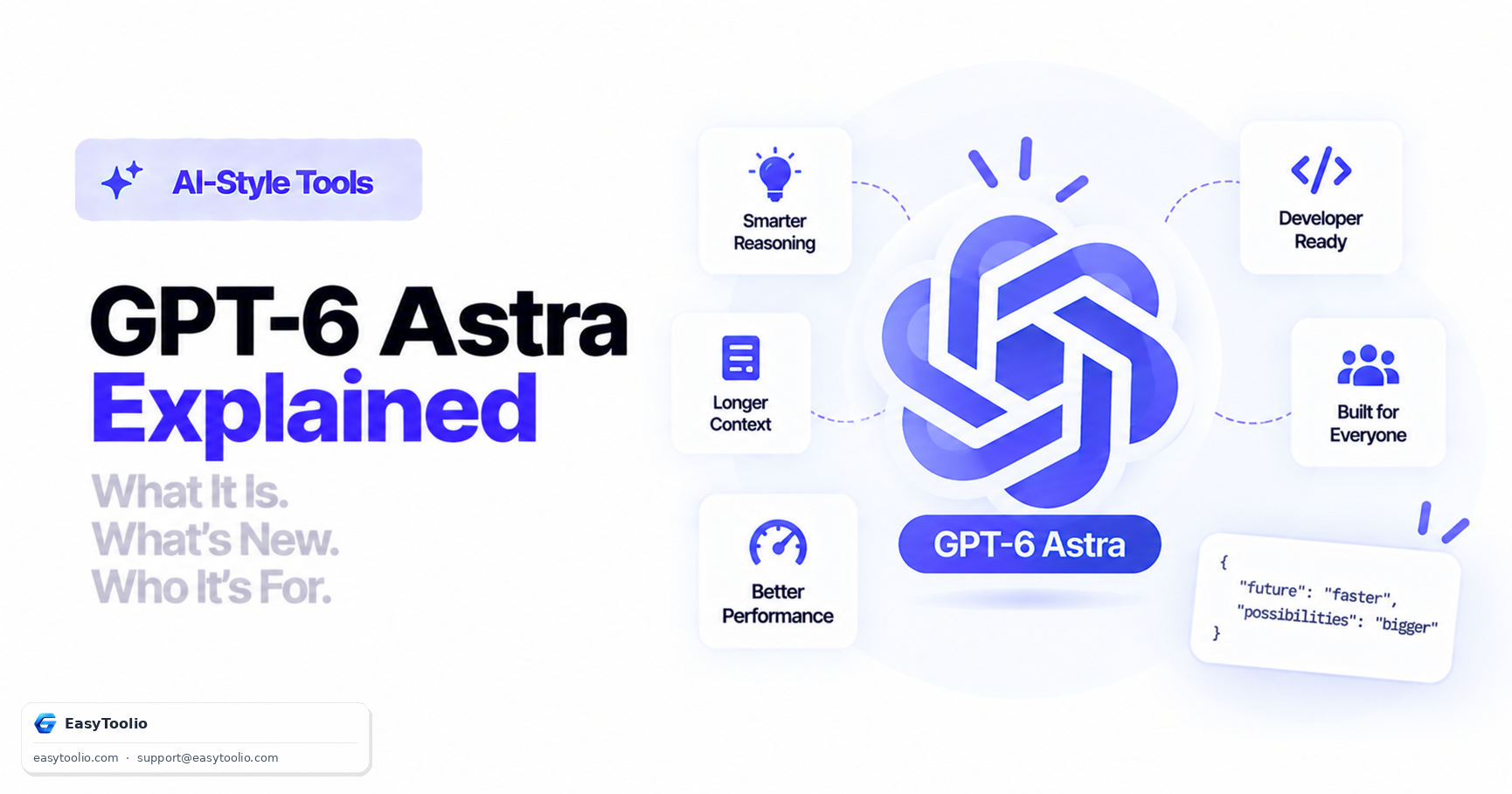
Astra is a single frontier model, not a product bundle. OpenAI positions it as the model for "the hardest end-to-end work" — long agentic runs, real software engineering, computer operation, and research-grade analysis. The important framing for anyone choosing a model is that Astra is not a general quality upgrade applied evenly across every task. It is a large jump on a specific class of work and a modest one elsewhere, at 2.5 times the price of the model it replaces.
It reached users in phases. Approved enterprise customers got it first on 3 September 2026, general availability followed the next day, and the ChatGPT rollout arrived unevenly across Chat, ChatGPT Work and Codex over the following days.
The specifications, in plain numbers
| Property | GPT-6 Astra |
|---|---|
| Model ID | gpt-6-astra |
| Context window | 1,050,000 tokens |
| Maximum input tokens | 922,000 |
| Maximum output tokens | 128,000 |
| Input modalities | Text, image |
| Output modalities | Text |
| Knowledge cutoff | 30 April 2026 |
| Input price | $10 / million tokens |
| Cached input price | $1 / million tokens |
| Cache write price | $12.50 / million tokens |
| Output price | $50 / million tokens |
| Reasoning effort levels | low, medium, high, xhigh, max |
| Tier 1 rate limits | 500 requests/min, 500,000 tokens/min |
Two of those rows matter more than the rest in practice. The 922,000-token input limit is what you can actually send — the 1,050,000 figure is the whole window including what the model generates back. And output tokens cost five times input tokens, which is the single fact that will shape your bill more than anything else.
What is genuinely new
Computer use. Astra operates a computer — clicking, scrolling, reading the screen — well enough that OpenAI leads with it. On OSWorld 2.0, a computer-use benchmark, OpenAI's launch tables report 72.6% at roughly 40 minutes per task, against 65.7% at roughly 75 minutes for GPT-5.6 Sol. The time figure is arguably the more interesting half: similar-or-better accuracy in about half the wall-clock time changes what is practical to automate.
Software engineering. On Terminal-Bench 4.0 the launch tables report 57.7% versus 37.3% for Sol. That benchmark measures multi-step work in a real shell, which is closer to what an engineer actually does than a single-function coding puzzle.
Binary reverse engineering. On SRE-Bench — a contamination-free cybersecurity benchmark from Vals AI that tests whether a model can reverse engineer compiled software binaries without access to source — OpenAI reports 88.0% single-attempt against Sol's 55.9%, and 99.2% within four attempts against 68.7%. Vals AI notes that OpenAI's run used pass@4 as the metric, with no step limits and a custom harness, so this is not an apples-to-apples single-shot comparison. This result belongs with the cybersecurity story below rather than with general development productivity.
Long-context recall. OpenAI reports MRCR v2 8-needle retrieval at 100% in the 256K–512K band and 96.3% in the 512K–1M band. A large window is only useful if the model can find things in it, and those numbers say it largely can.
A much bigger tool surface. Astra supports web search, file search, image generation, code interpreter, a hosted shell, apply-patch, skills, computer use, MCP and tool search, alongside streaming, structured outputs, function calling and prompt caching. That list, not the raw intelligence, is what makes agentic workflows viable.
Where the benchmarks help and where they do not
Every capability number above is from OpenAI's own launch tables. Vendor-reported benchmarks are useful directional evidence and weak proof, and a couple deserve specific scepticism.
The most-quoted figure is ARC-AGI-3 at 99.9% against Sol's 7.8%. That result is from an adapter harness; OpenAI's own note is that a standard stateless harness produced scores in the range of roughly 17% to 63%. A spread that wide means the harness is doing a great deal of the work, and the headline number should not be read as "the model solved ARC-AGI." Similarly, FrontierMath Tier 4 at 97.6% and ExploitBench at 100% describe saturated benchmarks — once a test is saturated it stops discriminating and stops telling you much.
The practical read: trust the direction (large gains in agentic, terminal and computer-use work), and validate the magnitude on your own tasks before you rewrite anything.
Who should actually use it
| Your work looks like | Sensible choice |
|---|---|
| Chat, drafting, summarising, classification at volume | GPT-5.6 Luna or Terra — Astra is heavy overspend here |
| Solid general professional work, coding assistance | GPT-5.6 Sol at $4 / $20 |
| Long agentic runs, multi-file refactors, real shell work | GPT-6 Astra |
| Operating software or a browser end to end | GPT-6 Astra (this is the clearest gap) |
| Whole-repository or whole-corpus analysis in one pass | GPT-6 Astra, for the retrieval accuracy at long context |
| Cost-sensitive high-volume pipelines | GPT-5.6 Luna at $0.20 / $1.20, batched |
If you cannot point at the specific step in your workflow that fails today and would stop failing on Astra, the honest answer is that you do not need it yet. We walk through the trade-off in detail in GPT-6 Astra vs GPT-5.6 Sol.
How to get access
In ChatGPT. Astra shipped as a phased rollout, and availability differs by plan and by product. Pro, Business and Enterprise plans received GPT-6 Pro (powered by Astra) in Chat; Plus received Astra inside ChatGPT Work and Codex before it appeared in the ordinary chat model picker; the Free and Go tiers do not include it. Reported weekly message caps differ by plan too. Because this is still moving, check OpenAI's own pricing page rather than trusting a third-party table — including this one. The full breakdown is in Is GPT-6 Astra Free?.
In the API. Call it as gpt-6-astra. It is also offered through Microsoft Azure and Amazon Bedrock. If you want to fire a request and inspect the raw response before writing any code, our API Tester will send the call and show you the full response body, and the JSON Formatter will make that body readable — the usage object in it is where you confirm your token counts and cached-token hits.
The safety caveat worth knowing about
Astra is the first model OpenAI has assessed as reaching the Critical cybersecurity threshold under its Preparedness Framework, meaning that with sufficient tooling and access it can find previously unknown security flaws and develop ways to exploit them without step-by-step human direction. Access to the most sensitive cyber capabilities was deliberately restricted at launch, and OpenAI documented a set of deployment safeguards including universal monitoring of full model trajectories.
The system card also reports something less comfortable: a substantial decrease in chain-of-thought monitorability compared with earlier models. In plain terms, it is harder to inspect this model's reasoning to check whether it is doing what you asked. On robustness the picture is better — indirect prompt injection attack success on the Gray Swan evaluation is reported at 8.5% for Astra against 27.0% for Sol, which is a real improvement if you are building anything that reads untrusted web content.
Frequently Asked Questions (FAQs)
Is GPT-6 Astra the same thing as GPT-6 Pro?
Not quite. gpt-6-astra is the model. "GPT-6 Pro" is the name of the higher-compute ChatGPT offering powered by Astra that rolled out to Pro, Business and Enterprise plans. If you are calling the API, you want the model ID.
Does the 1,050,000-token context window mean I can send a million tokens?
No. The maximum input is 922,000 tokens; the rest of the window is reserved for output, capped at 128,000 tokens. In word terms that input limit is roughly 690,000 English words — see How Many Words Is 1,000 Tokens? for how that estimate is derived.
Why is Astra so much more expensive than GPT-5.6 Sol?
Astra is $10 / $50 per million input/output tokens against Sol's $4 / $20 — 2.5 times on both sides. Whether that is worth paying depends entirely on whether your workload is in the category where Astra's gains are concentrated.
Can GPT-6 Astra generate images or process audio?
It accepts text and image input and returns text only. Image generation is available to it as a separate tool rather than as a native output modality, and audio is not part of its input or output modalities.
Is its knowledge current?
Its training knowledge cutoff is 30 April 2026, so it does not inherently know about anything after that date. For current information it needs the web search tool, or you need to supply the facts in the prompt.
The short version
GPT-6 Astra is a real step forward on a specific and important class of work: operating computers, running long multi-step engineering tasks, and reasoning reliably across very large inputs. It is also 2.5 times the price of the model most teams are currently using, its most eye-catching benchmark number rests on a harness that OpenAI itself flags as inflating it, and it comes with a genuinely novel set of safety caveats.
Pick it deliberately, for the step in your workflow that needs it — not as a blanket upgrade. If you are building against the API, start with GPT-6 Astra API Cost Explained so the first invoice is not a surprise.
Sources: OpenAI API model reference for gpt-6-astra and gpt-5.6-sol (specifications, pricing, rate limits, knowledge cutoff); OpenAI GPT-6 Astra announcement and Deployment Safety Hub system card (release date, benchmark names, Preparedness Framework classification, prompt-injection and monitorability findings). Capability benchmark scores are OpenAI's own launch-table figures (vendor-reported). SRE-Bench is a third-party benchmark built by Vals AI; its definition, the pass@4 figures and the custom-harness caveat come from Vals AI.