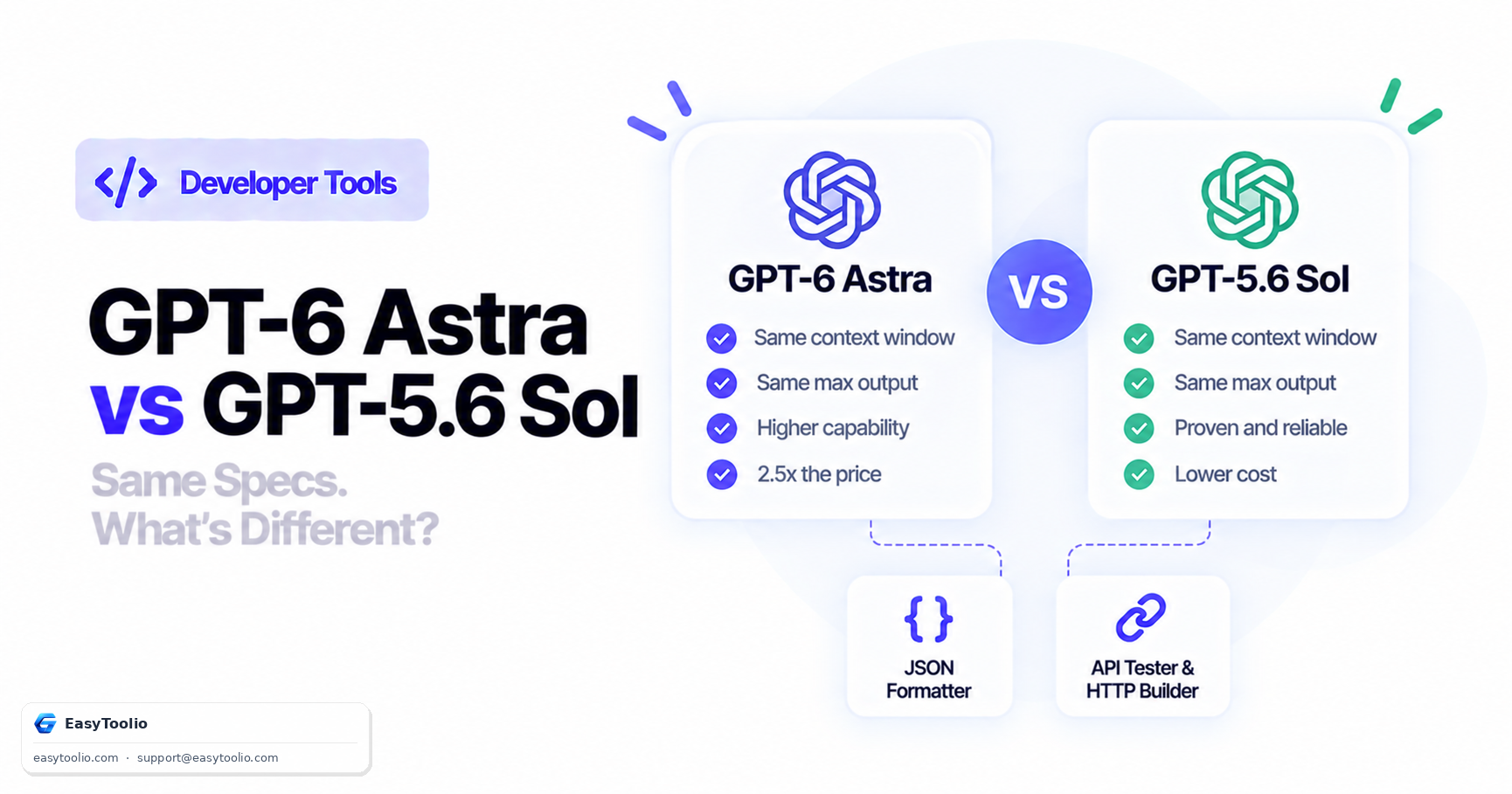
The first thing worth knowing about GPT-6 Astra versus GPT-5.6 Sol is what did not change. Both have a 1,050,000-token context window. Both cap input at 922,000 tokens and output at 128,000. Both take text and image input and return text. Both support the same tool surface. If you were expecting the generational leap to show up in the specification table, it mostly does not.
What changed is the price, the knowledge cutoff, and the performance on long multi-step work.
Direct Answer: GPT-6 Astra and GPT-5.6 Sol share identical context windows (1,050,000 tokens), identical input and output caps (922,000 / 128,000) and identical modalities. The differences are: price — Astra is $10 in / $50 out per million tokens against Sol's $4 / $20, exactly 2.5 times on both sides; knowledge cutoff — 30 April 2026 versus 16 February 2026; and performance on agentic, terminal and computer-use tasks, where OpenAI's launch tables show large gaps (Terminal-Bench 4.0: 57.7% vs 37.3%; OSWorld 2.0: 72.6% vs 65.7% at roughly half the time per task; ScreenSpot-Pro: 92.7% vs 76.9%), plus a very large gap on binary reverse engineering (SRE-Bench: 88.0% vs 55.9% single-attempt). Astra is also substantially more resistant to indirect prompt injection (8.5% vs 27.0% attack success on Gray Swan). On ordinary chat, drafting and single-shot coding the gap is much narrower, so Sol remains the better value for most workloads.
Specification comparison
| Property | GPT-6 Astra | GPT-5.6 Sol |
|---|---|---|
| Model ID | gpt-6-astra |
gpt-5.6-sol |
| Context window | 1,050,000 | 1,050,000 |
| Max input tokens | 922,000 | 922,000 |
| Max output tokens | 128,000 | 128,000 |
| Input modalities | Text, image | Text, image |
| Output modalities | Text | Text |
| Knowledge cutoff | 30 Apr 2026 | 16 Feb 2026 |
| Reasoning effort levels | low, medium, high, xhigh, max | none, low, medium, high, xhigh, max |
| Prompt caching | Yes | Yes |
| Structured outputs | Yes | Yes |
| Function calling | Yes | Yes |
One small asymmetry: Sol exposes a none reasoning-effort setting that Astra's documented list does not. If you have a latency-critical path where you deliberately want no reasoning overhead, that is a point for Sol.
The price difference is the headline
| Token type | GPT-6 Astra | GPT-5.6 Sol | Multiplier |
|---|---|---|---|
| Input | $10.00 / MTok | $4.00 / MTok | 2.5× |
| Cached input | $1.00 / MTok | $0.40 / MTok | 2.5× |
| Cache write | $12.50 / MTok | $5.00 / MTok | 2.5× |
| Output | $50.00 / MTok | $20.00 / MTok | 2.5× |
Clean 2.5× across the board, which makes the decision unusually easy to reason about: Astra needs to be worth 2.5 times as much to you as Sol on the same task. Not marginally better — two and a half times.
Put that in a concrete shape. A workload sending 50,000 input tokens and generating 5,000 output tokens per call, 10,000 times a month:
| GPT-6 Astra | GPT-5.6 Sol | |
|---|---|---|
| Input: 500M tokens | $5,000 | $2,000 |
| Output: 50M tokens | $2,500 | $1,000 |
| Monthly total | $7,500 | $3,000 |
A $4,500 monthly difference is a real hiring decision. It is worth paying when Sol fails the task and Astra completes it; it is pure waste when both succeed.
Benchmark comparison
All figures below are from OpenAI's launch tables — vendor-reported, so treat them as directional.
| Benchmark | What it measures | Astra | Sol |
|---|---|---|---|
| Terminal-Bench 4.0 | Multi-step work in a real shell | 57.7% | 37.3% |
| SRE-Bench (1 attempt) | Reverse engineering compiled binaries without source | 88.0% | 55.9% |
| OSWorld 2.0 | Operating a computer end to end | 72.6% (~40 min/task) | 65.7% (~75 min/task) |
| ScreenSpot-Pro | Locating UI elements on screen | 92.7% | 76.9% |
| Agents' Last Exam | Broad agentic task suite | 59.3% | 53.6% |
| FrontierMath Tier 4 v2 | Hardest research mathematics | 97.6% | 83.0% |
| ExploitBench | Exploit development | 100.0% | 78.5% |
| ARC-AGI-3 (adapter harness) | Abstract reasoning | 99.9% | 7.8% |
Read that table with three corrections applied.
First, ARC-AGI-3 is not what it appears. The 99.9% is from an adapter harness. OpenAI's own note is that a standard stateless harness scored roughly 17% to 63%. A 46-point spread attributable to harness design means the headline figure is measuring the scaffolding as much as the model.
Second, FrontierMath Tier 4 and ExploitBench are saturated. At 97.6% and 100% there is no headroom left, so those benchmarks have stopped being able to distinguish models. A saturated benchmark tells you a ceiling was reached, not how far above it the model sits.
Third, SRE-Bench carries a harness caveat too, and it is not a general coding benchmark. It tests reverse engineering of compiled binaries — a cybersecurity capability, not everyday software development. Vals AI, who built the benchmark, note that OpenAI's run used pass@4 as the metric with no step limits and a custom harness; Astra reached 99.2% at pass@4 against Sol's 68.7%, which Vals AI describe as effectively saturating it. Read this row as evidence about cyber capability, not about whether the model will refactor your service well.
The rows that carry the most real signal for ordinary engineering work are Terminal-Bench, OSWorld and ScreenSpot-Pro — unsaturated, agentic, and closest to what someone actually pays a model to do. Note also that Agents' Last Exam moved only 5.7 points. The gains are concentrated, not uniform.
Where Astra clearly wins
- Long agentic runs. A twenty-point gap on Terminal-Bench 4.0 is not noise. If your task involves many dependent steps where an early mistake compounds, this is where the money goes.
- Security and reverse-engineering work. The thirty-two-point single-attempt gap on SRE-Bench is the largest in the table on an unsaturated benchmark, and it is consistent with Astra being the first model OpenAI classified at the Critical cybersecurity threshold.
- Computer and browser operation. Comparable-or-better OSWorld accuracy in roughly half the time per task, plus a 16-point ScreenSpot-Pro gap, changes what is practical to automate.
- Injection resistance. 8.5% versus 27.0% attack success on Gray Swan's indirect prompt injection evaluation. If your agent reads web pages, email or user-supplied documents, this is a security property, not a nicety.
- Output safety at scale. In a Codex deployment simulation, Astra produced 34 severity-3-or-higher flags (0.063% of trajectories) against Sol's 73 — roughly 53% fewer.
- Recency. Ten extra weeks of knowledge, if that matters to you.
Where Sol is still the right call
- Anything high-volume and bounded. Classification, extraction, summarisation, drafting. Sol at $4 / $20 does these well and Astra's edge is small.
- Latency-sensitive paths, where Sol's
nonereasoning-effort setting is genuinely useful. - Single-shot coding help. The agentic benchmark gaps largely do not describe "write me this function."
- Anything where 2.5× is not in the budget. And if cost is the binding constraint, look further down the family than Sol: GPT-5.6 Terra runs $2 / $12 and GPT-5.6 Luna $0.20 / $1.20.
A decision framework
- Measure Sol on your actual task first. Not on a benchmark — on your own evaluation set, with your own prompts.
- If Sol passes, stop. You have your answer and it costs 40% as much.
- If Sol fails, characterise the failure. Does it fail on step 7 of a 12-step chain? Does it lose the thread in a 400,000-token context? Does it misread a UI? Those are Astra-shaped failures and the upgrade will probably help.
- If it fails on knowledge, prompt structure or output format instead, Astra will not fix it. Add retrieval, add structured outputs, fix the prompt.
- If you do switch, tier it. Route the hard step to Astra and keep the cheap surrounding steps on Terra or Luna. This is usually where the actual savings are.
- Turn on prompt caching either way. Cached input reads bill at 0.1× the standard rate, which is the single largest lever most teams have not pulled. See Prompt Caching Explained.
To run step 1 without writing a harness first, our API Tester will send the same prompt to both model IDs so you can compare responses side by side, and the JSON Formatter makes the usage block readable so you can see exactly what each call cost in tokens.
Frequently Asked Questions (FAQs)
Is GPT-6 Astra better than GPT-5.6 Sol?
On agentic, terminal and computer-use work, clearly and substantially. On ordinary chat, drafting and one-shot coding, only modestly — and it costs 2.5 times as much. "Better" depends on which of those describes your workload.
Does GPT-6 Astra have a bigger context window than GPT-5.6 Sol?
No. Both are 1,050,000 tokens with a 922,000-token input cap. This is the most common misconception about the upgrade. Astra is better at using long context — OpenAI reports 96.3% MRCR v2 8-needle retrieval in the 512K–1M band — but the window itself is identical.
Should I migrate everything from Sol to Astra?
Almost certainly not. Migrate the specific steps that fail on Sol. Tiering models across a pipeline is nearly always cheaper than moving the whole pipeline to the flagship.
Is GPT-5.6 Sol being deprecated?
It is still listed as a current model in OpenAI's model reference alongside Astra, Terra and Luna. Nothing announced at Astra's launch indicated a Sol retirement, but deprecation schedules do change — check the official model list before you plan a migration around it.
Which is safer to build an agent on?
Astra, on the evidence available: substantially lower indirect prompt injection success and roughly half the high-severity flags in Codex deployment simulation. The counterweight is that Astra's system card reports reduced chain-of-thought monitorability, so its reasoning is harder to audit.
The short version
Identical windows, identical caps, identical modalities, 2.5× the price, and gains concentrated in exactly one place: long multi-step tool-using work. If that is your workload, Astra is a genuine upgrade and the injection-resistance improvement alone may justify it. If it is not, GPT-5.6 Sol is still the better-value model, and Terra or Luna may be better still.
Test before you switch. Read GPT-6 Astra for Developers for how to structure that test, and GPT-6 Astra Explained if you want the full picture on the model itself.
Sources: OpenAI API model reference for gpt-6-astra and gpt-5.6-sol (specifications, pricing, reasoning-effort levels, knowledge cutoffs); OpenAI GPT-6 Astra announcement and Deployment Safety Hub system card (benchmark names, prompt-injection and Codex-simulation figures). Capability scores are OpenAI's own launch-table figures (vendor-reported), including the ARC-AGI-3 harness caveat. SRE-Bench definition, pass@4 scores and harness caveat are from Vals AI, who built that benchmark.