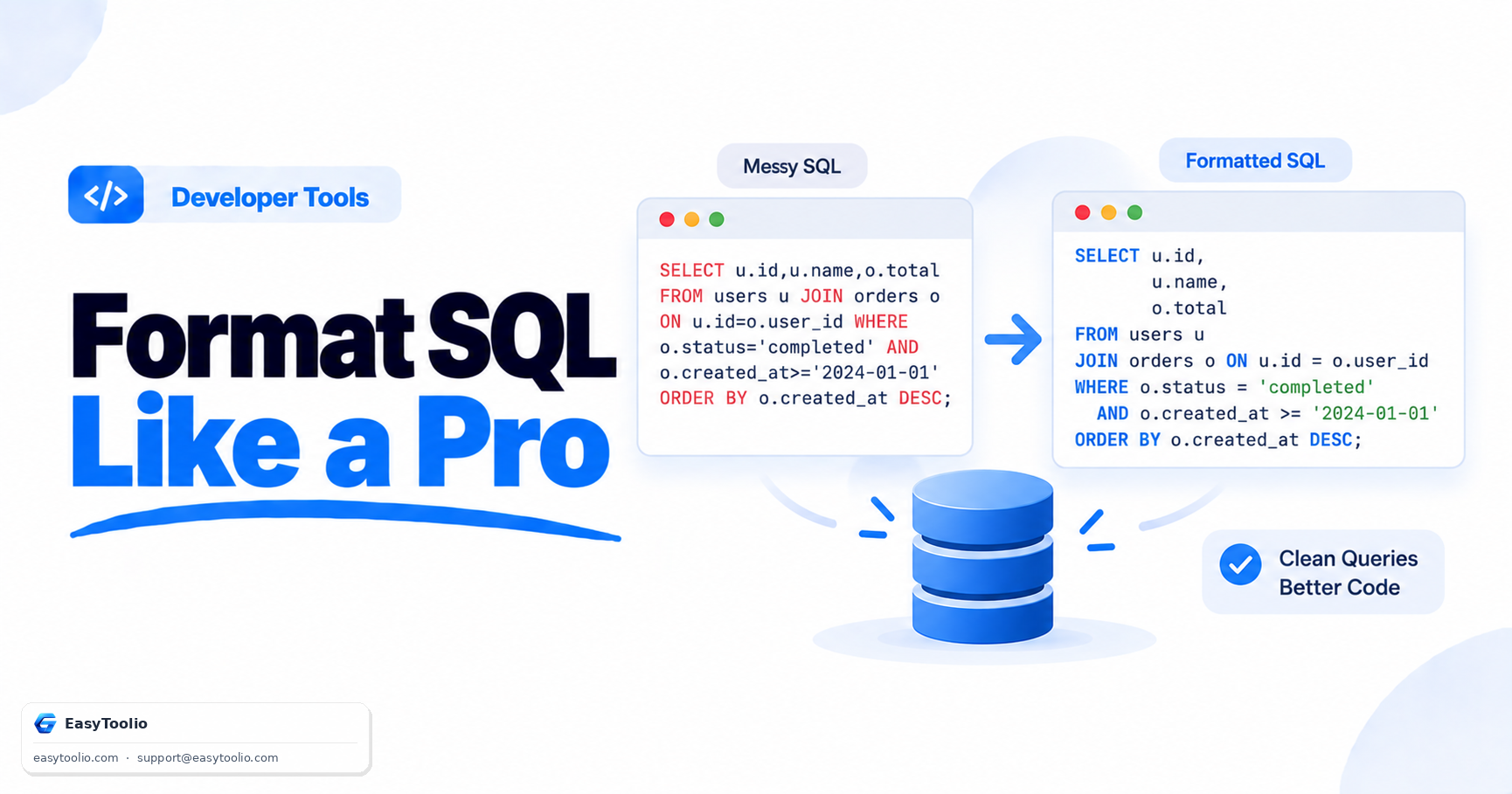
Anyone who has inherited a legacy codebase knows the feeling of opening a 400-character single-line SQL query and trying to figure out which JOIN connects to which subquery. SQL formatting isn't cosmetic — it's the difference between spotting a missing WHERE clause in five seconds and missing it entirely during a code review.
What SQL Formatting Actually Changes
Formatting a SQL query restructures its layout without changing its logic: keywords get capitalized consistently, clauses (SELECT, FROM, WHERE, JOIN, GROUP BY, ORDER BY) each start on their own line, and nested subqueries get indented to show their scope. Here's a query before formatting:
select u.id, u.name, count(o.id) as order_count from users u left join orders o on o.user_id = u.id where u.created_at > '2024-01-01' group by u.id, u.name having count(o.id) > 5 order by order_count desc;
And after formatting:
SELECT
    u.id,
    u.name,
    COUNT(o.id) AS order_count
FROM users u
LEFT JOIN orders o
    ON o.user_id = u.id
WHERE u.created_at > '2024-01-01'
GROUP BY u.id, u.name
HAVING COUNT(o.id) > 5
ORDER BY order_count DESC;
Nothing about what the query does has changed — it will return identical results and use the identical execution plan. What changed is that a reviewer can now instantly see the join condition, the filter, the grouping, and the having clause as separate, scannable pieces instead of one dense line.
Why Indentation Matters More in SQL Than Most Languages
Unlike languages with block syntax (curly braces, significant whitespace), SQL has no structural requirement for line breaks at all — a query can be syntactically valid as one continuous line. That flexibility is exactly why hand-written SQL degrades into unreadable messes over time: there's no compiler forcing structure, so consistency depends entirely on discipline (or tooling). This is especially true for queries with multiple joins, correlated subqueries, or CASE WHEN expressions, where visual nesting is the only signal a human has for understanding logical grouping. Running dense, auto-generated, or copy-pasted queries through the SQL Formatter instantly restores that visual structure without you needing to manually reformat every clause.
Practical Use Case: Reviewing a Pull Request
Say a teammate submits a migration with a raw query buried in a PHP string:
DB::select("SELECT a.id,a.email,b.plan_name FROM accounts a inner join subscriptions b on b.account_id=a.id where b.status='active' and a.region='EU'");
Formatted, the reviewer can immediately verify the join key and the two filter conditions:
SELECT
    a.id,
    a.email,
    b.plan_name
FROM accounts a
INNER JOIN subscriptions b
    ON b.account_id = a.id
WHERE b.status = 'active'
    AND a.region = 'EU'
This is where formatting earns its keep in a real workflow: it's not about personal style preference, it's about making logic errors (wrong join type, missing filter, unintended cartesian product) visible during review instead of in production.
SQL Formatting vs SQL Optimization
It's worth being clear that formatting and optimization are unrelated. Formatting changes layout only — it has zero effect on query performance, execution plan, or index usage. Optimization involves things like rewriting subqueries as joins, adding indexes, or avoiding SELECT *. A formatter will never make a slow query fast; it will only make a slow query easier to read while you diagnose why it's slow, which is often the first step toward optimizing it.
Frequently Asked Questions
Q: Does formatting change how a SQL query performs? A: No. Formatting only affects whitespace and capitalization for readability. The query optimizer strips whitespace during parsing, so execution plans and performance are completely unaffected.
Q: Should I format SQL that's embedded inside application code strings? A: Yes, especially for complex queries. Even though it adds line breaks inside a string literal, most languages handle multi-line strings fine, and the readability gain during debugging and code review outweighs the minor formatting overhead.
Q: Is there one universal SQL formatting standard? A: Not officially, but common conventions include uppercase keywords, one clause per line, and indenting subqueries — the goal is internal team consistency more than adherence to a single global standard.