MD5 and SHA-256 both take arbitrary input and produce a fixed-length digest, but they are not interchangeable, and using the wrong one in a security context can be a serious mistake. MD5 is fast and was widely used for decades, but it's now considered cryptographically broken. SHA-256 is slower but remains secure for integrity verification today. Here's what actually differs and why it matters.
Digest Length and Basic Mechanics
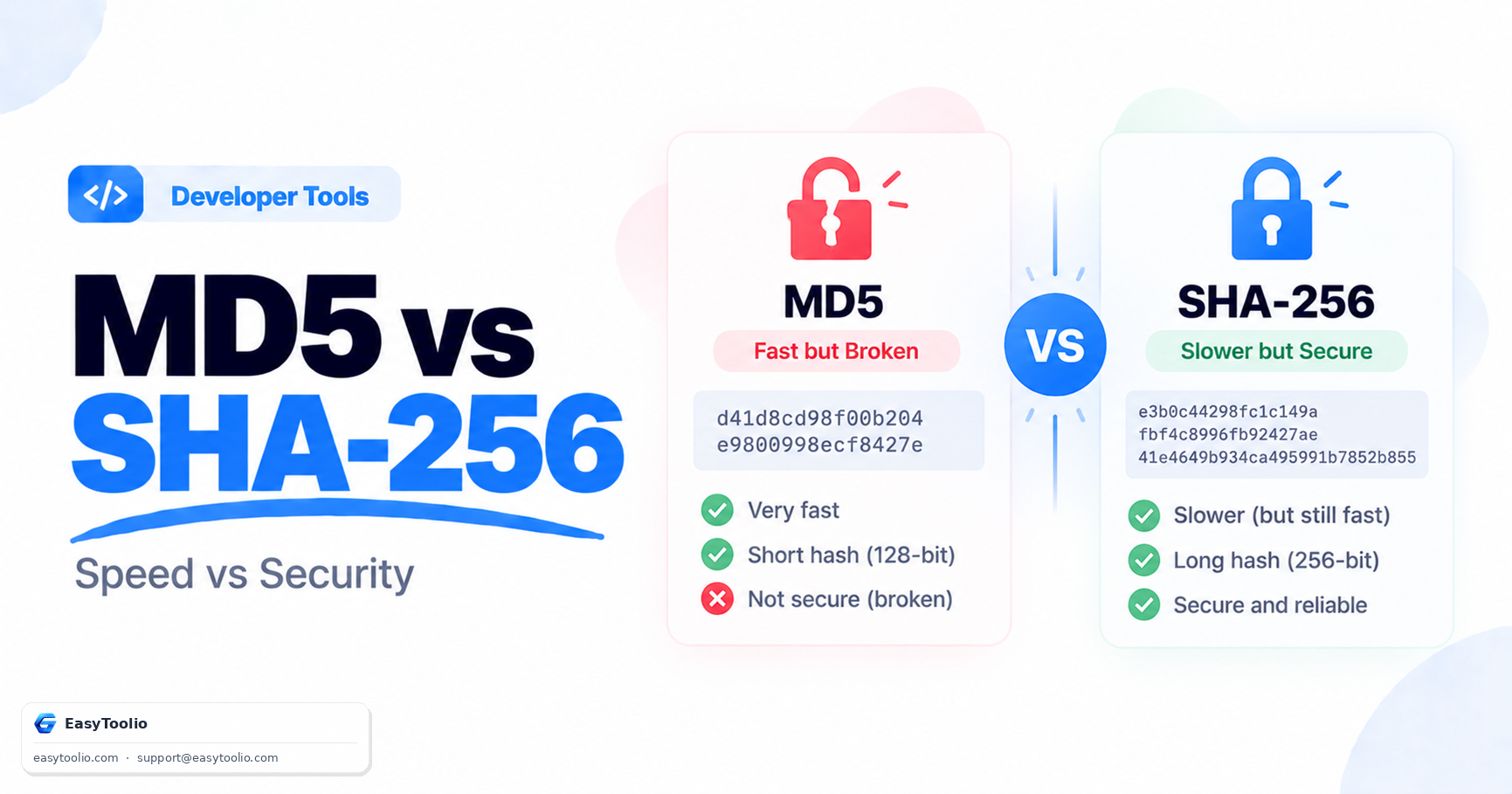
MD5 produces a 128-bit digest, represented as 32 hexadecimal characters:
Input:  hello world
MD5:    5eb63bbbe01eeed093cb22bb8f5acdc3
SHA-256 produces a 256-bit digest, represented as 64 hexadecimal characters:
Input:   hello world
SHA-256: b94d27b9934d3e08a52e52d7da7dacefe86b19f6cd2ae4e59730e79d38d6f43e
Both are deterministic (same input always produces the same output) and one-way (you cannot reverse a hash back into the original input) — that part is identical. The difference that matters is collision resistance: how hard it is to find two different inputs that produce the same hash. You can generate and compare both instantly with the Hash Generator, which supports both algorithms alongside SHA-1 and others.
Why MD5 Is Considered Broken
MD5's 128-bit output space made it theoretically weaker from the start, but the real problem is a practical one: researchers demonstrated real collision attacks against MD5 back in 2004, and modern hardware can now generate colliding MD5 pairs in seconds. This means an attacker can craft two different files — say, a legitimate document and a malicious one — that produce the identical MD5 hash. If a system uses MD5 to verify file integrity or authenticity, that system can be fooled. This is why MD5 has been deprecated for any security-relevant use — TLS certificates, digital signatures, password hashing — for years, even though it's still fine for cases that have nothing to do with security.
Why SHA-256 Remains Secure
SHA-256 (part of the SHA-2 family) has a much larger 256-bit output space and, as of 2026, has no known practical collision or preimage attacks — it remains the standard choice for TLS certificates, blockchain (Bitcoin uses double SHA-256), code signing, and file integrity verification. The tradeoff is that SHA-256 is computationally more expensive than MD5, which is precisely why it's slower — but for verifying that a downloaded file wasn't corrupted or tampered with, that extra computation cost is negligible on modern hardware and well worth the security guarantee.
When to Use MD5 vs SHA-256
Use MD5 only for non-security purposes where speed matters more than collision resistance: generating a quick checksum to detect accidental file corruption during a transfer, deduplicating files by content hash, or creating cache keys. Use SHA-256 for anything where an attacker might deliberately try to forge a match: verifying downloaded software checksums published by a vendor, generating API signatures, storing data fingerprints in security-sensitive systems, or any scenario involving authentication or integrity guarantees against a malicious actor.
One more important note: neither MD5 nor SHA-256 should be used alone for password storage. Both are fast general-purpose hash functions, which is exactly the wrong property for passwords — fast hashes make brute-force attacks cheap. Passwords should use a purpose-built, slow algorithm like bcrypt, scrypt, or Argon2 instead.
Frequently Asked Questions
Q: Is MD5 completely useless now? A: Not entirely — it's still fine for non-adversarial checksums, like verifying a file wasn't accidentally corrupted during download, since accidental corruption doesn't involve someone deliberately engineering a collision. It should never be used where security or trust verification is required.
Q: Is SHA-256 the most secure hash algorithm available? A: It's currently secure and widely trusted, but SHA-3 and SHA-512 also exist as modern alternatives. SHA-256 remains the most common choice due to its strong balance of security, performance, and broad support across platforms and libraries.
Q: Can I convert an MD5 hash back to the original text? A: Not directly — hashing is one-way by design. However, weak or short inputs can sometimes be recovered via precomputed "rainbow table" lookups or brute force, which is another reason MD5 is unsuitable for hashing sensitive data like passwords.