Blood Pressure Chart by Age: What Your Numbers Actually Mean
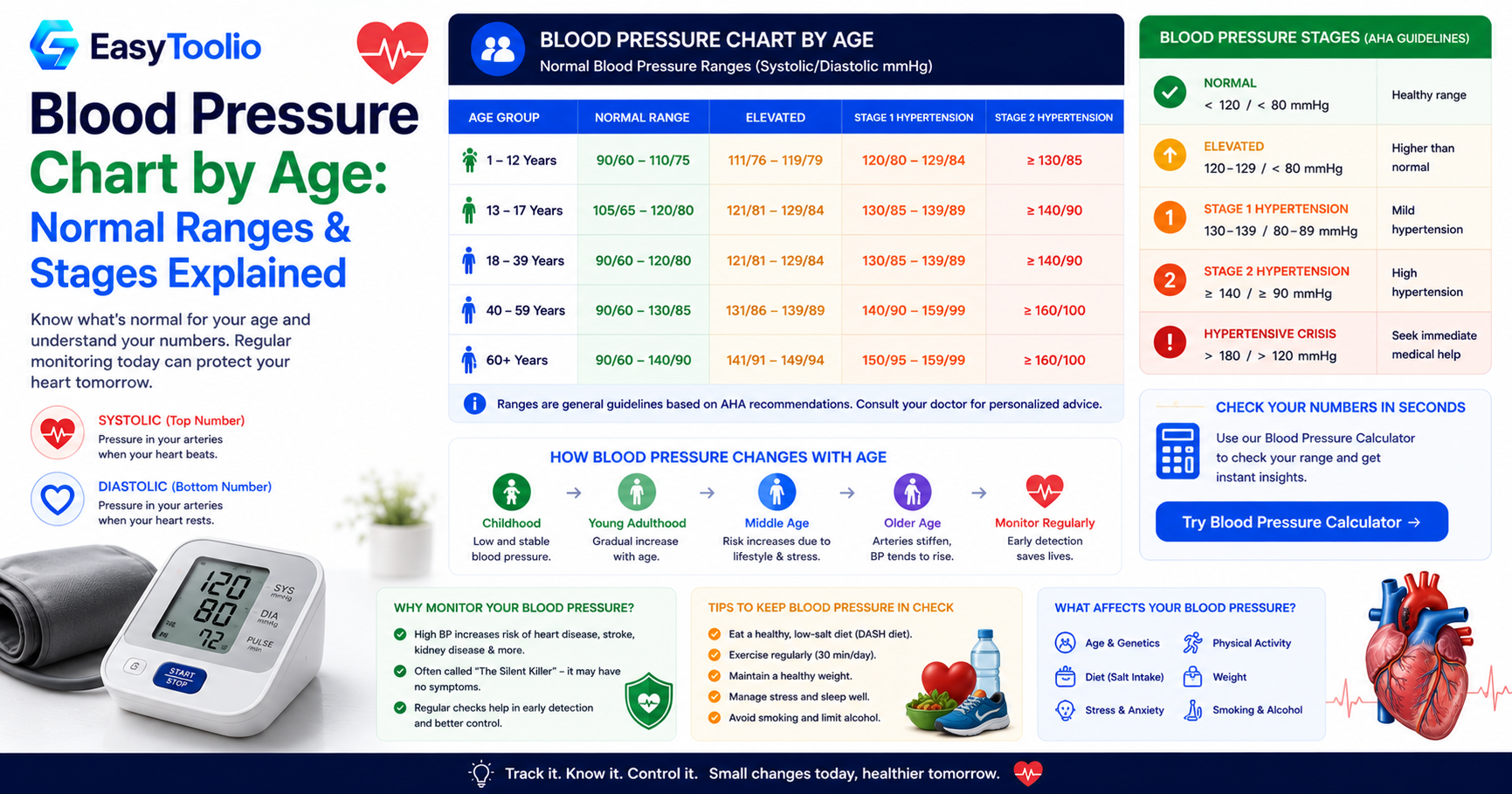
A blood pressure reading of "120/80" means nothing until you know the categories. Here is the full AHA chart, how ranges shift with age, and when a number becomes an emergency.
Calculate your BMI, tracking healthy weight targets and fitness recommendations. Explore 26 free online utility tools.
Classify your blood glucose reading, estimate your type 2 diabetes risk factors, and get general care recommendations.
Calculate your waist-to-height ratio to assess body fat distribution and health risk, often considered more reliable than BMI alone.
Calculate your BMI weight class, estimate resting metabolism BMR, and track hydration requirements. Grounded in standard WHO and NIH guidelines, these fitness calculators help you set realistic wellness goals.
Our fitness and health calculators are designed in strict accordance with peer-reviewed medical and athletic guidelines, including standard formulas from the World Health Organization (WHO) and the National Institutes of Health (NIH).
BMI measures body fat based on height and weight, calculated as:
BMI = weight (kg) / [height (m)]^2
While BMI is a useful screening tool for general population risk groups (Underweight < 18.5, Normal 18.5–24.9, Overweight 25–29.9, Obese >= 30), it has limitations for athletes with high muscle mass since it does not differentiate between muscle and fat. Consider combining this measurement with waist-to-hip ratio trackers.
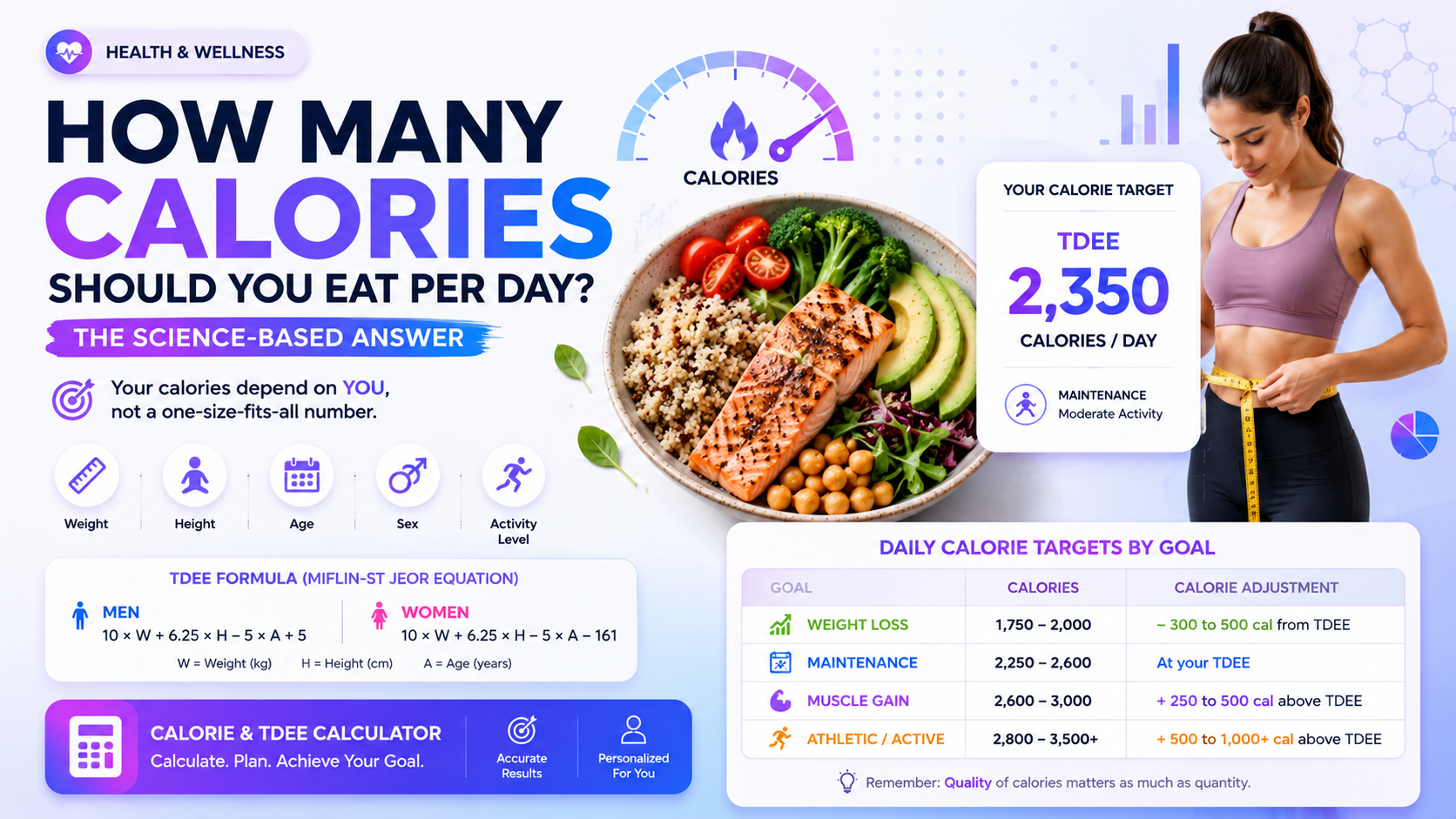
For daily calorie planning, we use the highly accurate Mifflin-St Jeor Equation to determine your resting energy output:
Men: BMR = (10 x weight in kg) + (6.25 x height in cm) - (5 x age in years) + 5 Women: BMR = (10 x weight in kg) + (6.25 x height in cm) - (5 x age in years) - 161
This baseline rate is multiplied by an activity factor (from sedentary to highly active) to calculate your Total Daily Energy Expenditure (TDEE), the exact caloric budget needed to maintain, lose, or gain body weight safely.

Open BMI, Calorie Needs, BMR, Body Fat, or Water Intake calculators.
Input height, weight, age, activity multipliers, or body measurements in the form.
Analyze daily caloric budgets, target heart rates, or recommended water intake schedules.
Calculates wellness indices using Mifflin-St Jeor, Harris-Benedict, and BMI equations.
Track hydration targets with a persistent tracker saved in your local browser.
Get customized splits of proteins, carbs, and fats tailored to your weight goal.
Height, weight, and health parameters are calculated locally and never stored online.
We calculate it using standard WHO guidelines for Body Mass Index (BMI) ranges of 18.5 - 24.9, scaling it based on height and adjusted by body frame width (small, medium, large).
Yes, your logged intake, streaks, and settings are preserved in local storage so they remain active when you reopen the page.
We support both the Mifflin-St Jeor and Harris-Benedict formulas, factoring in age, gender, height, and weight to calculate your baseline daily caloric burn.
No. These calculators utilize standard mathematical equations to estimate metrics (like BMI, BMR, or fat percentage) and are intended for general fitness references.
TDEE stands for Total Daily Energy Expenditure. It represents the total calories you burn daily, acting as the starting point for weight loss (-500 cal) or muscle gain (+300 cal).
Our tool uses the U.S. Navy Circumference method (measuring height, neck, waist, and hips) to estimate body composition, which is more accurate than simple BMI for athletes.
Yes. Based on your age and resting pulse rate, our calculators can determine target zones (fat burn, aerobic, peak) for fitness training.
It measures body fat distribution. Higher waist-to-hip ratios indicate abdominal fat deposition, which correlates with higher cardiovascular risks.
All calculations are completed directly inside your browser. No personal parameters or details are ever stored or processed on our servers.
A blood pressure reading of "120/80" means nothing until you know the categories. Here is the full AHA chart, how ranges shift with age, and when a number becomes an emergency.
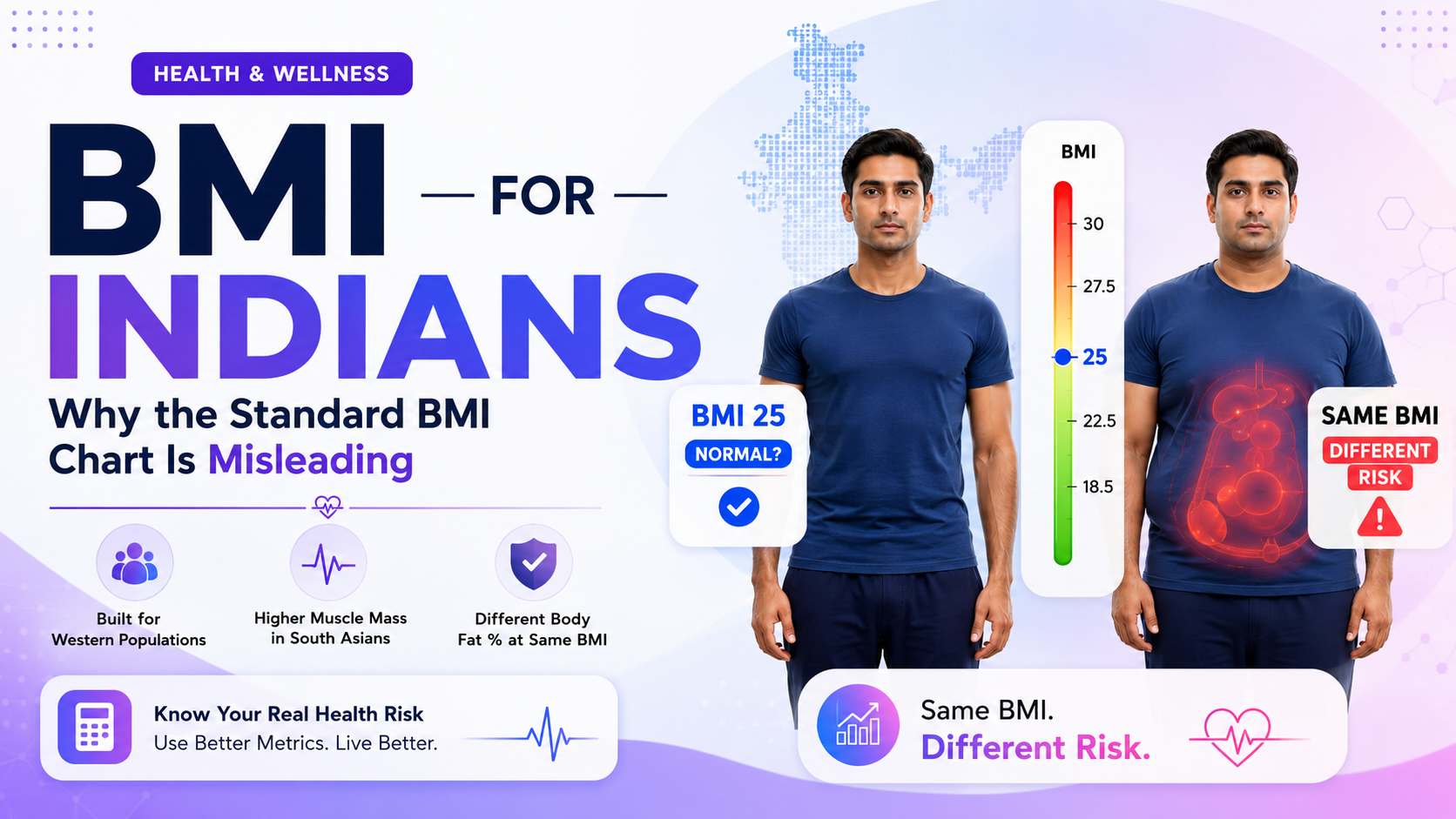
A BMI of 25 is "overweight" for a Western adult, but research shows South Asians carry significantly more body fat at the same BMI — and face higher metabolic risk. The WHO recognises lower BMI thresholds for Asians. Here is what the research says and why it matters.
The answer to "how many calories per day" is not the same for everyone. Your TDEE — Total Daily Energy Expenditure — depends on your weight, height, age, sex, and activity level. Here is the exact formula and tables by goal.
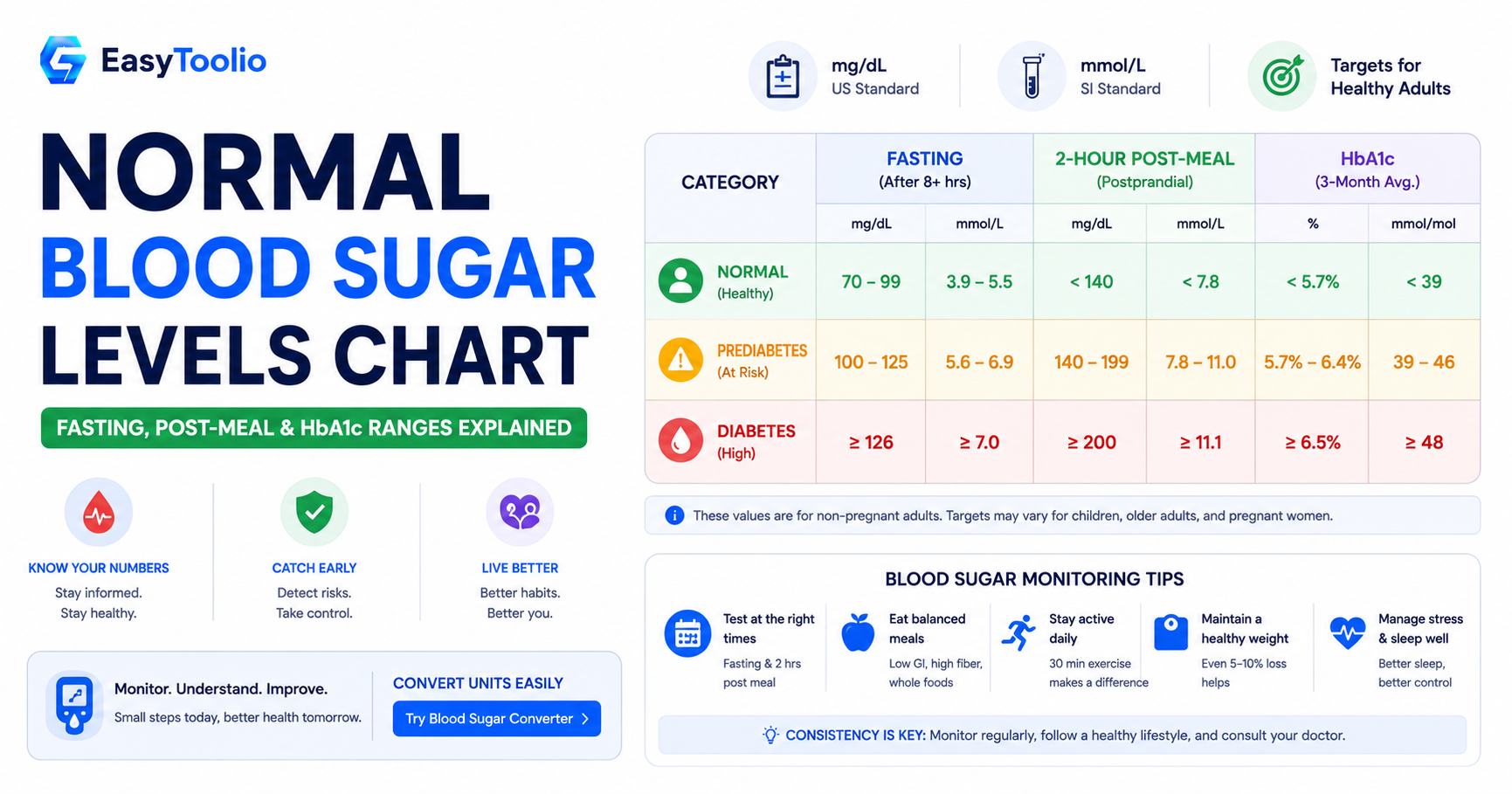
Fasting, post-meal, random, and HbA1c blood sugar tests each measure something different. Here is the complete normal-vs-prediabetic-vs-diabetic chart for all four.