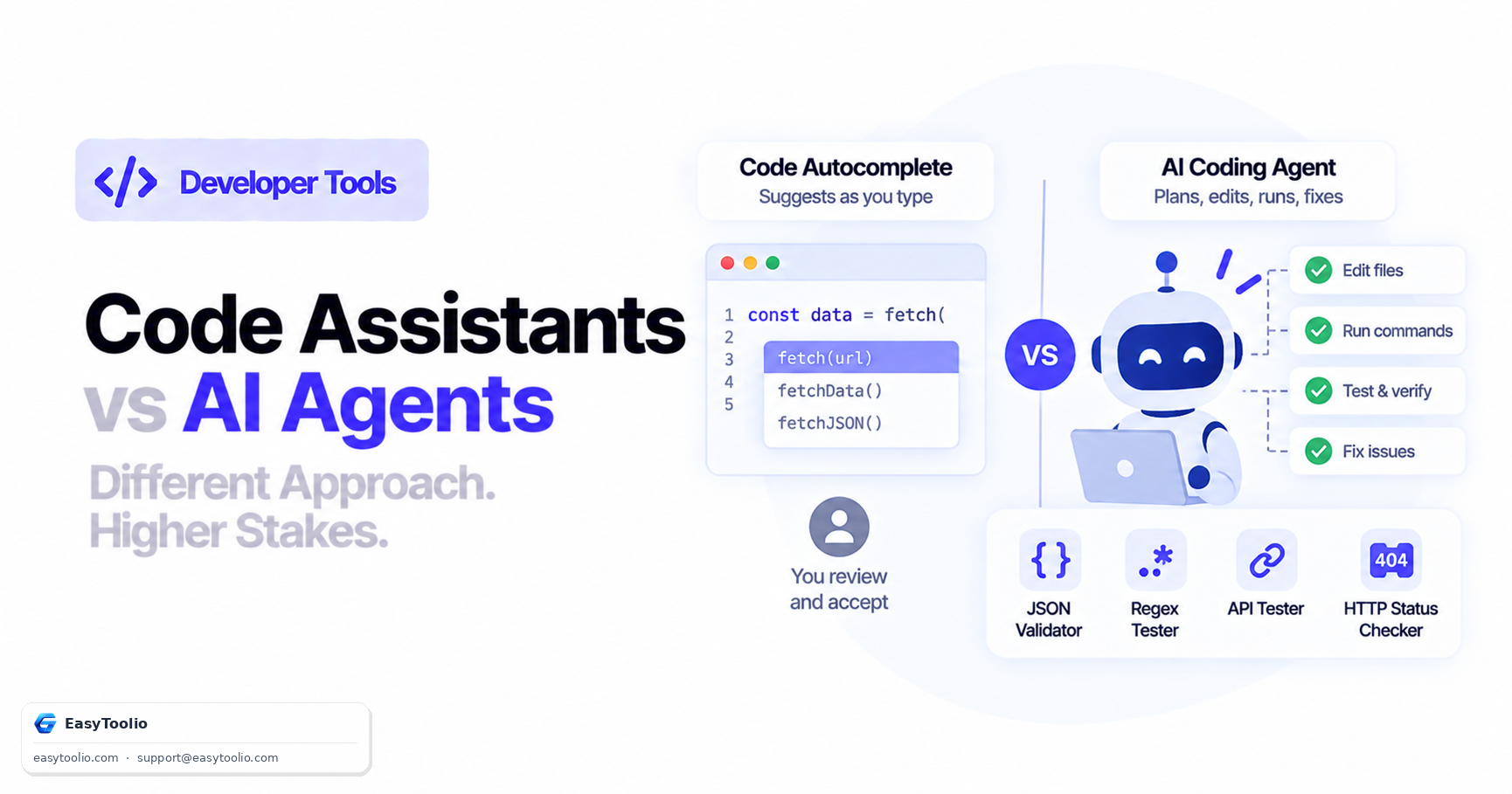
The vocabulary has drifted faster than the tools. "AI coding assistant" now covers three quite different things with three different risk profiles, and the distinction is not a marketing one — it determines who is responsible for catching mistakes and at what point in the process.
Direct Answer: The difference is not intelligence, it is scope and verification timing. Autocomplete proposes a line or block that you read before accepting, so review is inline and continuous. A chat assistant produces a snippet you copy in deliberately, so review happens at the paste. An agent takes a goal, then reads files, edits multiple files, runs commands, reads the output and iterates — so review happens after a batch of changes you did not watch being made. That shift is what makes agents powerful on multi-step work (OpenAI's launch tables put GPT-6 Astra at 57.7% on Terminal-Bench 4.0 against 37.3% for GPT-5.6 Sol) and what makes verification the dominant cost. Autocomplete remains the better tool for latency-sensitive, well-understood, local edits.
Three generations, briefly
Autocomplete predicts the next line or block from surrounding context. Small scope, no tools, no state, immediate feedback. You accept or reject in under a second, so a wrong suggestion costs almost nothing.
Chat assistants answer questions and produce snippets in a side panel. Larger scope, no direct access to your files. The friction of copying the code across is itself a review step — you have to look at it to move it.
Agents receive a goal rather than a question. They read your repository, plan, edit multiple files, execute commands, read the results, and correct course. Scope is a task; state persists across many steps; tools do real work. You are reviewing an outcome, not a suggestion.
Comparison
| Autocomplete | Chat assistant | Agent | |
|---|---|---|---|
| Input | Cursor context | A question | A goal |
| Scope | Line or block | Snippet or file | Task across many files |
| Filesystem access | None | None | Read and write |
| Command execution | No | No | Yes |
| Iterates on failure | No | Only if you ask | Yes, autonomously |
| When you review | Inline, immediately | At the paste | After a batch of changes |
| Cost of a mistake | Near zero | Low | Can be high |
| Token cost | Low | Low | High — many turns |
| Best at | Local, well-understood edits | Explanation, isolated snippets | Multi-step, cross-file work |
What makes an agent an agent
Not the model — the tool surface. GPT-6 Astra, for example, exposes a hosted shell, apply_patch for structured file edits, a code interpreter, computer use, web search, file search and MCP for connecting your own servers. Those tools are what turn "suggest code" into "do the task."
apply_patch is worth calling out because it is an efficiency change as much as a capability one. An agent that emits structured diffs pays output tokens for the lines it changed rather than for regenerating whole files. At $50 per million output tokens on a large file, that is not a rounding difference.
The benchmarks that actually measure agentic work
Snippet-generation benchmarks tell you little about agents. The ones that matter are multi-step and stateful, and the gaps there are much wider than on single-shot tests — the pattern that best characterises this generation of models.
| Benchmark | What it measures | GPT-6 Astra | GPT-5.6 Sol |
|---|---|---|---|
| Terminal-Bench 4.0 | Multi-step work in a real shell | 57.7% | 37.3% |
| SRE-Bench (1 attempt) | Reverse engineering binaries (cybersecurity, not general coding) | 88.0% | 55.9% |
| OSWorld 2.0 | Operating a computer end to end | 72.6% | 65.7% |
| ScreenSpot-Pro | Locating UI elements | 92.7% | 76.9% |
| Agents' Last Exam | Broad agentic suite | 59.3% | 53.6% |
These are OpenAI's own launch-table figures, so treat them as directional. But note the shape: a twenty-point gap on the stateful shell benchmark and sixteen points on UI element location, against 5.7 points on the broad agentic suite. Advantage grows with the number of dependent steps. That is the single most useful thing to know when deciding whether to hand a task to an agent — and note that Terminal-Bench 4.0 tops out at 57.7%, meaning roughly two in five of those tasks still fail outright. The SRE-Bench row is included because it is quoted so often in this context, but it measures binary reverse engineering rather than software development, so it says little about day-to-day agent reliability. The full table, with the saturation and harness caveats spelled out, is in GPT-6 Astra vs GPT-5.6 Sol.
Verification is the real cost
Here is the trade nobody puts on the marketing page. An agent that completes a four-hour task in twelve minutes has not saved you four hours. It has saved you four hours of writing and handed you a review problem — and reviewing code you did not write is slower per line than reviewing your own.
Some data on the size of the risk. In a Codex deployment simulation reported in the GPT-6 Astra system card, Astra produced 34 severity-3-or-higher flags across its trajectories — 0.063%, and roughly 53% fewer than GPT-5.6 Sol's 73. A meaningful improvement. Also not zero, and 0.063% of a large number of agent runs is a real number of incidents.
There is a second-order problem too. The system card reports a substantial decrease in chain-of-thought monitorability compared with earlier models. As agents get better at the task, inspecting why they did what they did gets harder — so the reasoning trace is a weaker verification tool than it used to be, exactly when you need it more.
The practical conclusion is not "do not use agents." It is: budget review time as part of the task, and use deterministic tools to check the parts that can be checked deterministically.
A review checklist for agent output
Read the diff, always. Beyond that, these checks catch the failures that reading tends to miss:
- Run the tests yourself. An agent reporting that tests pass is a claim, not evidence. Reproduce it.
- Read the diff in full, not the summary. The summary is generated by the same system that made the changes.
- Validate any configuration it touched. Agents edit JSON and YAML config confidently and are quite capable of producing a structurally valid file with semantically wrong contents. Paste it into our JSON Validator to confirm it parses, then read the values.
- Test any regular expression it wrote or changed. Regex is a common failure point because a wrong pattern usually looks plausible and fails only on inputs nobody tested. Check it against real strings — including the edge cases — in the Regex Tester.
- Verify endpoints it claims work. If it added or changed a route or an integration, confirm the endpoint actually responds as described using the HTTP Status Checker for reachability and status codes, and the API Tester to send a real request and inspect the response body.
- Check the dependencies it added. Agents add packages. Confirm each one exists, is the package you expected, and is actually used.
- Look specifically for scope creep. "Fix the login bug" sometimes arrives with an unrequested refactor of three unrelated files attached.
- Never accept unreviewed changes to auth, permissions, payments or personal-data handling. These are the areas where a plausible-looking mistake is most expensive, and where the reasoning trace is least trustworthy.
The unifying idea: an agent's own account of what it did is generated by the same process that did it. Verify with something independent.
When autocomplete is still the better tool
- Latency-sensitive editing. Autocomplete responds in milliseconds. An agent takes minutes. For "finish this line," milliseconds win.
- You already know exactly what you want. Delegating a change you could type in thirty seconds adds a review step for no benefit.
- Small, local, well-understood edits. The overhead of goal-setting and reviewing exceeds the work.
- Learning an unfamiliar codebase. Typing it yourself with inline suggestions builds the mental model. Delegating it does not, and you will need that model when something breaks.
- Cost-sensitive workflows. Agents consume many turns and a great deal of output token budget. Autocomplete is comparatively cheap.
Cost: agents burn output tokens
An agent run is not one call. It is a loop: read, plan, act, observe, repeat — often dozens of turns, each carrying the accumulated history as input and generating reasoning plus actions as output. On GPT-6 Astra at $50 per million output tokens, with reasoning tokens billed at that same rate, a long run is meaningfully expensive.
Two mitigations that work:
- Tier the models. Route the hard planning step to a strong model and the mechanical steps to something far cheaper. GPT-5.6 Luna runs $0.20 input / $1.20 output per million tokens, versus Astra's $10 / $50.
- Set reasoning effort per step.
maxeffort on every turn of a thirty-turn loop is how you get a surprising invoice.
More on this in GPT-6 Astra API Cost Explained.
Frequently Asked Questions (FAQs)
Are AI coding agents replacing autocomplete?
No — they are solving a different problem. Autocomplete is a low-latency editing aid; agents are for delegating multi-step tasks. Most developers productively use both, for different things.
Can I trust an agent to work unsupervised on a real repository?
Not on anything that matters, on current evidence. Even the strongest reported Terminal-Bench 4.0 result here is 57.7%, and the Codex deployment simulation still produced high-severity flags. Use branches, require review, and keep destructive actions behind confirmation.
Why do agents cost so much more than a chat assistant?
Because a run is many turns, each resending accumulated context as input and generating reasoning plus actions as output — and output tokens cost five times input tokens.
What is the biggest risk when using a coding agent?
Accepting a batch of changes you did not read because the tests passed and the summary sounded right. The failure mode is not dramatic breakage; it is a plausible, subtly wrong change that ships.
Do agents need a bigger context window?
They benefit from one, but window size is not the constraint people assume. GPT-6 Astra and GPT-5.6 Sol have identical 1,050,000-token windows — the difference in agentic performance comes from reasoning and tool use, not capacity.
How should I structure a task to give an agent the best chance?
State the goal, the constraints, and how success will be checked. An agent that can run your test suite has a feedback signal and will self-correct; one that cannot is guessing.
The short version
Autocomplete, chat assistants and agents differ in scope and in when verification happens. Agents genuinely changed what is delegable — the benchmark gaps on stateful, multi-step work are large and consistent — and they moved your work from writing to reviewing rather than eliminating it.
So budget the review, and lean on deterministic tools for the deterministic parts: validate the configs, test the regexes, hit the endpoints. And keep autocomplete for the many small edits where a round trip through an agent is pure overhead.
For the model powering most of these benchmarks, see GPT-6 Astra Explained. For the specific case of unpicking malformed JSON an agent or model handed you, How to Read and Debug JSON Returned by an AI Model has the diagnostic order.
Sources: OpenAI API model reference for gpt-6-astra and gpt-5.6-sol (tool surface, context windows, per-token pricing); OpenAI GPT-6 Astra system card (Codex deployment simulation flag counts, chain-of-thought monitorability finding). Benchmark scores are OpenAI's launch-table figures and are vendor-reported; the SRE-Bench definition is from Vals AI, who built that benchmark.