"Am I okay to drive?" is one of the most consequential guesses people make after a night out, and it's usually based on nothing more than how sober they feel — which is a notoriously unreliable gauge, since impairment affects judgment about impairment itself. A BAC calculator replaces that guess with an actual formula, though it's important to understand exactly what that formula can and can't tell you.
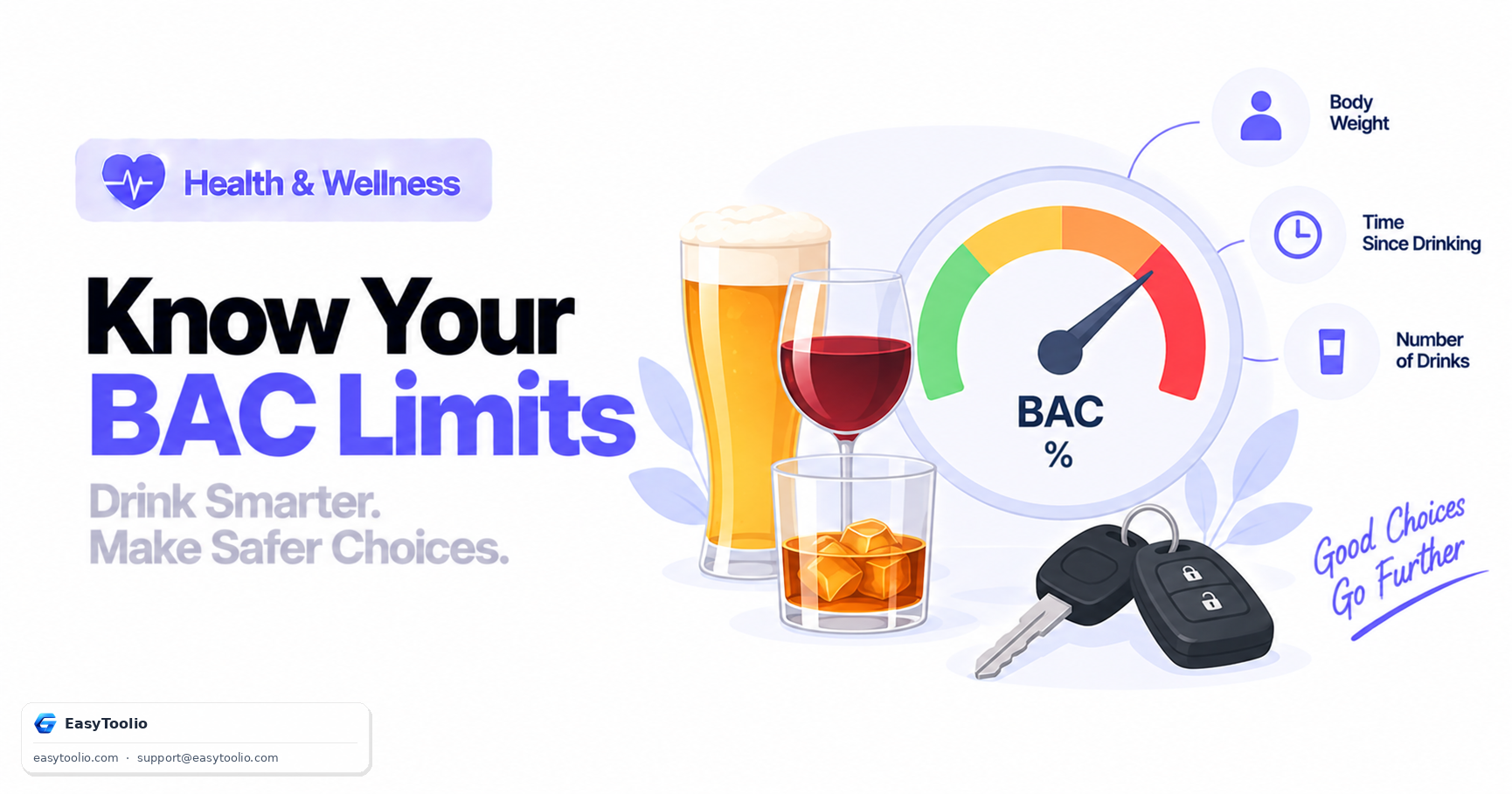
Direct Answer: Blood Alcohol Content is most commonly estimated using the Widmark formula: BAC = [Alcohol consumed in grams / (Body weight in grams × distribution ratio r)] − (elimination rate × hours since first drink). The distribution ratio (r) is typically 0.68 for men and 0.55 for women, reflecting differences in average body water content, and the average elimination rate is roughly 0.015% BAC per hour. This produces an estimate, not a legally admissible measurement — actual BAC varies with food intake, medication, metabolism, and drink strength, so calculators should never be used to decide it's safe to drive.
The Widmark Formula, Step by Step
Developed by Swedish physiologist Erik Widmark in the 1930s, the formula remains the basis for most consumer and even some forensic BAC estimation tools:
BAC = (A / (W × r)) − (β × t)

A = grams of alcohol consumed
W = body weight in grams
r = alcohol distribution ratio (0.68 male / 0.55 female, on average)
β = elimination rate (~0.015% per hour, average)
t = hours elapsed since drinking began
Grams of alcohol consumed is calculated from a drink's volume, alcohol-by-volume (ABV) percentage, and the density of ethanol: a standard 12 oz (355 ml) beer at 5% ABV, a 5 oz (148 ml) glass of wine at 12% ABV, and a 1.5 oz (44 ml) shot of 40% ABV spirits each contain roughly 14 grams of pure alcohol — this is the basis for the "standard drink" unit used in most public health guidance.
Why the Distribution Ratio Differs by Sex
The distribution ratio (r) reflects how much of the body is water, since alcohol distributes through body water rather than fat tissue. On average, women have a higher proportion of body fat and lower proportion of body water than men of the same weight, which concentrates the same amount of alcohol into a smaller water volume — this is the physiological reason women often reach a higher BAC than a man of identical weight after consuming the same amount of alcohol, all else being equal. Individual variation is significant, though, and the 0.68/0.55 figures are population averages, not fixed constants for any one person.
Enter your weight, sex, drinks, and time elapsed into our BAC calculator to get an instant Widmark-based estimate rather than doing this arithmetic manually.
Legal BAC Limits by Country/Region
| Country / Region | Standard Legal Limit | Notes |
|---|---|---|
| United States (most states) | 0.08% | Lower limits (0.02-0.04%) for commercial drivers and under-21 drivers |
| United Kingdom (England, Wales, NI) | 0.08% | |
| Scotland | 0.05% | Lower than rest of the UK |
| India | 0.03% | One of the stricter limits globally |
| Germany, France, Australia | 0.05% | Common EU/Commonwealth standard |
| Japan | 0.03% | |
| Sweden, Norway | 0.02% | Among the strictest globally |
These limits vary not just by country but sometimes by driver category within the same country (commercial vs. private, new vs. experienced drivers), so always check local regulations rather than assuming a single global standard.
Factors That Make Real BAC Differ From the Estimate
The Widmark formula assumes ideal, uniform conditions that real drinking situations rarely match:
- Food in the stomach significantly slows alcohol absorption, meaning peak BAC after drinking on a full stomach can be notably lower and later than the formula predicts for the same amount consumed on an empty stomach.
- Drink strength variability — a "shot" poured at a bar is rarely exactly 1.5 oz, and craft beers can range from 4% to over 10% ABV, both of which throw off the grams-of-alcohol input.
- Individual metabolism — elimination rate varies from roughly 0.010% to 0.020% per hour between individuals based on liver function, genetics, and tolerance.
- Medications and health conditions can slow or alter alcohol metabolism substantially.
- Rate of consumption — drinking the same total amount over 30 minutes versus 3 hours produces very different peak BAC values, something a simple total-based formula doesn't fully capture without time-segmented tracking.
Because of this variability, a BAC calculator should be treated as an educational estimate of general impairment trends, not a precise or legally reliable number — it is not a substitute for professional medical guidance, and it should never be used as the basis for deciding whether it's safe to drive.
What "Impairment" Looks Like at Different BAC Levels
| Approximate BAC | Typical Effects |
|---|---|
| 0.02–0.03% | Mild relaxation, slight mood elevation |
| 0.05–0.06% | Reduced judgment, lowered inhibition, minor motor impairment |
| 0.08% | Legal limit in most of the US/UK; noticeable coordination and reaction time impairment |
| 0.10–0.15% | Significant impairment in balance, speech, and reaction time |
| 0.20%+ | Severe impairment; risk of confusion, loss of coordination |
| 0.30%+ | Risk of alcohol poisoning, loss of consciousness |
| 0.40%+ | Life-threatening; risk of respiratory failure |
Frequently Asked Questions
How long does it take for BAC to reach zero after drinking?
At an average elimination rate of 0.015% per hour, it takes roughly one hour to metabolize one standard drink's worth of BAC increase, but this varies by individual — there is no reliable way to "speed up" elimination through coffee, cold showers, or exercise; only time reduces BAC.
Can a BAC calculator be used as evidence in a DUI case?
No. Consumer BAC calculators produce estimates based on averages and self-reported inputs; they are not calibrated or certified measuring instruments and are not legally admissible as evidence of actual BAC in the way a breathalyzer or blood test is.
Does eating food actually lower my BAC?
Food doesn't lower your ultimate BAC from a given amount of alcohol, but it does slow the rate of absorption, which lowers your peak BAC and spreads the effect over a longer period compared to drinking the same amount on an empty stomach.
Why do I feel more affected by alcohol than my calculated BAC suggests?
Tolerance, fatigue, medication interactions, and individual differences in alcohol sensitivity can all make subjective impairment feel stronger or weaker than a population-average formula predicts — the calculator estimates a statistical average, not your personal physiology exactly.
Is it safe to drive at exactly the legal BAC limit?
No — legal limits define a threshold for criminal liability, not a threshold for safety. Reaction time and judgment measurably decline starting well below most legal limits, so the only fully safe choice after drinking is not to drive at all.
This calculator is for general educational and informational purposes only and is not a substitute for professional medical advice or a certified breath/blood alcohol test.
References: Widmark, E.M.P. (1932), "Die theoretischen Grundlagen und die praktische Verwendbarkeit der gerichtlich-medizinischen Alkoholbestimmung"; National Highway Traffic Safety Administration (NHTSA) BAC guidance; World Health Organization (WHO) Global Status Report on Alcohol and Health.