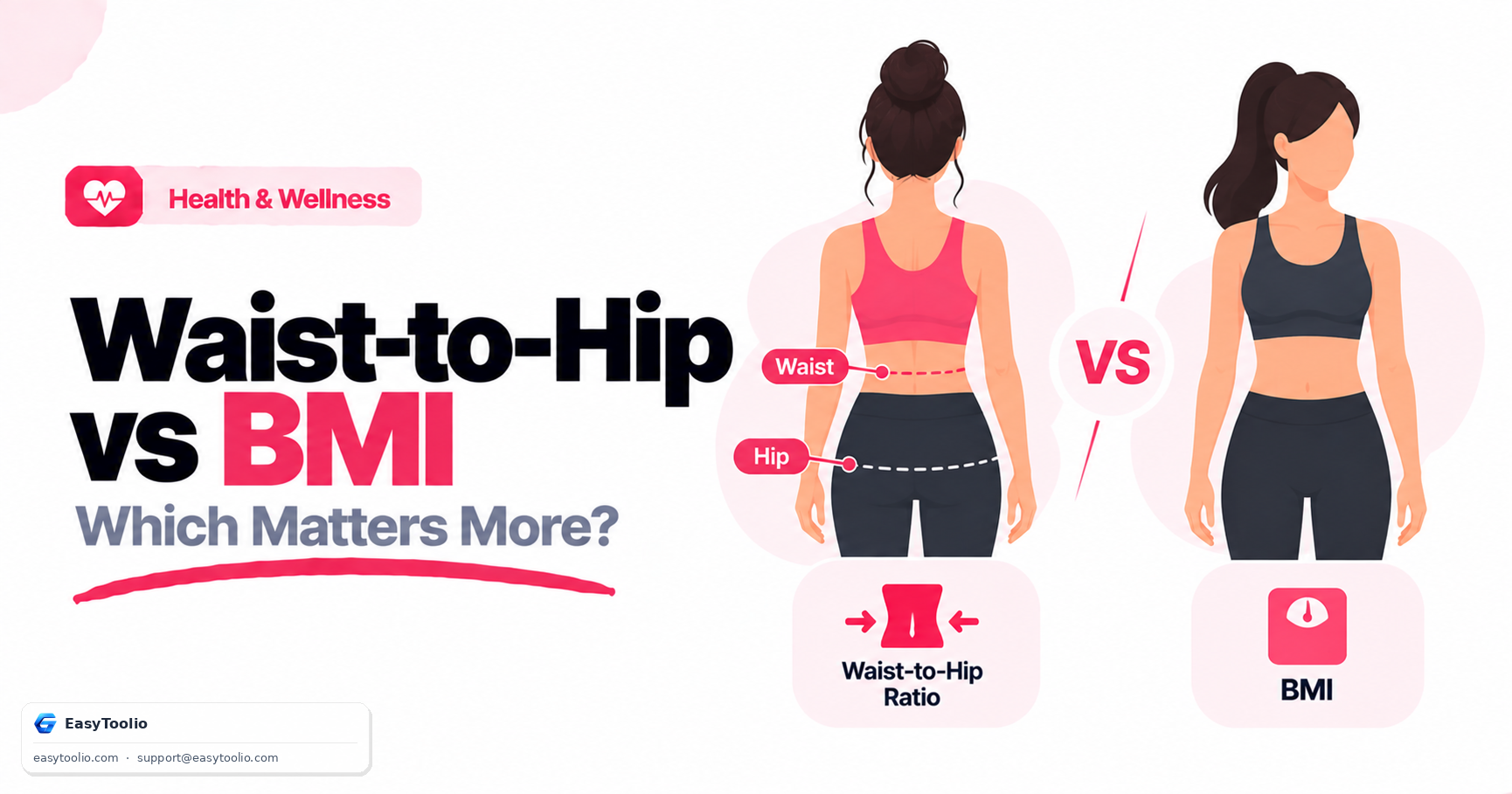
Two people can have the exact same BMI — say, 27 — and yet one carries noticeably higher cardiovascular risk than the other. The reason lies in where the extra weight is stored, something BMI cannot measure at all but waist-to-hip ratio (WHR) captures directly.
This article is educational information and not a medical diagnosis. Anyone concerned about their body composition or cardiovascular risk should consult a doctor.
How BMI Is Calculated — and Its Well-Known Limitation
Body Mass Index (BMI) is calculated as:
BMI = weight (kg) ÷ height (m)²
It's simple, requires only a scale and a measuring tape, and correlates reasonably well with health risk at a population level. But BMI has a widely acknowledged blind spot: it cannot distinguish muscle from fat, and it says nothing about where fat is distributed on the body.
A muscular athlete and a sedentary person of the same height and weight can post an identical BMI despite having very different body compositions and health profiles. Check your own number with the BMI Calculator.
How Waist-to-Hip Ratio Is Calculated — and What It Measures Instead
Waist-to-hip ratio measures fat distribution rather than total body mass:
WHR = waist circumference ÷ hip circumference
Both measurements are taken in the same units (cm or inches) — waist at the narrowest point (typically just above the belly button) and hips at the widest point around the buttocks.
Unlike BMI, WHR specifically flags abdominal (visceral) fat — fat stored around internal organs in the abdomen — which is more metabolically active and more strongly linked to cardiovascular disease, insulin resistance, and type 2 diabetes than fat stored elsewhere on the body, such as the hips or thighs.
Calculate yours with the Waist-to-Hip Ratio Calculator.
WHO Reference Thresholds for WHR Risk
| Sex | Low Risk | Moderate Risk | High Risk |
|---|---|---|---|
| Men | Below 0.90 | 0.90–0.99 | 1.00 or higher |
| Women | Below 0.80 | 0.80–0.84 | 0.85 or higher |
These WHO reference bands are general population guidance, not a diagnostic tool on their own — they're best used as one input among several when discussing cardiovascular risk with a doctor.
"Apple" vs "Pear" Body Shapes: Same BMI, Different Risk
This is where WHR earns its usefulness. Consider two people with an identical BMI of 27:
- Person A ("apple" shape): Carries most of their extra weight around the abdomen. Waist 95 cm, hips 98 cm → WHR = 0.97 (high risk for a man).
- Person B ("pear" shape): Carries most of their extra weight around the hips and thighs. Waist 88 cm, hips 108 cm → WHR = 0.81 (moderate/lower risk for a man).
Both people are classified identically by BMI alone — both fall in the "overweight" category. But WHR reveals that Person A's fat distribution pattern is associated with meaningfully higher cardiovascular and metabolic risk, even at the same total body weight. This is the core reason researchers increasingly treat central (abdominal) fat as a more direct risk signal than total body mass.
Use Both Metrics Together, Not Either Alone
Neither measurement is meant to replace the other — they answer different questions:
- BMI answers: "Is your total weight, relative to your height, in a range associated with population health risk?"
- WHR answers: "Is your fat concentrated in a pattern known to raise cardiovascular and metabolic risk, regardless of total weight?"
Used together, they give a fuller picture than either alone. A person with a "normal" BMI but a high WHR may still carry meaningful metabolic risk from abdominal fat that BMI alone would miss entirely — and a person with a slightly elevated BMI but a low WHR and good fitness markers may carry less risk than the BMI number alone suggests.
How to Measure Waist and Hip Circumference Correctly
WHR is only as reliable as the two measurements behind it, and inconsistent technique is a common source of misleading results:
- Waist: Measure at the narrowest point of your torso, typically just above the belly button and below the ribcage. Stand relaxed — don't hold your breath or suck in your stomach, since this artificially shrinks the reading.
- Hips: Measure at the widest point around the buttocks, keeping the tape parallel to the floor.
- Tape tension: The tape should sit snugly against the skin without compressing it — too loose or too tight both distort the number.
- Timing: Measuring at a consistent time of day (rather than right after a large meal) gives more comparable results if you're tracking the ratio over time.
Because a few centimeters of measurement error can shift which risk band a WHR falls into (especially near a boundary like 0.80 or 0.90), consistent technique matters more for this metric than for a simple weight or BMI reading.
A Related Metric: Waist-to-Height Ratio
Waist-to-hip ratio isn't the only distribution-based alternative to BMI. Waist-to-height ratio (WHtR) — waist circumference divided by height, in the same units — is another commonly cited screening metric. A frequently referenced general guideline is to keep waist circumference under half of height (a WHtR below 0.5), though as with WHR, this is a population-level screening guideline rather than an individual diagnostic cutoff. WHtR is sometimes preferred in research because it requires only one additional measurement (height, which is already commonly recorded) rather than two separate circumference measurements, though WHR remains the more widely used and studied of the two in clinical guidance.
Common Mistakes When Interpreting These Metrics
- Treating BMI as a body-fat measurement. BMI measures weight relative to height only — it cannot distinguish muscle from fat, which is why a muscular individual can be misclassified as "overweight" by BMI alone.
- Comparing your WHR to the wrong sex's threshold. The WHO reference bands differ for men and women, reflecting typical differences in fat distribution patterns, so using the wrong column will misclassify risk.
- Sucking in your stomach while measuring waist circumference. This is one of the most common self-measurement errors and can meaningfully understate abdominal fat.
- Treating a single WHR reading as a diagnosis. Like blood pressure or cholesterol, WHR is one data point among several a healthcare provider would consider alongside your broader health history, not a standalone diagnostic result.
Frequently Asked Questions
Q: Can two people have the same BMI but different health risk? A: Yes. BMI only accounts for total weight relative to height, not where fat is stored. Two people with identical BMI can have very different waist-to-hip ratios, and abdominal ("apple" shape) fat carries higher cardiovascular risk than fat stored around the hips ("pear" shape).
Q: What waist-to-hip ratio is considered high risk? A: According to WHO reference bands, a WHR of 1.00 or higher for men and 0.85 or higher for women is classified as high risk, though this should be interpreted alongside other health markers rather than in isolation.
Q: Should I use BMI or waist-to-hip ratio to track my health? A: Ideally both. BMI gives a quick view of overall weight relative to height, while WHR reveals fat distribution and abdominal risk that BMI cannot detect. Using them together gives a more complete picture than relying on either alone.
Q: What's the most common mistake people make when measuring their own waist-to-hip ratio? A: Sucking in the stomach or measuring at an inconsistent point on the torso. For a reliable reading, measure the waist at its narrowest point while breathing normally, and the hips at their widest point, with the tape snug but not compressing the skin.
Q: Is waist-to-height ratio better than waist-to-hip ratio? A: Neither is universally "better" — they're related but distinct screening tools. Waist-to-height ratio only requires a waist measurement and your height, while waist-to-hip ratio captures fat distribution relative to hip size specifically. Waist-to-hip ratio has more established clinical reference bands and is the more widely used of the two.