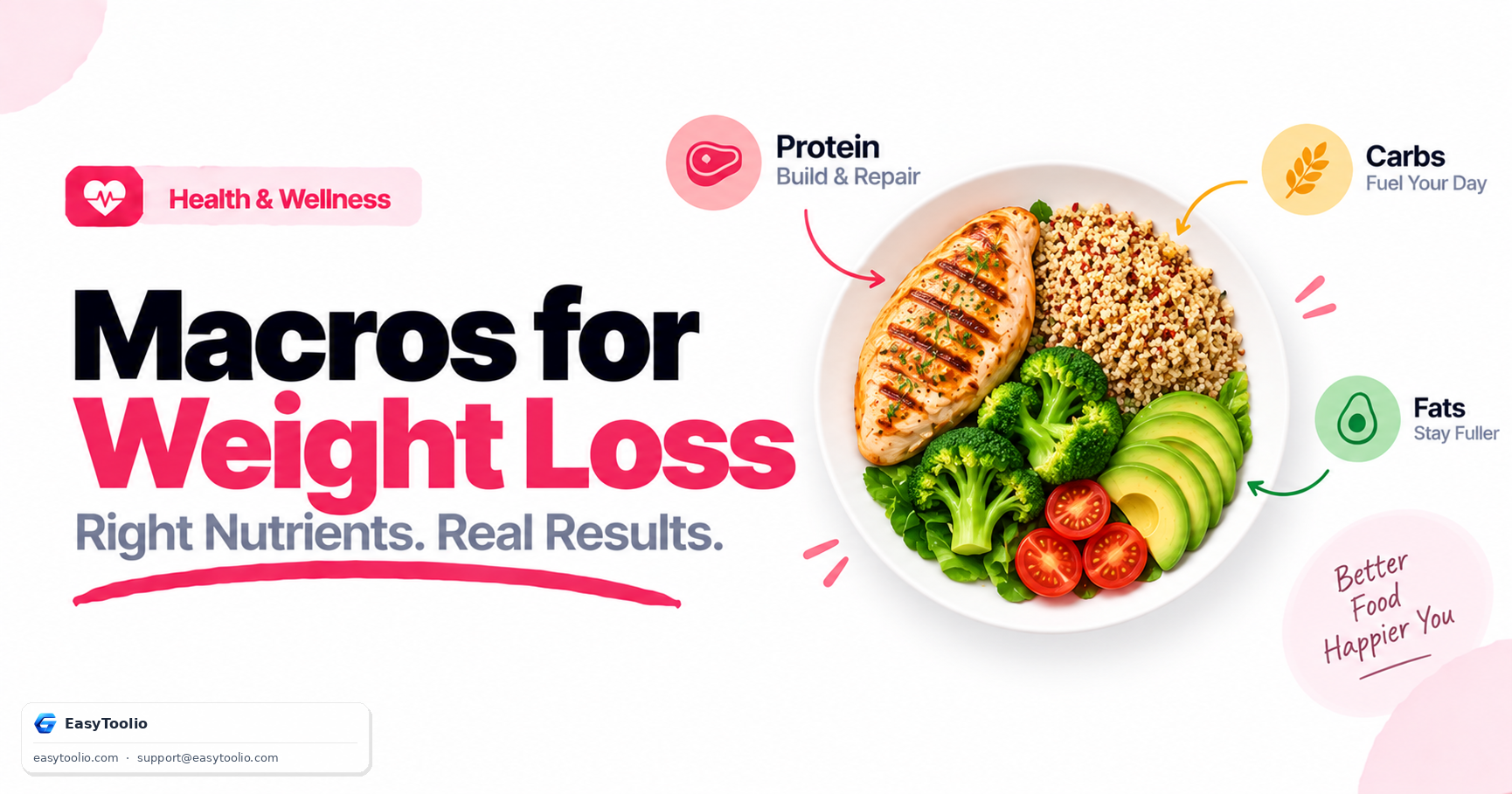
Calories tell you how much to eat, but macronutrients — protein, carbohydrates, and fat — tell you what that food is actually made of. For weight loss specifically, the mix matters almost as much as the total, because it determines how much of the weight you lose is fat versus muscle.
This article provides general nutrition education, not personalised medical or dietary advice. Anyone with a health condition should consult a doctor or registered dietitian before making major diet changes.
What Macronutrients Actually Are
There are three macronutrients, each with a fixed number of calories per gram:
- Protein: 4 calories per gram
- Carbohydrates: 4 calories per gram
- Fat: 9 calories per gram
Because fat contains more than double the calories per gram of protein or carbs, two meals with identical calories can have very different volumes and satiety levels depending on their macro composition. This is why "just eat fewer calories" often fails in practice — the type of calories affects hunger, muscle retention, and long-term adherence.
Get your personalised targets with the Macro Calculator, and check your protein needs specifically with the Protein Intake Calculator.
Common Macro Splits for Weight Loss vs Muscle Gain
| Goal | Protein | Carbohydrates | Fat |
|---|---|---|---|
| Fat loss (higher protein) | 40% | 30% | 30% |
| Standard fat loss | 30% | 40% | 30% |
| Maintenance | 25% | 45% | 30% |
| Muscle gain (bulk) | 25% | 50% | 25% |
Higher-protein splits are generally favored for weight loss because protein is the most satiating macronutrient and helps preserve lean muscle mass while you're in a calorie deficit — losing weight without losing muscle is the actual goal, not just a lower number on the scale.
Worked Example: Converting 1,800 Calories into Grams
Suppose your daily calorie target for weight loss is 1,800 calories, and you're using a 40/30/30 protein/carb/fat split.
Step 1: Calculate calories per macro.
- Protein: 40% of 1,800 = 720 calories
- Carbohydrates: 30% of 1,800 = 540 calories
- Fat: 30% of 1,800 = 540 calories
Step 2: Convert calories into grams using the calorie-per-gram values.
- Protein: 720 ÷ 4 = 180 g protein
- Carbohydrates: 540 ÷ 4 = 135 g carbohydrates
- Fat: 540 ÷ 9 = 60 g fat
Check: (180 × 4) + (135 × 4) + (60 × 9) = 720 + 540 + 540 = 1,800 calories ✓
So for a 1,800-calorie target on a 40/30/30 split, the daily targets are 180 g protein, 135 g carbs, and 60 g fat.
Why Protein Matters Most During a Calorie Deficit
When you eat fewer calories than you burn, your body pulls energy from stored fat — but without adequate protein intake, it will also break down muscle tissue for energy, especially if you're also exercising. Eating enough protein signals your body to preserve muscle and prioritize fat stores instead.
A commonly cited general guideline for protein intake during a fat-loss phase is:
1.6–2.2 grams of protein per kilogram of body weight per day
For a 70 kg person, that works out to roughly 112–154 grams of protein daily — noticeably higher than the general population recommendation of about 0.8 g/kg, which is designed for sedentary maintenance, not active fat loss.
Practical Tips for Hitting Macros Without Obsessive Tracking
- Anchor each meal around a protein source first (dal, paneer, eggs, chicken, fish, tofu, Greek yogurt), then build carbs and fat around it — this alone gets most people close to target without weighing every gram.
- Use your hand as a rough guide: a palm-sized portion of protein, a fist-sized portion of carbs, and a thumb-sized portion of fat per meal approximates most moderate splits reasonably well.
- Track loosely for 1–2 weeks to build an intuitive sense of what your target looks like on a plate, then reduce to occasional spot-checks rather than logging every single day indefinitely.
- Don't treat one high-carb or high-fat meal as a failure. Macro targets are meant to be hit on average across the week, not perfectly at every single meal.
Frequently Asked Questions
Q: How do I calculate my macros for weight loss? A: Start with your total daily calorie target, choose a split such as 40% protein / 30% carbs / 30% fat, multiply your calorie target by each percentage, then divide protein and carb calories by 4 and fat calories by 9 to get grams.
Q: Why is protein emphasized so much for weight loss specifically? A: Protein is the most satiating macronutrient and helps your body preserve muscle mass while in a calorie deficit, so more of the weight lost comes from fat rather than muscle tissue.
Q: Do I need to track macros exactly every single day to lose weight? A: No. Many people get most of the benefit by anchoring meals around a protein source and roughly estimating carbs and fat, tracking closely only for a couple of weeks to calibrate their sense of portion sizes.