
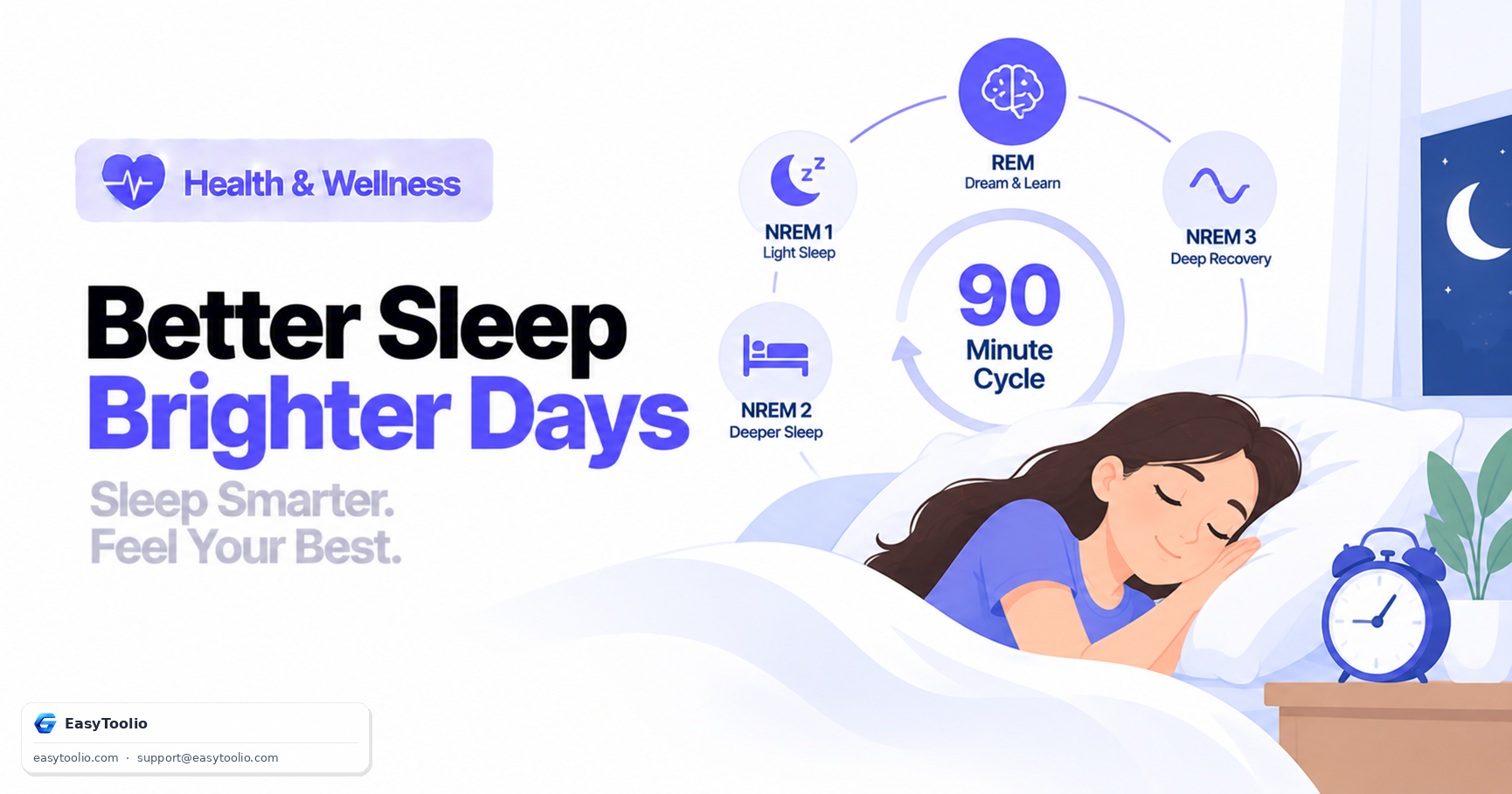
Waking up feeling exhausted despite getting eight hours of sleep is a common frustration. Waking groggy often stems not from total sleep duration alone, but from being awakened in the middle of deep slow-wave sleep. Aligning wake-up alarms with the natural boundaries of sleep cycles can reduce morning sleep inertia.
Direct Answer: Human sleep progresses through recurring ultradian sleep cycles lasting approximately 90 minutes on average (typically ranging between 70 and 110 minutes depending on individual genetics and age). Each cycle consists of Non-Rapid Eye Movement (NREM Stage 1, Stage 2, and Stage 3 Deep Sleep) followed by Rapid Eye Movement (REM) sleep. Calculating bedtimes in 90-minute increments (plus an average 14-minute sleep onset latency) provides an estimate of optimal wake times, though individual sleep architecture varies.
Health & Medical Disclaimer: Bedtime cycle calculations represent general mathematical estimates and are not medical advice. Waking calculation rules do not diagnose or treat clinical sleep disorders such as sleep apnea or chronic insomnia. Consult a board-certified sleep specialist for persistent fatigue.
1. Sleep Architecture: NREM vs REM Stages
Throughout a typical 7.5 to 9 hour sleep period, the brain cycles through distinct physiological states:
Bedtime ──► Sleep Latency (~14m) ──► Stage 1 Light ──► Stage 2 ──► Stage 3 Deep SWS ──► REM Sleep (Cycle 1 ~90m) ──► Cycle 2 ──► Wake Up
- NREM Stage 1 (Light Sleep): Transitional phase between wakefulness and sleep (1–5 minutes).
- NREM Stage 2 (Light Sleep): Heart rate and body temperature drop; brain waves show sleep spindles (45%–55% of total night).
- NREM Stage 3 (Deep / Slow-Wave Sleep - SWS): Delta brain waves dominate. Tissue repair, human growth hormone (HGH) release, and physical recovery occur primarily during early-night Stage 3 cycles.
- REM Sleep (Rapid Eye Movement): Vivid dreaming, memory consolidation, and emotional processing occur. REM periods lengthen during later cycles in the morning.
To calculate optimal bedtime and wake times based on cycle math, use the Sleep Calculator.
Approximate Stage Breakdown Across a Typical Night
For a healthy adult sleeping roughly 8 hours, sleep stages are not evenly distributed — deep sleep dominates early cycles, while REM dominates later ones. The following is an illustrative approximation, not a fixed rule:
| Sleep Stage | Approx. Share of Total Night | When It's Most Concentrated |
|---|---|---|
| NREM Stage 1 (Light) | ~5% | Scattered throughout, mainly at sleep onset |
| NREM Stage 2 (Light) | ~45%–50% | Spread across the whole night |
| NREM Stage 3 (Deep / SWS) | ~15%–20% | Concentrated in the first 2–3 cycles (early night) |
| REM Sleep | ~20%–25% | Lengthens progressively, dominant in the final 2 cycles (early morning) |
This is precisely why being woken up during a 6 AM alarm cycle interrupts REM-heavy sleep (often producing vivid, hard-to-shake dream memories), while a similar interruption at 1 AM is more likely to cut into deep Stage 3 sleep (producing heavier, more disoriented grogginess).
2. Bedtime Calculation Math & Individual Variations
A standard sleep calculation uses the following formula: Optimal Bedtime = Desired Wake Time - (N × 90 Minutes) - Sleep Latency Where $N$ is the number of completed cycles (typically 5 or 6 cycles) and Sleep Latency averages 14 minutes.
Example Target: Wake Up at 6:30 AM
- 5 Completed Cycles (7.5 Hours of Sleep): 6:30 AM - 450 Minutes - 14 Minutes = 10:56 PM Bedtime
- 6 Completed Cycles (9.0 Hours of Sleep): 6:30 AM - 540 Minutes - 14 Minutes = 9:26 PM Bedtime
Crucial Scientific Nuances:
- No Universal 90-Minute Rule: While 90 minutes is the population average, individual cycles vary from 70 to 110 minutes.
- Cycle Length Shifts: Early-night cycles feature longer Stage 3 Deep Sleep and shorter REM, whereas morning cycles feature longer REM sleep.
- Sleep Latency Varies: Falling asleep can take 5 minutes when exhausted or 30+ minutes when stressed.
Working the Formula in Reverse: From Bedtime to Wake Time
The same math works forward too — if you already know what time you're going to bed, you can calculate ideal wake times:
Optimal Wake Time = Bedtime + Sleep Latency + (N × 90 Minutes)
Example: Going to bed at 11:00 PM, add the average 14-minute sleep latency, then add 90-minute blocks:
- End of Cycle 4 (6 hours after latency): 11:00 PM + 14m + 360m ≈ 5:14 AM
- End of Cycle 5 (7.5 hours): 11:00 PM + 14m + 450m ≈ 6:44 AM
- End of Cycle 6 (9 hours): 11:00 PM + 14m + 540m ≈ 8:14 AM
Setting an alarm close to one of these cycle-boundary times, rather than at an arbitrary round number like 7:00 AM, is the core logic behind cycle-based wake-up calculators.
3. Sleep Needs by Age Group
Total sleep duration and the balance between NREM and REM sleep both shift significantly across the lifespan. The ranges below are general population guidelines, not individual prescriptions:
| Age Group | Typical Recommended Sleep Duration | Notable Architecture Difference |
|---|---|---|
| Newborns (0–3 months) | 14–17 hours | Nearly 50% REM sleep; very short, fragmented cycles (~50–60 minutes) |
| School-age Children (6–12 yrs) | 9–12 hours | Higher proportion of deep Stage 3 sleep, supporting growth and development |
| Teenagers (13–18 yrs) | 8–10 hours | Natural circadian shift toward later bedtimes ("night owl" tendency) |
| Adults (18–64 yrs) | 7–9 hours | Stable ~90-minute cycle length; 4–6 cycles per night |
| Older Adults (65+ yrs) | 7–8 hours | Lighter sleep, more nighttime awakenings, reduced deep Stage 3 sleep |
4. Factors Influencing Sleep Quality
| Factor | Physiological Impact | Recommended Action |
|---|---|---|
| Blue Light Exposure | Suppresses nocturnal melatonin secretion from pineal gland. | Avoid unshielded screens 60 minutes before bedtime. |
| Alcohol Consumption | Suppresses early-night REM sleep and causes mid-night rebound awakenings. | Stop alcohol intake 3–4 hours prior to sleep. |
| Circadian Alignment | Shift work and jet lag desynchronize suprachiasmatic nucleus (SCN) rhythm. | Maintain consistent wake times 7 days a week. |
| Caffeine Half-Life | Caffeine has an average half-life of ~5 hours; residual caffeine delays sleep latency and reduces deep sleep. | Avoid caffeine intake within 6–8 hours of bedtime. |
Travelers adjusting sleep schedules across global time zones can manage shift offsets using the Time Zone Converter, and can plan realistic hydration alongside sleep and travel routines using the water intake guide.
5. Frequently Asked Questions (FAQs)
How many sleep cycles should I aim to complete each night?
Most adults function best after 5 to 6 completed 90-minute cycles, equating to roughly 7.5 to 9 hours of total sleep. Waking at the boundary between cycles—rather than mid-cycle—is what a bedtime calculator targets, since it lets you surface from lighter NREM Stage 1 or 2 sleep instead of being pulled out of deep slow-wave sleep or REM.
Why do I sometimes feel more groggy after 8 hours of sleep than after 6?
Sleep inertia is driven primarily by which stage you're in when the alarm sounds, not total duration. Six hours of sleep that ends right at a cycle boundary (after 4 full 90-minute cycles) can produce a clearer wake-up than 8 hours that cuts off mid-cycle during Stage 3 deep sleep, when brain arousal thresholds are highest.
Is the 90-minute sleep cycle length the same for everyone?
No. Ninety minutes is a population average; individual cycles genuinely range from about 70 to 110 minutes and shift with age, genetics, and how sleep-deprived you are. This is why bedtime calculators should be treated as a mathematical starting estimate to test and fine-tune against your own morning alertness, not a fixed medical rule.
Can I "catch up" on missed deep sleep or REM sleep over the weekend?
Partially, through a process researchers call REM rebound and slow-wave sleep rebound, where the brain prioritizes recovering lost deep and REM sleep on subsequent nights. However, this compensation is incomplete — chronic sleep restriction during the week is not fully offset by extra sleep on weekends, and irregular sleep timing itself can further disrupt circadian rhythm and cycle consistency.